Palo Alto Networks Certified XSIAM Engineer — Free Practice Questions
10 free sample questions from a bank of 62, with the correct answers and explanations. No signup required — start practising right now.
- Any structured logs coming into it are left completely unchanged, and only metadata is added to the raw data.
- For structured logs, like CEF, LEEF, and JSON, it decouples the key-value pairs and saves them in table format.
- Any unstructured logs coming into it are left completely unchanged, and metadata is not added to the raw data.
- For unstructured logs, it decouples the key-value pairs and saves them in a table format.
The short version
B — structured logs are decoupled into tables. CEF, LEEF, and JSON key-value pairs land as queryable columns.
Key concepts in this question
- Structured intake: known formats with parseable pairs.
- Decoupling: pairs split into table columns for XQL.
- Unstructured contrast: free text keeps raw form plus metadata.
Why B is correct
For structured logs XSIAM decouples the key-value pairs and saves them in table format.
Why the others are wrong
- A. Structured logs are transformed, not left unchanged.
- C. Unstructured logs do gain metadata; the no-metadata claim is false.
- D. Unstructured logs lack reliable pairs to decouple.
XSIAM Engineer exam tip
Structured means decoupled to tables. Unstructured means raw plus metadata.
- XDR Collector audit logs (type = Rules, subtype = Error)
- correlations_auditing dataset through XQL
- Management audit logs (type = Rules, subtype = Error)
- Alerts table as a health alert
The short version
B and D — rule errors surface in data and as health alerts. The correlations_auditing dataset plus alerts-table health alerts are the two watchpoints.
Key concepts in this question
- correlations_auditing dataset: XQL-visible rule execution errors.
- Health alerts: rule failures raised into the alerts table.
- Wrong logs: collector and management audit trails track other events.
Why B and D are correct
- B. The correlations_auditing dataset exposes correlation errors to XQL.
- D. Failing rules raise health alerts visible in the alerts table.
Why the others are wrong
- A. Collector audit logs cover collection, not rule errors.
- C. Management audit logs record admin actions, not rule errors.
XSIAM Engineer exam tip
Rule-error drill: dataset for detail, alerts table for alarm. Logs never judge rules.
- Free text/number
- Multi-select
- Fixed filter
- Single-select
The short version
B — multiple dynamic values need Multi-select. One widget control then filters on several chosen values.
Key concepts in this question
- Multi-select: dynamic control accepting several values.
- Single-select: exactly one dynamic value.
- Fixed filter: static preset values, never dynamic.
Why B is correct
Displaying data filtered by more than one dynamic value is the Multi-select use case.
Why the others are wrong
- A. Free text/number takes one ad-hoc entry, not multi-dynamic filtering.
- C. Fixed filters are static by definition.
- D. Single-select caps at one dynamic value.
XSIAM Engineer exam tip
More-than-one dynamic means Multi-select. One means Single, none-means Fixed.
- In a different region than Cortex XSIAM; logs can be verified using pan_dss_raw dataset
- In a different region than Cortex XSIAM; logs can be verified using endpoints dataset
- In the same region as Cortex XSIAM; logs can be verified using pan_dss_raw dataset
- In the same region as Cortex XSIAM; logs can be verified using endpoints dataset
The short version
C — same region plus pan_dss_raw verification. The engine pairs with the tenant region and proves flow in the DSS dataset.
Key concepts in this question
- Regional pairing: engine and tenant share a region.
- Verification dataset: pan_dss_raw shows the engine logs.
- Endpoints contrast: agent data lives elsewhere.
Why C is correct
Cloud Identity Engine deploys in the same region as XSIAM with logs verifiable in pan_dss_raw.
Why the others are wrong
- A. Cross-region deployment breaks the pairing requirement.
- B. Cross-region deployment plus the wrong dataset doubly fails.
- D. Endpoints dataset carries agent data, not engine logs.
XSIAM Engineer exam tip
Identity engine rule: same region, DSS dataset. Region mismatch blinds a geography.
- Data source is using an unsupported data format.
- Data source has reached its maximum storage capacity.
- Data source has reached its end of life for support.
- API key used for the integration has expired.
The short version
D — expired API keys kill working feeds instantly. Yesterday's success plus today's silence points at credentials.
Key concepts in this question
- Sudden-loss signature: was-fine-now-dark implicates secrets, not formats.
- API key expiry: silent auth death on a schedule.
- Slow deaths: capacity, lifecycle, and format issues never strike suddenly on healthy feeds.
Why D is correct
An expired integration API key abruptly stops ingestion from a previously successful source.
Why the others are wrong
- A. Unsupported formats fail from day one, never suddenly later.
- B. Sources do not fill storage caps that cut feeds this way.
- C. End-of-life is announced and gradual, not a sudden cut.
XDR Engineer exam tip
Was-working-now-dark means check secrets first: keys, tokens, passwords.
- Scripts
- Parsing rules
- Lists
- Layouts
The short version
A and D — scripts and layouts travel the remote repo. Code plus presentation sync between dev tenants and production.
Key concepts in this question
- Remote repository: versioned content sync for XSIAM objects.
- Pushable pair: scripts and layouts.
- Local-only: parsing rules and lists stay out of this flow.
Why A and D are correct
- A. Scripts can be pushed to or pulled from the remote repository.
- D. Layouts can be pushed to or pulled from the remote repository.
Why the others are wrong
- B. Parsing rules are not the repo-traveling objects here.
- C. Lists are not the repo-traveling objects here.
XSIAM Engineer exam tip
Repo pair is scripts plus layouts. Data-plane objects never ride along.
- Disable the breakpoint and rerun the playbook from the start.
- Skip the task with the breakpoint to let the playbook proceed automatically.
- Wait for all parallel tasks to be completed before the breakpoint task resumes automatically.
- Click Run Script Now or Complete Manually.
The short version
B and D — skip it or finish it by hand. Non-manual breakpoints resume via task skip or manual run/complete.
Key concepts in this question
- Breakpoint pause: execution halts for inspection.
- Skip path: bypass the task and proceed automatically.
- Manual path: run-now or complete-manually pushes past.
Why B and D are correct
- B. Skipping the breakpoint task lets the playbook proceed automatically.
- D. Run Script Now or Complete Manually pushes past the breakpoint.
Why the others are wrong
- A. Disabling plus full rerun restarts everything; it does not continue.
- C. Parallel-task waiting never releases a breakpoint.
XSIAM Engineer exam tip
Breakpoint release is skip or hand-finish. Restarts and waits never resume.
- To periodically rotate encryption keys used for tenant communication
- To perform administration on agents without requiring static credentials
- To authorize agents to download and install content updates
- To temporarily disable the agents during maintenance windows
The short version
B — rolling tokens remove static credentials. Agent administration proceeds without stored secrets.
Key concepts in this question
- Rolling tokens: short-lived rotating auth for agent ops.
- Static-credential risk: long-lived secrets leak and linger.
- Non-purposes: key rotation, content auth, and maintenance modes differ.
Why B is correct
Rolling tokens exist so administration runs without requiring static credentials.
Why the others are wrong
- A. Tenant channel encryption keys rotate elsewhere.
- C. Content-update authorization follows a different mechanism.
- D. Maintenance windows disable nothing via tokens.
XSIAM Engineer exam tip
Token purpose is credentialless admin. Key rotation and updates live elsewhere.
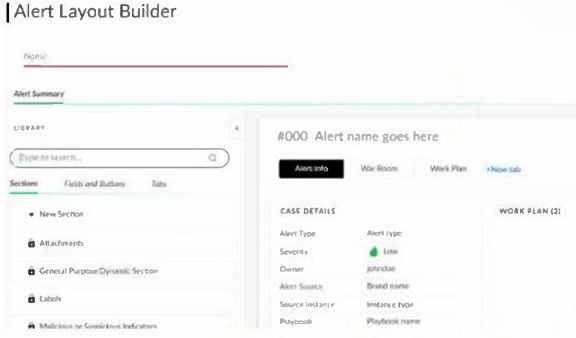
- Only "Alert Info" tab can be removed.
- Only "Alert Info" and "War Room" tabs can be removed.
- Only "War Room" and "Work Plan" tabs can be removed.
- Only "Work Plan" tab can be removed.
The short version
A — only the Alert Info tab is removable. War Room and Work Plan are structural tabs the layout keeps.
Key concepts in this question
- Alert Info tab: the customizable removable tab.
- Structural tabs: War Room and Work Plan persist by design.
- Vote backing: 10-to-1 community agreement with the banked key.
Why A is correct
When creating a new alert layout, only the Alert Info tab can be removed.
Why the others are wrong
- B. War Room cannot be removed alongside Alert Info.
- C. Neither War Room nor Work Plan is removable.
- D. Work Plan cannot be removed.
XSIAM Engineer exam tip
Layout surgery touches Alert Info only. War Room and Work Plan are load-bearing.
- If no reputation integration instance is configured, the '!ip' command will execute but will return no results.
- Reputation commands such as '!ip' will fail if the required reputation integration instance is not configured and enabled.
- The mapping flow for enrichment commands is disabled if extraction is set to "None."
- Enrichment data will not be saved to the indicator unless the extraction setting is manually configured in the playbook task.
The short version
B — reputation commands die without their instance. No configured and enabled integration means the !ip call fails.
Key concepts in this question
- Reputation dependency: commands need a live integration instance.
- Fail-closed: missing instance fails the command, never empty-results it.
- Mapping/extraction: separate enrichment plumbing, unaffected here.
Why B is correct
Reputation commands such as !ip fail when the required reputation integration instance is not configured and enabled.
Why the others are wrong
- A. The command does not run empty; it fails outright.
- C. Extraction settings do not gate command execution.
- D. Saving enrichment is unrelated to the failure mode.
XSIAM Engineer exam tip
Reputation command failed? Check the integration instance first, the playbook second.
Want the full bank of 62 questions for Palo Alto Networks Certified XSIAM Engineer? See all practice exams.