Palo Alto Networks Certified XSIAM Analyst — Free Practice Questions
10 free sample questions from a bank of 54, with the correct answers and explanations. No signup required — start practising right now.
- dataset = pan_dss_raw
- dataset = ngfw_threat_panw_raw
- dataset = panw_ngfw_traffic_raw
- dataset = ngfw*
The short version
C — NGFW traffic lives in panw_ngfw_traffic_raw. The traffic-log dataset is the analyst search target.
Key concepts in this question
- Traffic dataset: firewall session logs by name.
- DSS contrast: data-services dataset serves other sources.
- Wildcard myth: dataset names are exact, never globbed.
Why C is correct
Palo Alto Networks NGFW traffic logs are searched in dataset panw_ngfw_traffic_raw.
Why the others are wrong
- A. pan_dss_raw carries data-services logs, not NGFW traffic.
- B. The threat-log dataset covers threats, not the traffic ask.
- D. Wildcard dataset references are not valid XQL.
XSIAM Analyst exam tip
Traffic questions name panw_ngfw_traffic_raw. DSS names answer other sources.
- The file retrieval policy applied to the endpoints may restrict access to certain system or kernel files.
- The retrieval process is limited to 500 MB in total file size.
- The endpoint agents were in offline mode during the file retrieval process, causing some files to be skipped.
- The analyst must manually retrieve kernel files by accessing the machine directly.
The short version
A — retrieval policies gate system files. Kernel and protected files fall outside the allowed retrieval scope.
Key concepts in this question
- Retrieval policy: per-endpoint file-access scope.
- Kernel exclusion: system files restricted by default.
- Size/offline myths: no 500MB cap and no silent offline skips explain this.
Why A is correct
The applied file retrieval policy restricts access to certain system or kernel files, leaving the list incomplete.
Why the others are wrong
- B. No 500MB total retrieval cap causes this pattern.
- C. Offline agents queue rather than silently skip listed files.
- D. Direct machine access is unnecessary; policy is the gate.
XSIAM Analyst exam tip
Incomplete retrieval means check the retrieval policy first, plumbing second.
- Playbook triggers were not configured for those alerts.
- Installation of the appropriate content pack was not completed.
- Misconfiguration of the connector instance has occurred.
- Playbook classifier was not configured for the alert type.
The short version
A — suggested but silent means triggers missing. Without alert-bound triggers, suggested playbooks never fire.
Key concepts in this question
- Playbook triggers: the alert conditions that launch automation.
- Suggestion vs execution: recommendation engines propose; triggers dispose.
- Pack/connector contrast: content and plumbing exist already here.
Why A is correct
Playbook triggers were never configured for those alerts, so nothing executed automatically.
Why the others are wrong
- B. Missing packs would hide suggestions too, yet suggestions appeared.
- C. Connector faults break actions, not the decision to run.
- D. Classifiers type incidents; they gate no playbook launch.
XSIAM Analyst exam tip
Suggested-but-silent always means triggers. Check the trigger binding first.
- From XQL Search, locate the query to save to a personal Query Library Right-click, and select "Save query to library" Enable the "Share with others" option
- From the Query Center, in the XQL query field, define the parameters of the query Save as, and choose the "Query to Library" option Enable the "Share with others" option
- From XQL Search, in the XQL query field, define the parameters of the query Save as, and choose the "Query to Library" option Enable the "Share with others" option
- From the Query Center, locate the query to save to a personal Query Library Right-click, and select "Save query to library" Enable the "Share with others" option
The short version
B and C — share via save-as Query-to-Library with sharing on. Both the Query Center and XQL Search paths converge on that flow.
Key concepts in this question
- Save-as flow: define, save-as, choose Query to Library.
- Share toggle: Enable Share with others publishes it.
- Right-click myth: personal-library right-click is not the share path.
Why B and C are correct
- B. The Query Center save-as path with sharing enabled creates and shares.
- C. The XQL Search save-as path with sharing enabled creates and shares.
Why the others are wrong
- A. Right-click saving to a personal library shares nothing.
- D. Right-click saving to a personal library shares nothing.
XSIAM Analyst exam tip
Share means save-as plus the share toggle. Right-clicks stay personal.
- cytool security enable
- cytool service start
- cytool runtime start
- cytool protect enable
The short version
C — paused protection resumes with runtime start. The cytool runtime verb re-arms the agent.
Key concepts in this question
- Runtime control: stop/start toggles live protection.
- Verb precision: runtime start is the documented resume.
- Service contrast: service verbs manage daemons, not protection state.
Why C is correct
cytool runtime start re-enables protection on the paused endpoint.
Why the others are wrong
- A. Security enable is not the documented resume verb.
- B. Service start manages the service, not paused protection.
- D. Protect enable is not the documented resume verb.
XSIAM Analyst exam tip
Pause and resume are runtime verbs: stop to pause, start to re-arm.
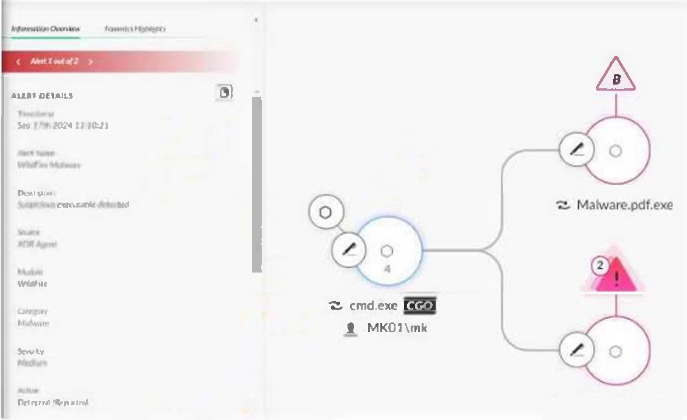
- Three alerts in total were generated by the agent on the endpoint.
- Cortex XDR agent malware profile module applied is set to "Report" mode.
- Malware.pdf.exe is responsible for the entire chain of execution resulting in the alerts.
- The process cmd.exe is responsible for the entire chain of execution resulting in the alerts.
Selected Answer: C A is actually the only incorrect response. B-D would all work but C is best suited. upvoted 1 times Thomahawk7 months, 2 weeks ago Selected Answer: C C is the answer upvoted 2 times Topic 1
- Add the C-level executive users to the Executive Accounts asset role.
- Add a tag to the C-level executive users.
- Create a Featured Alert field for the C-level hosts.
- Create a dynamic group for the C-level hosts.
The short version
C — executive hosts get a Featured Alert field. The field surfaces their alerts to analysts.
Key concepts in this question
- Featured fields: high-visibility alert attributes.
- Host scoping: C-level machines as the field population.
- Role/tag contrast: asset roles and tags organize; fields highlight.
Why C is correct
A Featured Alert field for the C-level hosts highlights their alerts.
Why the others are wrong
- A. Asset roles group; they highlight no alerts.
- B. User tags label; they surface no alert queue.
- D. Dynamic groups collect; they highlight no alerts.
XSIAM Analyst exam tip
Highlight means featured field. Grouping and tagging only organize.
- Rare process execution in organization
- Suspicious admin account creation
- WildFire Malware
- Suspicious AMSI DLL load location
The short version
A — the first alert births the incident. Rare process execution at 10:24:17 opened it; the rest joined.
Key concepts in this question
- Creation rule: earliest alert forms the incident.
- Join rule: later alerts attach to the open case.
- Severity myth: highest severity does not retro-found cases.
Why A is correct
The 10:24:17 Informational alert was first, so it created the incident.
Why the others are wrong
- B. The later high-severity correlation joined; it founded nothing.
- C. The WildFire alert joined second-to-last.
- D. The AMSI alert joined second.
XSIAM Analyst exam tip
Who-created-it means earliest timestamp. Severity never outranks time.
- An asset attributed to the organization because the Subject Organization field contains the company name
- An asset attributed to the organization because the name server domain contains the company domain
- An asset discovered through registration information attributed to the organization
- An asset manually approved by a Cortex Xpanse analyst
The short version
A — org-name matches carry the lowest confidence. Subject-organization text is the weakest attribution signal.
Key concepts in this question
- Evidence ladder: analyst approval tops, name text trails.
- Nameserver/registration: infrastructure signals outrank bare names.
- Manual approval: human-vetted gold standard.
Why A is correct
Subject-Organization name matching is the lowest-confidence attack-surface evidence.
Why the others are wrong
- B. Nameserver-domain matches outrank bare org names.
- C. Registration discovery outranks bare org names.
- D. Analyst approval is the highest confidence, not the lowest.
XSIAM Analyst exam tip
Confidence climbs: name text, infrastructure signals, human approval.
- Security
- Hunting
- IT
- Health
The short version
C — internal vuln scanning lands in IT. Hygiene operations type their own domain.
Key concepts in this question
- IT domain: operational hygiene alerts and incidents.
- Security contrast: adversary activity, not self-scanning.
- Health contrast: platform wellness, not scan findings.
Why C is correct
Alerts from internal vulnerability scanning are assigned the built-in IT incident domain.
Why the others are wrong
- A. Security hosts threat activity, not own-team scanning.
- B. Hunting hosts analyst-driven quests, not scanner output.
- D. Health hosts platform state, not scan findings.
XSIAM Analyst exam tip
Self-scan noise is IT-domain by design. Threats never share its roof.
Want the full bank of 54 questions for Palo Alto Networks Certified XSIAM Analyst? See all practice exams.