Splunk Enterprise Certified Admin (SPLK-1003) — Free Practice Questions
10 free sample questions from a bank of 255, with the correct answers and explanations. No signup required — start practising right now.
- maxDaysToKeep
- moveToFrozenAfter
- maxDataRetentionTime
- frozenTimePeriodInSecs
The short version
D — time-based retention uses frozenTimePeriodInSecs. The settled key names the indexes.conf setting that ages buckets to frozen.
Key concepts in this question
- Bucket lifecycle: hot to warm to cold to frozen as data ages and rolls.
- Time control: frozenTimePeriodInSecs defines seconds before indexed data rolls to frozen.
- Size and count contrast: max total and volume settings limit disk use, not age.
- Cold-to-frozen contrast: moveToFrozenAfter and related paths handle location, still driven by time setting.
- Retention goal: compliance windows expressed in days convert directly to seconds in this setting.
Why D is correct
D is correct because Splunk documents frozenTimePeriodInSecs in indexes.conf as the control for retention by time, defaulting to six years when unset. When age exceeds the value, buckets roll to frozen for archival or deletion. Admin slides list it among core indexes.conf retention options.
Why the others are wrong
- A. maxDaysToKeep is not the credited indexes.conf time control here.
- B. moveToFrozenAfter is a legacy or path nuance, not the settled time setting.
- C. maxDataRetentionTime is not the documented time-retention attribute.
SPLK-1003 exam tip
For retention by time think frozenTimePeriodInSecs in seconds, not days.
- $SPLUNK_HOME/etc/apps
- $SPLUNK_HOME/etc/search
- $SPLUNK_HOME/etc/master-apps
- $SPLUNK_HOME/etc/deployment-apps
The short version
D — deployment clients pull from etc/deployment-apps. The settled key isolates the server-side distribution directory.
Key concepts in this question
- Deployment server role: central host that pushes apps and configs to forwarders and clients.
- deployment-apps purpose: staging area whose content is packaged for defined server classes.
- etc/apps contrast: local installed apps for that Splunk instance, not distribution source.
- etc/search contrast: search-head knowledge objects, not forwarder deployment content.
- master-apps contrast: legacy manager terminology, not the current deployment path.
Why D is correct
D is correct because Splunk requires deployable content to reside in SPLUNK_HOME slash etc slash deployment-apps on the deployment server. Clients assigned through server classes pull that content on phone-home. Documentation confirms this directory as the pull source.
Why the others are wrong
- A. etc/apps holds local instance apps, not deployment staging.
- B. etc/search is search-time knowledge, not deployment distribution.
- C. etc/master-apps reflects outdated naming and is not credited.
SPLK-1003 exam tip
Deploy equals deployment-apps: stage there, map with server class, clients pull.
- SEDCMD-1acct = s/VendorID=\d{3}(\d{4})/VendorID=xxx/g
- SEDCMD-xxxAcct = s/AcctID=\d{3}(\d{4})/AcctID=xxx/g
- SEDCMD-1acct = s/AcctID=\d{3}(\d{4})/AcctID=\1xxx/g
- SEDCMD-1acct = s/AcctID=\d{3}(\d{4})/AcctID=xxx\1/g
The short version
D — mask with s pattern plus xxx before backreference one. The settled key preserves the last four digits while hiding the first three.
Key concepts in this question
- SEDCMD function: props.conf regex that rewrites raw text at parse time before indexing.
- Capture group: parentheses around four digits create group one for reuse as backreference.
- Replacement order: xxx plus backreference keeps suffix visible and masks prefix.
- Field targeting: AcctID pattern must match the account field, not VendorID.
- Output contract: AcctID equals xxx5309 proves prefix masked and suffix retained.
Why D is correct
D is correct because s slash AcctID equals digits-three plus group of four slash AcctID equals xxx plus group-one replaces only the first three digits with xxx and reinserts the captured last four. That yields exactly xxx5309 from the sample event. Reversed order or wrong field would corrupt the required output.
Why the others are wrong
- A. targets VendorID instead of AcctID and masks the wrong field.
- B. replaces the whole match with xxx and drops the captured suffix.
- C. places group before xxx, producing digits plus xxx instead of xxx plus digits.
SPLK-1003 exam tip
Mask prefix keep suffix means xxx then backreference one in replacement.
- It requires a separate channel provided by the client.
- It is configured the same as indexer acknowledgement used to protect in-flight data.
- It can be enabled at the global setting level.
- It stores status information on the Splunk server.
The short version
A — HEC indexer acknowledgement needs a separate client channel. The settled key distinguishes token channels for reliable delivery.
Key concepts in this question
- HTTP Event Collector purpose: token-based HTTP ingestion for application events.
- Indexer acknowledgement: confirms indexed persistence before the sender discards data.
- Channel requirement: a unique channel identifier per client enables per-sender ack tracking.
- Global-setting contrast: HEC acks are managed per token and channel, not one global switch.
- Storage contrast: status lives with the sender workflow, not as server-side stored state alone.
Why A is correct
A is correct because Splunk HEC with indexer acknowledgement requires the client to supply a separate channel GUID so the indexer can track which events that sender has had acknowledged. Without distinct channels, acks for multiplexed senders cannot be reconciled. The settled key credits this channel requirement as the defining trait.
Why the others are wrong
- B. HEC ack setup differs from classic forwarder ack and is not configured the same.
- C. it cannot be enabled purely at the global setting level in this model.
- D. storing status on the server alone does not describe the client-channel mechanism.
SPLK-1003 exam tip
HEC ack equals channel: no channel, no per-client acknowledgement.
- Navigate to Settings > Server Settings > General Settings, and set an App server port.
- Navigate to Settings > Forwarding and receiving, and click on Enable Forwarding.
- Create a server class and map it to a client in SPLUNK_HOME/etc/system/local/serverclass.conf.
- Place an app in the SPLUNK_HOME/etc/deployment-apps directory of the deployment server.
The short version
D — activation needs an app in deployment-apps on the server. The settled key treats content presence as the enablement trigger.
Key concepts in this question
- Forwarder management goal: use Splunk Web deployment-server UI to push configs to clients.
- Activation condition: placing at least one app in deployment-apps turns the host into an active server.
- Server class mapping: links deployment-apps content to client URIs for targeted delivery.
- Settings-page contrast: server and forwarding pages tune ports, not activation state.
- Enable-forwarding contrast: starts forwarding on a forwarder, not server management capability.
Why D is correct
D is correct because Splunk documentation states the deployment server activates once an app exists in etc slash deployment-apps, such as the send-to-indexer app. Splunk Web then exposes forwarder management for server classes. Without staged content, there is nothing to manage and activation does not occur.
Why the others are wrong
- A. app server port tunes web services but does not enable management.
- B. Enable Forwarding starts forwarder output, not server-side management.
- C. creating a class alone without staged app content is insufficient.
SPLK-1003 exam tip
No app in deployment-apps equals no deployment server: stage one first.
- Breaks data into events with timestamps.
- Applies event-level transformations.
- Fine-tunes metadata.
- Performs character encoding.
The short version
D — the input phase performs character encoding. The settled key places byte-to-text handling at the pipeline start.
Key concepts in this question
- Splunk pipeline order: input, parsing, indexing, and search-time processing.
- Input duties: consume bytes from sources and normalize character encoding.
- Parsing contrast: breaks streams into events, stamps time, and applies line rules.
- Transformation contrast: event-level enrichments and metadata tuning happen after event creation.
- Admin-course anchor: data-admin material lists encoding under input phase responsibilities.
Why D is correct
D is correct because the input phase must interpret source bytes as text through character-encoding handling before events can be formed. That early normalization prevents mojibake downstream. Vendor course notes confirm encoding as the input-phase item among the choices.
Why the others are wrong
- A. breaking into events with timestamps belongs to the parsing phase.
- B. event-level transformations occur after parsing, not at input.
- C. fine-tuning metadata is later enrichment, not initial input work.
SPLK-1003 exam tip
Pipeline start equals bytes to text: input does encoding, parsing does events.
- source, host, time
- time, sourcetype, source
- host, raw, sourcetype
- sourcetype, source, host
The short version
D — index-time metadata is sourcetype, source, and host. The settled key lists the three routing and classification fields.
Key concepts in this question
- Metadata role: describes origin and type so Splunk can route, parse, and search efficiently.
- Sourcetype meaning: format classifier that selects parsing rules for the data.
- Source meaning: file, port, or feed path identifying where the event came from.
- Host meaning: device or forwarder identity used for filtering and topology.
- Time and raw contrast: timestamp aids ordering while raw is content, not the credited trio member here.
Why D is correct
D is correct because Splunk documentation defines source, sourcetype, and host as core metadata assigned at input and index time. That trio travels with every event for access control and search. Reference pages confirm D while excluding time and raw from this particular metadata set.
Why the others are wrong
- A. includes time instead of sourcetype and misses the settled trio.
- B. includes time instead of host and breaks the credited set.
- C. includes raw content instead of source and host pairing.
SPLK-1003 exam tip
Memorize metadata trio as three S-H words: source, sourcetype, host.
- \r\n
- ([\r\n]+)
- \r+\n+
- (\r\n+)
The short version
B — default LINE_BREAKER matches any newline run. The settled key cites the parenthesized character class for event splitting.
Key concepts in this question
- LINE_BREAKER role: regex in props.conf that finds boundaries where raw streams split into events.
- Default pattern: open-paren plus bracket with carriage-return and newline plus close-paren for one-or-more.
- Cross-platform need: Windows CRLF, Unix LF, and old Mac CR must all split correctly.
- Narrow patterns contrast: single-sequence forms miss mixed line endings and merge events.
- Docs anchor: configure-event-line-breaking page states the default explicitly.
Why B is correct
B is correct because Splunk defaults LINE_BREAKER to any sequence of carriage returns and newlines, covering LF, CRLF, and repeated blanks. That tolerant pattern prevents event merging across operating systems. Documentation confirms B as the out-of-box value.
Why the others are wrong
- A. bare CRLF misses lone LF and repeated breaks.
- C. plus-heavy variant is not the documented default form.
- D. unbalanced grouping is not the credited default expression.
SPLK-1003 exam tip
Default breaker equals any newline run in parentheses and brackets.
- [monitor:///var/log/.../secure.*]
- [monitor:///var/log/www1/secure.*]
- [monitor:///var/log/www1/secure.log]
- [monitor:///var/log/www/secure.]
The short version
A — recursive ellipsis plus suffix wildcard matches all four paths. The settled key uses triple-dot traversal for monitor stanzas.
Key concepts in this question
- Ellipsis wildcard: triple dots recurse through any directory depth under var log.
- Asterisk scope: trailing star matches within one path segment, ideal for secure dot-star suffixes.
- Coverage need: www1, www, nested logs, and www2 variants must all be captured.
- Single-directory contrast: www1-only stanza misses peer and nested directories.
- Partial-wildcard contrast: www star still fails to descend into deeper logs nesting.
Why A is correct
A is correct because monitor with ellipsis slash secure dot star recurses from var log through every subdirectory and matches any secure-prefixed file. That covers secure.log, secure.l, and secure.logs across all listed depths. Docs confirm ellipsis recurses while single star stays in one segment, making A uniquely complete.
Why the others are wrong
- B. www1-only path misses www and www2 trees entirely.
- C. single-file stanza matches one log and ignores siblings.
- D. www star stays shallow and misses nested logs subdirectory.
SPLK-1003 exam tip
Need every depth plus suffix match, choose ellipsis plus secure dot star.
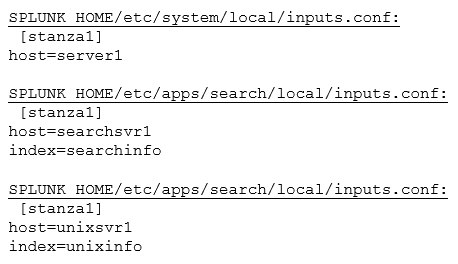
- host=server1 index=unixinfo
- host=server1 index=searchinfo
- host=searchsvr1 index=searchinfo
- host=unixsvr1 index=unixinfo
The short version
B — stanza1 resolves to server1 plus searchinfo by precedence. The settled key applies Splunk configuration layering to host and index.
Key concepts in this question
- Precedence order: system local outranks app local, which outranks app default, then system default.
- Host resolution: server1 from higher-precedence local config wins over broader defaults.
- Index resolution: searchinfo from the winning scope applies at index time for the stanza.
- Lexicographic nuance: same-tier app files resolve alphabetically before falling back.
- Index-time effect: resolved values stamp every event through that input stanza.
Why B is correct
B is correct because applying index-time precedence to the given files promotes host server1 and index searchinfo as the effective values for stanza1. Lower layers suggesting alternate hosts or unixinfo are overridden. Vendor precedence list confirms system local first, yielding the B pairing.
Why the others are wrong
- A. unixinfo loses to the higher-precedence searchinfo for this stanza.
- C. alternate searchsvr host does not win under precedence rules.
- D. unixsvr plus unixinfo reflects overridden lower-layer values.
SPLK-1003 exam tip
Resolve conflicts top-down: system local, app local, app default, system default.
Want the full bank of 255 questions for Splunk Enterprise Certified Admin (SPLK-1003)? See all practice exams.