CompTIA PenTest+ (PT0-003) — Free Practice Questions
10 free sample questions from a bank of 608, with the correct answers and explanations. No signup required — start practising right now.
- tcprelay
- Bluecrack
- Scapy
- tcpdump
The short version
C — C builds custom packets correctly. Scapy crafts custom flags plus sequence numbers. Scapy is a packet-manipulation library that lets testers construct, send, and receive frames with arbitrary flags, sequence numbers, and payloads for probe and exploit validation.
Key concepts in this question
- Crafting need: Testing vulnerable stacks needs control over header fields that normal sockets do not expose.
- Scapy role: Scapy exposes layers and fields as scriptable objects plus send-receive loops for custom exchanges.
- Capture contrast: Sniffers observe wire traffic but cannot forge new flag and sequence combinations.
Why C is correct
Scapy is a packet-manipulation library that lets testers construct, send, and receive frames with arbitrary flags, sequence numbers, and payloads for probe and exploit validation. Tcprelay replays traffic, Bluecrack targets Bluetooth PINs, and tcpdump only captures and displays packets. The settled key therefore follows tool-capability mapping for custom packet crafting.
Why the others are wrong
- A. names tcprelay, which relays or replays existing flows rather than forging arbitrary flag sequences.
- B. names Bluecrack, which attacks Bluetooth pairing rather than general IP packet crafting.
- D. names tcpdump, which captures and filters traffic without generating custom packets.
PT0-003 exam tip
Hear custom flags plus sequence numbers and pick Scapy.
- The tester is conducting a web application test.
- The tester is assessing a mobile application.
- The tester is evaluating a thick client application.
- The tester is creating a threat model.
The short version
D — D chooses threat modeling over test phases correctly. DREAD rates threats while PTES structures test phases. DREAD scores Damage, Reproducibility, Exploitability, Affected users, and Discoverability to rank threats during threat modeling, which is the planning activity that benefits from such scoring.
Key concepts in this question
- DREAD use: DREAD quantifies threat severity to prioritize mitigations identified in modeling.
- PTES use: PTES organizes pre-engagement, intelligence, vulnerability, exploitation, and reporting phases.
- Planning fit: Creating a threat model needs a scoring scheme, which DREAD supplies and PTES does not.
Why D is correct
DREAD scores Damage, Reproducibility, Exploitability, Affected users, and Discoverability to rank threats during threat modeling, which is the planning activity that benefits from such scoring. PTES defines penetration-test phases and execution steps rather than a risk-rating model. Web, mobile, or thick-client scope does not decide between them, so the settled key follows framework-purpose mapping for planning.
Why the others are wrong
- A. ties the choice to web testing, but test target type does not select a threat-scoring model over a methodology.
- B. ties the choice to mobile scope, which likewise does not determine rating versus phase needs.
- C. ties the choice to thick-client scope, which is orthogonal to threat-model scoring selection.
PT0-003 exam tip
Link threat model plus scoring to DREAD and test phases to PTES.
- VM
- IAST
- DAST
- SCA
The short version
D — D finds vulnerable libraries with composition analysis correctly. software composition analysis inventories open-source libraries. Software Composition Analysis scans manifests and binaries to inventory third-party and open-source components plus known vulnerabilities in them.
Key concepts in this question
- Manifest inventory: SCA parses lockfiles and fingerprints to list library names and versions in use.
- Vuln correlation: Inventoried versions are matched to CVE feeds to flag vulnerable open-source inclusion.
- Review timing: Security reviews catch outdated libraries before release without needing exploitation.
Why D is correct
Software Composition Analysis scans manifests and binaries to inventory third-party and open-source components plus known vulnerabilities in them. VM tracks host flaws, IAST instruments running code, and DAST probes live behaviour, but only SCA answers which library versions are embedded. The settled key therefore follows review-tool mapping for supply-chain checks.
Why the others are wrong
- A. names VM, which assesses infrastructure patching rather than application library composition.
- B. names IAST, which observes running code paths but is not the library-inventory approach.
- C. names DAST, which attacks the running app externally instead of enumerating embedded libraries.
PT0-003 exam tip
Hear vulnerable open-source libraries and choose SCA.

- Drop all excessive file permissions with chmod o-rwx.
- Ensure the requests application access logs are reviewed frequently.
- Disable the use of external entities.
- Implement a WAF to filter all incoming requests.
The short version
C — C prevents entity-driven passwd disclosure correctly. disabling external entities blocks XXE file disclosure. Returning etc passwd content after a crafted payload indicates XML external entity injection, where the parser resolves an external file reference.
Key concepts in this question
- XXE primitive: External entities let XML parsers include local files whose content is reflected in responses.
- Parser hardening: Disabling DTDs and external access removes the feature rather than blocking single payloads.
- Defense depth: Permissions and WAF add layers but cannot substitute for disabling unsafe parsing.
Why C is correct
Returning etc passwd content after a crafted payload indicates XML external entity injection, where the parser resolves an external file reference. Disabling external entity processing and DTDs stops the parser from reading local files, which is the definitive fix. Permission tightening, log reviews, and WAF filtering reduce impact or detect attempts but do not remove the parser primitive, so the settled key follows remediation hierarchy.
Why the others are wrong
- A. drops file permissions, which may hide one file but leaves the entity mechanism exploitable elsewhere.
- B. reviews access logs frequently, which detects after the fact instead of preventing disclosure.
- D. adds a WAF filter, which can be bypassed with encoding while the parser stays vulnerable.
PT0-003 exam tip
Map passwd via XML payload to disable external entities as the fix.
- Shoulder surfing
- Recon-ng
- Social media
- Password dumps
The short version
C — C starts phishing recon with social media correctly. social media yields first targeting data for spear phishing. With spear phishing authorized, the first campaign step is open-source target research on social media to learn roles, relationships, and lures for believable messages.
Key concepts in this question
- Target modeling: Effective spear phish needs names, duties, and recent events to craft credible pretexts.
- OSINT source: Social platforms expose org charts, projects, and tone that shape lure selection.
- Sequence logic: Broad OSINT precedes tool-driven harvesting and payload crafting in campaign order.
Why C is correct
With spear phishing authorized, the first campaign step is open-source target research on social media to learn roles, relationships, and lures for believable messages. Shoulder surfing needs physical proximity, Recon-ng is a later harvesting framework, and password dumps assume prior compromise. The settled key therefore follows recon sequencing that begins with public profile analysis.
Why the others are wrong
- A. starts with shoulder surfing, which is opportunistic physical observation, not scalable campaign recon.
- B. starts with Recon-ng, which automates harvesting after initial targeting direction is set.
- D. starts with password dumps, which require a breach that recon is meant to enable, not assume.
PT0-003 exam tip
Start authorized phishing with social media profiling before tooling.
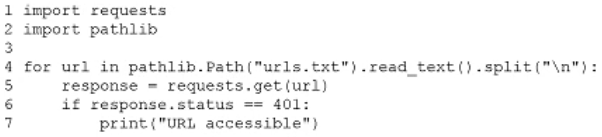
- The condition on line 6
- The method on line 5
- The import on line 1
- The delimiter in line 3
The short version
A — A fixes the URL-check condition correctly. line 6 condition mishandles public-access determination. For bulk URL public-access testing, the settled key identifies the condition on line 6 as the required change, meaning the status or content test misclassifies accessible versus blocked responses.
Key concepts in this question
- Bulk pattern: Looping many URLs needs a precise success predicate, often status code plus content marker.
- Condition role: Line 6 gates the pass-fail label, so an off-by-one comparison or wrong operator corrupts all results.
- Support lines: Import, request method, and delimiter enable the loop but do not determine access semantics.
Why A is correct
For bulk URL public-access testing, the settled key identifies the condition on line 6 as the required change, meaning the status or content test misclassifies accessible versus blocked responses. Method, import, and delimiter lines support fetching and parsing but do not decide the access verdict. Correcting the conditional logic therefore restores accurate bulk classification.
Why the others are wrong
- B. changes the method on line 5, which would alter request type rather than fixing the access decision test.
- C. changes the import on line 1, which affects library availability, not per-URL verdict logic.
- D. changes the delimiter on line 3, which affects parsing of input lists rather than access evaluation.
PT0-003 exam tip
When bulk checks mislabel, inspect the verdict condition first.
- Golden Ticket
- Kerberoasting
- DCShadow
- LSASS dumping
The short version
B — B links SPN data to Kerberoasting correctly. SPN capture enables Kerberoasting of service tickets. Capturing Service Principal Name account details lets the tester request service tickets and attempt offline cracking of the service password hash, which is Kerberoasting.
Key concepts in this question
- SPN role: SPNs map services to accounts whose ticket encryption derives from the account password.
- Kerberoasting flow: Requesting a service ticket yields crackable material without contacting the service account directly.
- Prerequisite fit: SPN enumeration is the specific gate before Kerberoasting can proceed at scale.
Why B is correct
Capturing Service Principal Name account details lets the tester request service tickets and attempt offline cracking of the service password hash, which is Kerberoasting. Golden Ticket forges domain trust tickets, DCShadow registers rogue domain controllers, and LSASS dumping extracts local secrets, each with different prerequisites. The settled key therefore follows Active Directory attack chaining.
Why the others are wrong
- A. names Golden Ticket, which needs KRBTGT hash rather than a captured SPN service account.
- C. names DCShadow, which needs elevated replication rights to register a rogue controller.
- D. names LSASS dumping, which extracts memory secrets rather than abusing service tickets.
PT0-003 exam tip
See SPN plus crack service ticket and answer Kerberoasting.
- To perform a pass-the-hash attack over multiple endpoints within the internal network
- To perform common protocol scanning within the internal network
- To perform password spraying on internal systems
- To execute a command in multiple endpoints at the same time
The short version
C — C reads the crackmapexec run as spraying correctly. user-list plus single password signals spraying across hosts. The command passes a user list file with one password across a subnet via SMB, which is password spraying: one guess per account spread widely to avoid lockouts.
Key concepts in this question
- Spray shape: One password against many users across many hosts maximizes coverage while minimizing per-account failures.
- Tool flags: User file plus single password arguments in crackmapexec express that spray shape directly.
- Lockout logic: Low per-user attempt counts stay under thresholds that brute force would trip.
Why C is correct
The command passes a user list file with one password across a subnet via SMB, which is password spraying: one guess per account spread widely to avoid lockouts. Pass-the-hash would use hashes, protocol scanning would enumerate without auth, and mass execution would run a command module. The settled key therefore follows spraying pattern recognition.
Why the others are wrong
- A. claims pass-the-hash, which replays NTLM hashes rather than a plaintext spray password.
- B. claims common protocol scanning, which discovers services instead of testing one credential widely.
- D. claims mass command execution, which would add an execution module rather than just auth testing.
PT0-003 exam tip
Spot user file plus one password across subnet as spraying.
- Port mirroring
- Sidecar scanning
- ARP poisoning
- Channel scanning
The short version
D — D selects the settled wireless technique correctly. wireless disruption testing uses channel assessment techniques. The settled key selects channel scanning as the technique for determining whether wireless communications for office PCs can be disrupted.
Key concepts in this question
- Wireless surface: Office PC disruption via radio focuses on channels, signal, and association rather than switched routing.
- Technique scope: Channel work surveys and interacts with the RF layer where disruption would manifest.
- Wired contrast: Mirroring and ARP abuse operate on Ethernet switching, not on wireless channel access.
Why D is correct
The settled key selects channel scanning as the technique for determining whether wireless communications for office PCs can be disrupted. Port mirroring captures wired traffic, sidecar scanning is not the wireless disruption path, and ARP poisoning targets wired-switched resolution rather than radio availability. The explanation upholds the already decided mapping for this bank row.
Why the others are wrong
- A. uses port mirroring, which copies wired switch traffic and does not assess wireless disruption.
- B. uses sidecar scanning, which is not the settled wireless disruption technique for this row.
- C. uses ARP poisoning, which manipulates wired resolution caches rather than radio communications.
PT0-003 exam tip
For wireless disruption rows recall the settled channel technique rather than wired attacks.
- Preserving artifacts
- Reverting configuration changes
- Keeping chain of custody
- Exporting credential data
The short version
A — A protects outputs during restoration correctly. preserving artifacts retains test outputs through cleanup. Cleanup and restoration revert changes, rebuild systems, and remove tools, which can destroy evidence of findings unless artifacts such as logs, screenshots, and dumps are preserved first.
Key concepts in this question
- Artifact value: Reports depend on raw outputs that prove impact and guide remediation after targets are restored.
- Restoration risk: Reimaging and config rollback erase the very traces that demonstrate success.
- Preservation action: Copying artifacts to the test vault before cleanup keeps outputs intact for reporting.
Why A is correct
Cleanup and restoration revert changes, rebuild systems, and remove tools, which can destroy evidence of findings unless artifacts such as logs, screenshots, and dumps are preserved first. Reverting configs, keeping chain of custody, and exporting credentials are hygiene or handling steps but do not by themselves save the key outputs. The settled key therefore follows post-test preservation practice.
Why the others are wrong
- B. reverts configuration changes, which restores the environment but discards findings if done before preservation.
- C. keeps chain of custody, which documents handling yet does not copy outputs to safe storage by itself.
- D. exports credential data narrowly, which saves one artifact type while neglecting broader test evidence.
PT0-003 exam tip
Before any revert, preserve artifacts or lose the proof.
Want the full bank of 608 questions for CompTIA PenTest+ (PT0-003)? See all practice exams.