10 free sample questions from a bank of 431, with the correct answers and explanations. No signup required — start practising right now.
1Which of the following statements describes an outcome?
Any of the projects specialist products
A result of the change derived from using the project's products
A measurable improvement resulting from a change
Something perceived as advantages by a stakeholder
Answer: B
The short version
B — An outcome is the result of change from using project products. It describes the new capability or state enabled once outputs enter operational use.
Key concepts in this question
Outcome: the consequence of applying project outputs, such as capability to deliver health and safety training after materials are adopted.
Specialist products: the deliverables themselves, like classroom packs or e-learning modules, classified as outputs rather than outcomes.
Benefit: the measurable improvement judged afterward, for example fewer lost days or lower legal costs.
Advantage perception: a stakeholder view of value that may foreshadow but does not define the outcome itself.
PRINCE2 results chain: outputs enable outcomes, outcomes enable benefits, each term with a distinct assurance role.
Why B is correct
B is correct because PRINCE2 defines outcome as the result of the change derived from using the project products. Training capability realized when ABC Company and customers use the accredited materials exemplifies that usage-derived change. That definition separates outcome from the products that enable it and from the quantified benefits that follow.
Why the others are wrong
A. Specialist products are outputs handed over by the project, not the change resulting from their use.
C. Measurable improvement resulting from change is the benefit definition, one step beyond outcome in the chain.
D. Something perceived as advantages by a stakeholder describes disbenefit or benefit perception, not the outcome event.
PRINCE2-Practitioner exam tip
For PRINCE2-Practitioner, chain it as products give outputs, use gives outcome, measurement gives benefit.
2Project Scenario – Health and Safety Training Project:
ABC Company is a well-established training company that uses a standard model to develop training materials and deliver courses to customers.
ABC Company has commissioned a project in response to recent changes in government legislation relating to health and safety on construction sites. The project will deliver “capability to provide health and safety training”, including the materials needed for classroom-based training and e-learning. The expected benefits for construction companies include a reduction in lost days and legal costs due to accidents.
The e-learning course will be developed by a specialist external consultancy. The materials for classroom-based training will be delivered by ABC Company’s development team. All course materials will be piloted before they are used. ABC Company will deliver training to its customers and also hopes to sell the course materials to other training companies as part of their operational business. ABC Company will use their own sales and marketing departments to promote the courses.
The legislation requires construction companies to comply with the new legislation within two years. The course materials and trainers have to be accredited by a government agency before courses can be delivered. ABC Company is planning to deliver pilot courses within five months of starting the project.
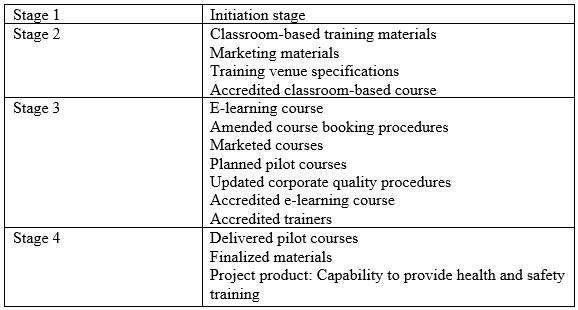
The ABC Company standard development model for new courses recommends the following stages: End of the Project scenario.
Additional Information:
The Chief Executive Officer (CEO) founded the company five years ago. Under her leadership, ABC Company has grown quickly into a successful training company. It delivers a range of accredited professional training.
The Finance Director is also a founder member of ABC Company and is responsible for authorizing budgets for the Operations and Development Teams. She authorizes all large contracts personally.
The Purchasing Manager reports to the Finance Director and is responsible for managing and monitoring supplier contracts.
The Operations Director is responsible for the delivery of all training and for the training development budget. His department organizes courses, venues and trainers. They work with the Product and the Sales teams to provide a comprehensive training schedule. ABC Company’s IT manager reports to the Operations Director.
The Business Development Director has recently been appointed to identify new training needs and propose new products. She will work with the Operations Director to ensure a cost-conscious approach and that appropriate development technologies are used for the health and safety course.
The Training Development Manager reports to the Business Development Director and is responsible for developing training materials and gaining accreditation, in accordance with the standard course development model. Course developers in his team have skills in a range of development technologies and are allocated to projects as needed.
The Training Delivery Manager, who reports to the Operations Director, is responsible for ensuring that internal and external trainers deliver ABC Company training courses to the required standard. He also checks course materials to ensure they are fit for purpose and of the required quality.
The Central Services Director has responsibility for corporate communications, facilities management and configuration management. He recently led a project to consolidate all company quality systems into one quality management system and set up a corporate quality department, now managed by the Corporate Quality Manager.
The Corporate Document Manager reports to the Central Services Director. She helped establish the company’s document management system and now operates it across the business. She manages a team of administrators and contracts staff when workload is high.
The Sales Director joined ABC Company two months ago and is keen to establish himself by suggesting new markets for the courses and material. All account managers and the marketing team report to him. They promote existing training courses to other training companies and existing customers.
End of the additional information.
Based on lessons from previous projects that used the ABC Company standard development model, the project board has set low cost and time tolerances for stage 2. As a result, the project manager plans to set very low tolerances for time and cost for all work packages to be carried out during stage 2.
Is this an appropriate application of the ‘manage by exception’ principle, and why?
Yes, because the project manager should set tolerance equally for all work packages in a stage.
Yes, because setting appropriate tolerances for work packages will help keep the stage within tolerances.
No, because tolerances set by the project manager should be the same as those set by the project board.
No, because the project manager should divide the stage tolerances between the team managers.
Answer: B
The short version
B — Yes, tailored work-package tolerances help keep the stage in tolerance. Delegating tight but achievable limits to teams operationalizes manage by exception for stage 2.
Key concepts in this question
Manage by exception: delegating within tolerances so higher layers intervene only on forecast breach, preserving delivery focus.
Stage tolerances: cost and time bounds set by the project board for stage 2 based on prior lessons and low appetite.
Work-package tolerances: team-level bounds set by the project manager to give early warning before stage breach.
Equality misconception: tolerances need not be identical across packages, they should reflect risk and work content.
Division misconception: tolerances are not created by arithmetically slicing stage bounds among managers.
Why B is correct
B is correct because the project manager appropriately translates low board tolerances into fitting work-package limits for stage 2 work. Appropriate team tolerances create timely exception signals if classroom or e-learning development drifts. That layered control keeps the stage within bounds without escalating routine variance, which is proper manage-by-exception behavior.
Why the others are wrong
A. Setting tolerances equally for all packages ignores differing risk and effort, so equality alone is not the justification.
C. Project-manager tolerances operate at work-package level and correctly differ in granularity from board stage tolerances.
D. Dividing stage tolerances arithmetically among managers is not the method, appropriateness to each package is.
PRINCE2-Practitioner exam tip
On PRINCE2-Practitioner tolerance items, choose appropriate tailored limits over equal splits or identical copying.
3Project Scenario – Health and Safety Training Project:
ABC Company is a well-established training company that uses a standard model to develop training materials and deliver courses to customers.
ABC Company has commissioned a project in response to recent changes in government legislation relating to health and safety on construction sites. The project will deliver “capability to provide health and safety training”, including the materials needed for classroom-based training and e-learning. The expected benefits for construction companies include a reduction in lost days and legal costs due to accidents.
The e-learning course will be developed by a specialist external consultancy. The materials for classroom-based training will be delivered by ABC Company’s development team. All course materials will be piloted before they are used. ABC Company will deliver training to its customers and also hopes to sell the course materials to other training companies as part of their operational business. ABC Company will use their own sales and marketing departments to promote the courses.
The legislation requires construction companies to comply with the new legislation within two years. The course materials and trainers have to be accredited by a government agency before courses can be delivered. ABC Company is planning to deliver pilot courses within five months of starting the project.
The ABC Company standard development model for new courses recommends the following stages: End of the Project scenario.
Additional Information:
The Chief Executive Officer (CEO) founded the company five years ago. Under her leadership, ABC Company has grown quickly into a successful training company. It delivers a range of accredited professional training.
The Finance Director is also a founder member of ABC Company and is responsible for authorizing budgets for the Operations and Development Teams. She authorizes all large contracts personally.
The Purchasing Manager reports to the Finance Director and is responsible for managing and monitoring supplier contracts.
The Operations Director is responsible for the delivery of all training and for the training development budget. His department organizes courses, venues and trainers. They work with the Product and the Sales teams to provide a comprehensive training schedule. ABC Company’s IT manager reports to the Operations Director.
The Business Development Director has recently been appointed to identify new training needs and propose new products. She will work with the Operations Director to ensure a cost-conscious approach and that appropriate development technologies are used for the health and safety course.
The Training Development Manager reports to the Business Development Director and is responsible for developing training materials and gaining accreditation, in accordance with the standard course development model. Course developers in his team have skills in a range of development technologies and are allocated to projects as needed.
The Training Delivery Manager, who reports to the Operations Director, is responsible for ensuring that internal and external trainers deliver ABC Company training courses to the required standard. He also checks course materials to ensure they are fit for purpose and of the required quality.
The Central Services Director has responsibility for corporate communications, facilities management and configuration management. He recently led a project to consolidate all company quality systems into one quality management system and set up a corporate quality department, now managed by the Corporate Quality Manager.
The Corporate Document Manager reports to the Central Services Director. She helped establish the company’s document management system and now operates it across the business. She manages a team of administrators and contracts staff when workload is high.
The Sales Director joined ABC Company two months ago and is keen to establish himself by suggesting new markets for the courses and material. All account managers and the marketing team report to him. They promote existing training courses to other training companies and existing customers.
End of the additional information.
MANAGING PRODUCT DELIVERY -
The team manager for the production of the ‘marketing materials’ has identified that they will not be ready within the timescale agreed in the work package. The team manager has sufficient tolerance to take corrective action. As a result, additional resources have been assigned to this work package.
Which theme is being applied?
Risk
Organization
Progress
Change
Answer: B
The short version
B — Adding the resource is the Organization theme. The Organization theme covers defining and assigning who does what on the project.
Key concepts in this question
Organization theme: deciding the project roles, responsibilities and relationships, and who fills them.
Progress theme: monitoring, forecasting and controlling delivery, and reporting status.
Why B is correct
Placing a resource into a work package is a decision about who performs the work, which belongs to the Organization theme and the principle of defining roles, responsibilities and relationships. Progress would only be the theme if the question were about tracking or correcting a schedule deviation.
Why the others are wrong
A. Risk is not a PRINCE2 theme and assigning a resource is not a risk activity.
C. Progress covers monitoring and control, not resource assignment.
D. Change control is for baselined products and plans, not staffing a work package.
PRINCE2 exam tip
"Who does it" is Organization; "when will it be finished" is Progress.
4Project Scenario – Health and Safety Training Project:
ABC Company is a well-established training company that uses a standard model to develop training materials and deliver courses to customers.
ABC Company has commissioned a project in response to recent changes in government legislation relating to health and safety on construction sites. The project will deliver “capability to provide health and safety training”, including the materials needed for classroom-based training and e-learning. The expected benefits for construction companies include a reduction in lost days and legal costs due to accidents.
The e-learning course will be developed by a specialist external consultancy. The materials for classroom-based training will be delivered by ABC Company’s development team. All course materials will be piloted before they are used. ABC Company will deliver training to its customers and also hopes to sell the course materials to other training companies as part of their operational business. ABC Company will use their own sales and marketing departments to promote the courses.
The legislation requires construction companies to comply with the new legislation within two years. The course materials and trainers have to be accredited by a government agency before courses can be delivered. ABC Company is planning to deliver pilot courses within five months of starting the project.
The ABC Company standard development model for new courses recommends the following stages: End of the Project scenario.
Additional Information:
The Chief Executive Officer (CEO) founded the company five years ago. Under her leadership, ABC Company has grown quickly into a successful training company. It delivers a range of accredited professional training.
The Finance Director is also a founder member of ABC Company and is responsible for authorizing budgets for the Operations and Development Teams. She authorizes all large contracts personally.
The Purchasing Manager reports to the Finance Director and is responsible for managing and monitoring supplier contracts.
The Operations Director is responsible for the delivery of all training and for the training development budget. His department organizes courses, venues and trainers. They work with the Product and the Sales teams to provide a comprehensive training schedule. ABC Company’s IT manager reports to the Operations Director.
The Business Development Director has recently been appointed to identify new training needs and propose new products. She will work with the Operations Director to ensure a cost-conscious approach and that appropriate development technologies are used for the health and safety course.
The Training Development Manager reports to the Business Development Director and is responsible for developing training materials and gaining accreditation, in accordance with the standard course development model. Course developers in his team have skills in a range of development technologies and are allocated to projects as needed.
The Training Delivery Manager, who reports to the Operations Director, is responsible for ensuring that internal and external trainers deliver ABC Company training courses to the required standard. He also checks course materials to ensure they are fit for purpose and of the required quality.
The Central Services Director has responsibility for corporate communications, facilities management and configuration management. He recently led a project to consolidate all company quality systems into one quality management system and set up a corporate quality department, now managed by the Corporate Quality Manager.
The Corporate Document Manager reports to the Central Services Director. She helped establish the company’s document management system and now operates it across the business. She manages a team of administrators and contracts staff when workload is high.
The Sales Director joined ABC Company two months ago and is keen to establish himself by suggesting new markets for the courses and material. All account managers and the marketing team report to him. They promote existing training courses to other training companies and existing customers.
End of the additional information.
The delivery of the pilot courses has been split into two separate products: ‘planned pilot courses’ and ‘delivered pilot courses’. ‘Planned pilot courses’ will be produced during stage 3, and the ‘delivered pilot courses’ will take place during stage 4. This will allow the project board to approve the plan for the pilot courses before the resources are committed to delivering the pilot courses.
Why is this an appropriate application of the plans theme to control the project?
Because a PRINCE2 project should focus on the quality of the products being delivered.
Because the pilot courses have been broken down into two separate products.
Because the project board should ensure that lessons from one stage are applied to the next stage.
Because the delivery steps to create the pilot courses have been aligned to the management stages.
Answer: D
The short version
D — Delivery steps aligned to management stages. That is the manage by stages principle in action.
Key concepts in this question
Manage by stages: dividing the project into manageable stages, each authorized and controlled separately.
Focus on products: the work is broken into products, each with a product description, quality criteria and tolerances.
Why D is correct
The principle of manage by stages requires that the work is organized into stages that are each manageable and separately authorized and controlled. Aligning the delivery steps for the pilot courses with the management stages is exactly that requirement.
Why the others are wrong
A. PRINCE2 does not prioritize product quality over other concerns; quality criteria sit in product descriptions.
B. There is no basis for splitting the pilots into two products; nothing in the scenario implies that.
C. Ensuring lessons are applied stage to stage is a team/PM and Project Board assurance matter, not a description of why a pilot is structured as it is.
PRINCE2 exam tip
If the option mentions stages being aligned, ordered or authorized, it is testing manage by stages.
5Which of the following should NOT be included in the business case?
Reasons
Major Risks
Business options
Business approach
Answer: D
The short version
D — Business approach does not belong in the business case. It is a solution-design choice, while reasons, risks and options justify continued investment.
Key concepts in this question
Business case contents: reasons, business options, benefits, costs, risks and timescale that justify the project under continued appraisal.
Reasons: the drivers such as legislative change requiring health and safety training capability.
Business options: alternatives like do nothing, do minimum or do something that frame the investment decision.
Major risks: uncertainties affecting viability that the board must weigh alongside returns.
Business approach misconception: delivery-method detail that sits in plans or approach documents, not in the justification case.
Why D is correct
D is correct because the settled PRINCE2 composition includes justification elements rather than approach mechanics. Reasons explain why, options frame what could be done, and major risks qualify confidence, all supporting the viability verdict. Business approach describes how delivery might proceed and therefore should NOT be included as a business-case component.
Why the others are wrong
A. Reasons are core justification showing the legislative and commercial drivers for the health and safety project.
B. Major Risks belong because continued viability depends on transparent risk exposure and mitigation.
C. Business options belong because the case must compare feasible alternatives before recommending investment.
PRINCE2-Practitioner exam tip
For PRINCE2-Practitioner business case, keep reasons plus options plus risks, and exclude approach detail.
6Project Scenario – Health and Safety Training Project:
ABC Company is a well-established training company that uses a standard model to develop training materials and deliver courses to customers.
ABC Company has commissioned a project in response to recent changes in government legislation relating to health and safety on construction sites. The project will deliver “capability to provide health and safety training”, including the materials needed for classroom-based training and e-learning. The expected benefits for construction companies include a reduction in lost days and legal costs due to accidents.
The e-learning course will be developed by a specialist external consultancy. The materials for classroom-based training will be delivered by ABC Company’s development team. All course materials will be piloted before they are used. ABC Company will deliver training to its customers and also hopes to sell the course materials to other training companies as part of their operational business. ABC Company will use their own sales and marketing departments to promote the courses.
The legislation requires construction companies to comply with the new legislation within two years. The course materials and trainers have to be accredited by a government agency before courses can be delivered. ABC Company is planning to deliver pilot courses within five months of starting the project.
The ABC Company standard development model for new courses recommends the following stages: End of the Project scenario.
Additional Information:
The Chief Executive Officer (CEO) founded the company five years ago. Under her leadership, ABC Company has grown quickly into a successful training company. It delivers a range of accredited professional training.
The Finance Director is also a founder member of ABC Company and is responsible for authorizing budgets for the Operations and Development Teams. She authorizes all large contracts personally.
The Purchasing Manager reports to the Finance Director and is responsible for managing and monitoring supplier contracts.
The Operations Director is responsible for the delivery of all training and for the training development budget. His department organizes courses, venues and trainers. They work with the Product and the Sales teams to provide a comprehensive training schedule. ABC Company’s IT manager reports to the Operations Director.
The Business Development Director has recently been appointed to identify new training needs and propose new products. She will work with the Operations Director to ensure a cost-conscious approach and that appropriate development technologies are used for the health and safety course.
The Training Development Manager reports to the Business Development Director and is responsible for developing training materials and gaining accreditation, in accordance with the standard course development model. Course developers in his team have skills in a range of development technologies and are allocated to projects as needed.
The Training Delivery Manager, who reports to the Operations Director, is responsible for ensuring that internal and external trainers deliver ABC Company training courses to the required standard. He also checks course materials to ensure they are fit for purpose and of the required quality.
The Central Services Director has responsibility for corporate communications, facilities management and configuration management. He recently led a project to consolidate all company quality systems into one quality management system and set up a corporate quality department, now managed by the Corporate Quality Manager.
The Corporate Document Manager reports to the Central Services Director. She helped establish the company’s document management system and now operates it across the business. She manages a team of administrators and contracts staff when workload is high.
The Sales Director joined ABC Company two months ago and is keen to establish himself by suggesting new markets for the courses and material. All account managers and the marketing team report to him. They promote existing training courses to other training companies and existing customers.
End of the additional information.
During stage 4, a work package was authorized for the ‘delivered pilot courses’ to be completed by the end of week 2. The ‘finalized materials’ work package will start in week 3. Both work packages have zero tolerances, and finalizing the materials is dependent on feedback from the pilot courses.
During week 1, there were some problems with the pilot courses, so at the start of week 2 the team manager rescheduled the courses to week 3, and reported this in the weekly checkpoint report as the end of week 2.
Should the team manager have reported this delay previously as an issue, and why?
Yes, because the work package to deliver the pilot courses was forecast to exceed its time tolerance.
Yes, because a team manager should not change the scheduled order of a work package.
No, because the checkpoint report for week 1 should include information on any issues that occurred.
No, because the feedback from the rescheduled courses can be used in week 4 to finalize the materials.
Answer: A
The short version
A — Yes, the forecast breach of zero tolerance required an immediate issue. Rescheduling pilot courses into week 3 guaranteed the week-2 work package would miss its limit.
Key concepts in this question
Zero tolerances: no permitted deviation on time for both pilot delivery and finalization packages, so any slip is a breach.
Forecast versus actual breach: PRINCE2 requires raising an issue as soon as a breach is forecast, not after it happens.
Work-package dependency: finalized materials starting week 3 depend on pilot feedback, amplifying the impact of the delay.
Checkpoint reporting: routine weekly progress updates that cannot substitute for timely exception escalation.
Team-manager duty: to notify the project manager immediately when tolerance is forecast to be exceeded.
Why A is correct
A is correct because at the start of week 2 the team manager already knew the week-2 delivery would slip to week 3 against zero tolerance. That forecast triggers the exception procedure and an issue report without waiting for the end-of-week checkpoint. Early escalation would let the project manager replan the dependent finalization package and protect accreditation timelines.
Why the others are wrong
B. Changing scheduled order is not the governing reason, the forecast tolerance breach alone mandates escalation.
C. Including problems in a later checkpoint report is too late and confuses routine progress with exception control.
D. Possible use of feedback in week 4 does not excuse failing to report a certain breach of a zero-tolerance package.
PRINCE2-Practitioner exam tip
With zero tolerance on PRINCE2-Practitioner, any forecast slip equals raise an issue now, never wait for checkpoint.
7Project Scenario – Health and Safety Training Project:
ABC Company is a well-established training company that uses a standard model to develop training materials and deliver courses to customers.
ABC Company has commissioned a project in response to recent changes in government legislation relating to health and safety on construction sites. The project will deliver “capability to provide health and safety training”, including the materials needed for classroom-based training and e-learning. The expected benefits for construction companies include a reduction in lost days and legal costs due to accidents.
The e-learning course will be developed by a specialist external consultancy. The materials for classroom-based training will be delivered by ABC Company’s development team. All course materials will be piloted before they are used. ABC Company will deliver training to its customers and also hopes to sell the course materials to other training companies as part of their operational business. ABC Company will use their own sales and marketing departments to promote the courses.
The legislation requires construction companies to comply with the new legislation within two years. The course materials and trainers have to be accredited by a government agency before courses can be delivered. ABC Company is planning to deliver pilot courses within five months of starting the project.
The ABC Company standard development model for new courses recommends the following stages: End of the Project scenario.
Additional Information:
The Chief Executive Officer (CEO) founded the company five years ago. Under her leadership, ABC Company has grown quickly into a successful training company. It delivers a range of accredited professional training.
The Finance Director is also a founder member of ABC Company and is responsible for authorizing budgets for the Operations and Development Teams. She authorizes all large contracts personally.
The Purchasing Manager reports to the Finance Director and is responsible for managing and monitoring supplier contracts.
The Operations Director is responsible for the delivery of all training and for the training development budget. His department organizes courses, venues and trainers. They work with the Product and the Sales teams to provide a comprehensive training schedule. ABC Company’s IT manager reports to the Operations Director.
The Business Development Director has recently been appointed to identify new training needs and propose new products. She will work with the Operations Director to ensure a cost-conscious approach and that appropriate development technologies are used for the health and safety course.
The Training Development Manager reports to the Business Development Director and is responsible for developing training materials and gaining accreditation, in accordance with the standard course development model. Course developers in his team have skills in a range of development technologies and are allocated to projects as needed.
The Training Delivery Manager, who reports to the Operations Director, is responsible for ensuring that internal and external trainers deliver ABC Company training courses to the required standard. He also checks course materials to ensure they are fit for purpose and of the required quality.
The Central Services Director has responsibility for corporate communications, facilities management and configuration management. He recently led a project to consolidate all company quality systems into one quality management system and set up a corporate quality department, now managed by the Corporate Quality Manager.
The Corporate Document Manager reports to the Central Services Director. She helped establish the company’s document management system and now operates it across the business. She manages a team of administrators and contracts staff when workload is high.
The Sales Director joined ABC Company two months ago and is keen to establish himself by suggesting new markets for the courses and material. All account managers and the marketing team report to him. They promote existing training courses to other training companies and existing customers.
End of the additional information.
ABC Company uses a standard development model to develop courses and uses PRINCE2 to manage these projects. The objectives from the Health and Safety Training Project have been documented in the business plan of ABC Company. This business plan has triggered this project. As a result, to save time, the executive has decided to simplify the ‘starting up a project’ process. The project mandate will be adapted and becomes the project brief.
Is this appropriate, and why?
Yes, because the business outcomes are clear, the project brief can be a sample statement elaborating the mandate.
Yes, because the executive can initiate the project based on the project mandate by passing the ‘starting up a project’ process.
No, because the project brief should be a statement which includes a fuller description of the project.
No, because capturing lessons from previous projects identify lessons to be applied to this project.
Answer: A
The short version
A — Yes, the brief can be a simple statement elaborating the mandate. Clear business outcomes justify tailoring the brief.
Key concepts in this question
Tailor to suit: scale the method to the project; Starting up can be simplified when the business case is clear.
Project brief: derived from the project mandate, ranging from a simple statement to a fuller description.
Why A is correct
The project brief is a Starting up a Project product derived from the mandate, and PRINCE2 quality criteria allow it to be a short statement where the business outcomes are clear and the work sits within the organization's standard approach. Under Tailor to suit, that simplification is acceptable.
Why the others are wrong
B. The executive cannot bypass Starting up a Project; they chair the board but cannot skip a process with required products.
C. A fuller description is required only when the mandate does not already convey enough detail.
D. Capturing lessons is a different concern and says nothing about the validity of the brief.
PRINCE2 exam tip
Mandate says "why", brief says "what"; the brief can be short when the why is already crystal clear.
8Project Scenario – Health and Safety Training Project:
ABC Company is a well-established training company that uses a standard model to develop training materials and deliver courses to customers.
ABC Company has commissioned a project in response to recent changes in government legislation relating to health and safety on construction sites. The project will deliver “capability to provide health and safety training”, including the materials needed for classroom-based training and e-learning. The expected benefits for construction companies include a reduction in lost days and legal costs due to accidents.
The e-learning course will be developed by a specialist external consultancy. The materials for classroom-based training will be delivered by ABC Company’s development team. All course materials will be piloted before they are used. ABC Company will deliver training to its customers and also hopes to sell the course materials to other training companies as part of their operational business. ABC Company will use their own sales and marketing departments to promote the courses.
The legislation requires construction companies to comply with the new legislation within two years. The course materials and trainers have to be accredited by a government agency before courses can be delivered. ABC Company is planning to deliver pilot courses within five months of starting the project.
The ABC Company standard development model for new courses recommends the following stages: End of the Project scenario.
Additional Information:
The Chief Executive Officer (CEO) founded the company five years ago. Under her leadership, ABC Company has grown quickly into a successful training company. It delivers a range of accredited professional training.
The Finance Director is also a founder member of ABC Company and is responsible for authorizing budgets for the Operations and Development Teams. She authorizes all large contracts personally.
The Purchasing Manager reports to the Finance Director and is responsible for managing and monitoring supplier contracts.
The Operations Director is responsible for the delivery of all training and for the training development budget. His department organizes courses, venues and trainers. They work with the Product and the Sales teams to provide a comprehensive training schedule. ABC Company’s IT manager reports to the Operations Director.
The Business Development Director has recently been appointed to identify new training needs and propose new products. She will work with the Operations Director to ensure a cost-conscious approach and that appropriate development technologies are used for the health and safety course.
The Training Development Manager reports to the Business Development Director and is responsible for developing training materials and gaining accreditation, in accordance with the standard course development model. Course developers in his team have skills in a range of development technologies and are allocated to projects as needed.
The Training Delivery Manager, who reports to the Operations Director, is responsible for ensuring that internal and external trainers deliver ABC Company training courses to the required standard. He also checks course materials to ensure they are fit for purpose and of the required quality.
The Central Services Director has responsibility for corporate communications, facilities management and configuration management. He recently led a project to consolidate all company quality systems into one quality management system and set up a corporate quality department, now managed by the Corporate Quality Manager.
The Corporate Document Manager reports to the Central Services Director. She helped establish the company’s document management system and now operates it across the business. She manages a team of administrators and contracts staff when workload is high.
The Sales Director joined ABC Company two months ago and is keen to establish himself by suggesting new markets for the courses and material. All account managers and the marketing team report to him. They promote existing training courses to other training companies and existing customers.
End of the additional information.
ABC Company carried out a similar project two years ago, in response to changes in health and safety legislation for the health service. The experiences from that project were used to refine the corporate risk management policy. For that reason, the project board decided to use the corporate risk management policy in the risk management approach for this project.
Is this appropriate, and why?
Yes, because experience from previous projects should be taken into account in the risk management approach.
Yes, because the corporate risk management policy was updated, as a result of lessons from previous projects.
No, because the risk management approach should be tailored to suit the project and its environment.
No, because a separate risk management approach is not necessary when the company has a risk management policy.
Answer: A
The short version
A — Yes, because experience from previous projects should be taken into account. This is Learn from Experience, and tailoring is not violated by using an organization's own policy.
Key concepts in this question
Learn from Experience: lessons should be actively sought and applied throughout the project.
Tailor to suit: the method is adapted to the project's environment; an organization-defined approach is one of the legitimate tailoring choices.
Why A is correct
The corporate risk management policy was refined using lessons from a similar project two years ago, and the board chose to build that learning into this project's risk management approach. That is precisely the Learn from Experience principle being applied.
Why the others are wrong
B. Merely restates a scenario fact; it does not give a PRINCE2 reason for why the decision is appropriate.
C. Tailoring is not violated — there is no evidence the policy has been applied untailored to this project.
D. Every PRINCE2 project needs its own risk management approach, with or without a corporate policy behind it.
PRINCE2 exam tip
"Previous project taught us something, we are using it now" is Learn from Experience, full stop.
9Project Scenario – Health and Safety Training Project:
ABC Company is a well-established training company that uses a standard model to develop training materials and deliver courses to customers.
ABC Company has commissioned a project in response to recent changes in government legislation relating to health and safety on construction sites. The project will deliver “capability to provide health and safety training”, including the materials needed for classroom-based training and e-learning. The expected benefits for construction companies include a reduction in lost days and legal costs due to accidents.
The e-learning course will be developed by a specialist external consultancy. The materials for classroom-based training will be delivered by ABC Company’s development team. All course materials will be piloted before they are used. ABC Company will deliver training to its customers and also hopes to sell the course materials to other training companies as part of their operational business. ABC Company will use their own sales and marketing departments to promote the courses.
The legislation requires construction companies to comply with the new legislation within two years. The course materials and trainers have to be accredited by a government agency before courses can be delivered. ABC Company is planning to deliver pilot courses within five months of starting the project.
The ABC Company standard development model for new courses recommends the following stages: End of the Project scenario.
Additional Information:
The Chief Executive Officer (CEO) founded the company five years ago. Under her leadership, ABC Company has grown quickly into a successful training company. It delivers a range of accredited professional training.
The Finance Director is also a founder member of ABC Company and is responsible for authorizing budgets for the Operations and Development Teams. She authorizes all large contracts personally.
The Purchasing Manager reports to the Finance Director and is responsible for managing and monitoring supplier contracts.
The Operations Director is responsible for the delivery of all training and for the training development budget. His department organizes courses, venues and trainers. They work with the Product and the Sales teams to provide a comprehensive training schedule. ABC Company’s IT manager reports to the Operations Director.
The Business Development Director has recently been appointed to identify new training needs and propose new products. She will work with the Operations Director to ensure a cost-conscious approach and that appropriate development technologies are used for the health and safety course.
The Training Development Manager reports to the Business Development Director and is responsible for developing training materials and gaining accreditation, in accordance with the standard course development model. Course developers in his team have skills in a range of development technologies and are allocated to projects as needed.
The Training Delivery Manager, who reports to the Operations Director, is responsible for ensuring that internal and external trainers deliver ABC Company training courses to the required standard. He also checks course materials to ensure they are fit for purpose and of the required quality.
The Central Services Director has responsibility for corporate communications, facilities management and configuration management. He recently led a project to consolidate all company quality systems into one quality management system and set up a corporate quality department, now managed by the Corporate Quality Manager.
The Corporate Document Manager reports to the Central Services Director. She helped establish the company’s document management system and now operates it across the business. She manages a team of administrators and contracts staff when workload is high.
The Sales Director joined ABC Company two months ago and is keen to establish himself by suggesting new markets for the courses and material. All account managers and the marketing team report to him. They promote existing training courses to other training companies and existing customers.
End of the additional information.
The Health and Safety Training Project is part of a programme of strategic expansion, which is important for ABC Company’s continued operation. At the end of stage 2, the estimated project costs are greater than the expected benefits in the business case. The project board has reviewed the situation and asked programme management to decide whether the project should be closed prematurely.
Is this an appropriate application of the ‘manage by stages’ principle, and why?
Yes, because decisions about closure should be escalated to programme management, unless otherwise instructed.
Yes, because the project board should escalate significant decisions to programme management.
No, because this contradicts the ‘manage by exception’ principle.
No, because the project board should decide whether to continue with the project.
Answer: D
The short version
D — No, the Project Board decides whether to continue. Closure or continuation is a Board authority, not a programme escalation.
Key concepts in this question
Continued business justification: the business case must remain valid throughout, and the Project Board monitors it.
Manage by exception: the PM acts within delegated tolerances; forecasts that breach tolerance go to the Board.
Why D is correct
At each stage boundary the Project Board reviews the business case and decides whether to continue, stop or redirect the project. Handing that decision off to programme management as a matter of course strips the Board of its directing responsibility.
Why the others are wrong
A. Default escalation to programme management is not a PRINCE2 requirement.
B. Significant decisions escalate upward only in a programme structure, and the Board still holds the authority.
C. Manage by exception is precisely why the Board, not the PM, holds this decision; nothing here contradicts it.
PRINCE2 exam tip
Board decides continue or stop; the PM only decides "carry on within tolerance".
10Project Scenario – Health and Safety Training Project:
ABC Company is a well-established training company that uses a standard model to develop training materials and deliver courses to customers.
ABC Company has commissioned a project in response to recent changes in government legislation relating to health and safety on construction sites. The project will deliver “capability to provide health and safety training”, including the materials needed for classroom-based training and e-learning. The expected benefits for construction companies include a reduction in lost days and legal costs due to accidents.
The e-learning course will be developed by a specialist external consultancy. The materials for classroom-based training will be delivered by ABC Company’s development team. All course materials will be piloted before they are used. ABC Company will deliver training to its customers and also hopes to sell the course materials to other training companies as part of their operational business. ABC Company will use their own sales and marketing departments to promote the courses.
The legislation requires construction companies to comply with the new legislation within two years. The course materials and trainers have to be accredited by a government agency before courses can be delivered. ABC Company is planning to deliver pilot courses within five months of starting the project.
The ABC Company standard development model for new courses recommends the following stages: End of the Project scenario.
Additional Information:
The Chief Executive Officer (CEO) founded the company five years ago. Under her leadership, ABC Company has grown quickly into a successful training company. It delivers a range of accredited professional training.
The Finance Director is also a founder member of ABC Company and is responsible for authorizing budgets for the Operations and Development Teams. She authorizes all large contracts personally.
The Purchasing Manager reports to the Finance Director and is responsible for managing and monitoring supplier contracts.
The Operations Director is responsible for the delivery of all training and for the training development budget. His department organizes courses, venues and trainers. They work with the Product and the Sales teams to provide a comprehensive training schedule. ABC Company’s IT manager reports to the Operations Director.
The Business Development Director has recently been appointed to identify new training needs and propose new products. She will work with the Operations Director to ensure a cost-conscious approach and that appropriate development technologies are used for the health and safety course.
The Training Development Manager reports to the Business Development Director and is responsible for developing training materials and gaining accreditation, in accordance with the standard course development model. Course developers in his team have skills in a range of development technologies and are allocated to projects as needed.
The Training Delivery Manager, who reports to the Operations Director, is responsible for ensuring that internal and external trainers deliver ABC Company training courses to the required standard. He also checks course materials to ensure they are fit for purpose and of the required quality.
The Central Services Director has responsibility for corporate communications, facilities management and configuration management. He recently led a project to consolidate all company quality systems into one quality management system and set up a corporate quality department, now managed by the Corporate Quality Manager.
The Corporate Document Manager reports to the Central Services Director. She helped establish the company’s document management system and now operates it across the business. She manages a team of administrators and contracts staff when workload is high.
The Sales Director joined ABC Company two months ago and is keen to establish himself by suggesting new markets for the courses and material. All account managers and the marketing team report to him. They promote existing training courses to other training companies and existing customers.
End of the additional information.
A new Training Delivery Manager is being recruited to replace the current manager in six month's time. The new Training Delivery Manager will need to review the 'classroom-based training materials' before they are finalized. As a result, the Chief Executive Officer (CEO), who is not part of the project management team, has stated that the project's duration should be at least seven months. Any deviations from this timescale must be escalated to the CEO.
Is this an appropriate application of the 'manage by exception' principle, and why?
Yes, because a project time constraint should be set to meet ABC Company's business objectives.
Yes, because the CEO should be responsible for resolving exceptions throughout the project.
No, because the executive should set time tolerances for the Health and Safety Training Project.
No, because completing the project earlier than expected should not be reported as an exception.
Answer: A
The short version
A — The project time constraint should follow business objectives. Tolerances come from the business layer's priorities.
Key concepts in this question
Tolerances: the deviation the PM may manage without escalating; project tolerances derive from the business case.
Manage by exception: forecasts beyond tolerance become exception reports to the Project Board.
Why A is correct
Project level time and cost tolerances exist to keep delivery aligned with the organization's business objectives, and they are derived from the business case. The Project Board then delegates stage tolerances downward within that envelope.
Why the others are wrong
B. Exception resolution within tolerance is the Project Manager's job, not the executive's, throughout the project.
C. The executive does not set project tolerances; those come from the business layer, and the Board sets stage tolerances.
D. True as a general point but it does not answer whether the time constraint is properly set.