PMI Scheduling Professional (PMI-SP) — Free Practice Questions
10 free sample questions from a bank of 70, with the correct answers and explanations. No signup required — start practising right now.
- Estimate activity resources
- Define activities
- Estimate activity durations
- Sequence activities
The short version
B — Define Activities is next after the WBS is created and approved.
Key concepts
- Create WBS produces work packages.
- Define Activities decomposes work packages into schedule activities via decomposition, rolling-wave planning, templates, expert judgment.
- Estimate resources/durations and Sequence Activities all require the activity list first.
Why B is correct
Once the WBS defines _what_ work is in scope, Define Activities defines the _actions_ needed to produce each work package (e.g., Build Foundation → excavate, lay rebar, pour, cure). PMI-SP sequencing logic requires the activity list before any resourcing, estimating, or networking.
Why the others are wrong
- A — Estimate activity resources: needs activity list and attributes to know what resources each activity needs.
- C — Estimate activity durations: needs activities + resources + calendars first.
- D — Sequence activities: cannot build PDM network without activities as nodes.
PMI-SP exam tip
WBS → Define Activities → Sequence → Estimate Resources → Estimate Durations → Develop Schedule. If a choice assumes the activity list exists, it comes after Define Activities.
- It means the largest schedule variance you can have is five percent.
- It is the earned value divided by the planned value for your project.
- It is the expectation of management to be 95 on schedule at 95 percent of the project.
- It means you will need to earn at least 95 cents per dollar invested in the project.
The short version
A — largest schedule variance is five percent. Conformance 0.95 = stay within 5% of plan.
Key concepts
- Conformance to schedule = required adherence / tolerance.
- 1.00 = perfect; 0.95 = allow 0.05 deviation.
- Distinct from SPI (EV/PV) and CPI (EV/AC).
Why A is correct
Management set tolerance: do not let schedule slip more than 1 − 0.95 = 5%. Report variance against that threshold; breach requires corrective action.
Why the others are wrong
- B — EV/PV: that defines Schedule Performance Index (SPI), not conformance.
- C — 95 on schedule at 95%: garbled wording, not a PMI metric.
- D — 95 cents per dollar: that describes Cost Performance Index (CPI = EV/AC), not schedule conformance.
PMI-SP exam tip
Conformance = tolerance. SPI/CPI = ratios. SV/CV = dollar/day variances. Read whether the stem asks for tolerance, ratio, or variance.
- One
- Five
- Four
- Zero
The short version
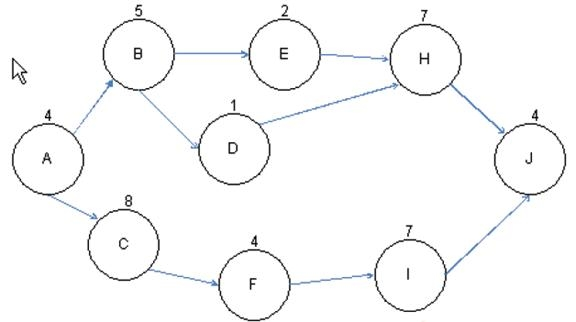
D - Zero float remains for H.
Key concepts in this question
Total float, critical path, path duration vs project duration.
Why D is correct
Path ABDHJ was 21 days with 27-day limit. Added 4+2=6 days makes it 27 days, consuming all float. H has no remaining float.
Why the others are wrong
A/B/C (One/Five/Four) all assume float remains, but 21+6=27 leaves zero slack without delaying project.
PMI-SP exam tip
Float = Late dates minus Early dates; when consumed duration equals project duration, float is zero.
- Expert Judgment
- Decomposition
- Rolling Wave Planning
- Templates
The short version
D - Templates.
Key concepts in this question
Define Activities, templates from prior projects, standard milestones.
Why D is correct
Templates from previous project activity lists carry typical milestones and help define new activities faster.
Why the others are wrong
A Expert Judgment provides advice but not standard milestone list; B Decomposition breaks WBS into activities; C Rolling Wave plans near-term detail only.
PMI-SP exam tip
When question asks for typical/standard/repeatable list from past projects, think Templates.
- The critical path will now take 26 days.
- The critical path will now take 17 days.
- The critical path will now take 23 days.
- The critical path will now take 20 days.
The short version
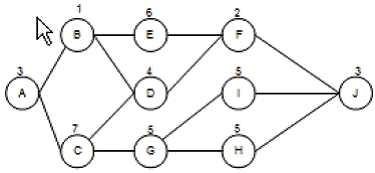
C - Critical path stays 23 days.
Key concepts in this question
Critical path = longest path, multiple critical paths.
Why C is correct
Paths ACGIJ and ACGHJ both 23 days. I shortens 3 days so ACGIJ becomes 20 days, but ACGHJ stays 23 days and remains critical.
Why the others are wrong
A 26 days wrong direction; B 17 days and D 20 days confuse reduced path ACGIJ with overall critical path.
PMI-SP exam tip
Shortening one critical path does not shorten project if another critical path remains.
- 80
- 1.02
- 102
- 0.80
The short version
D - SPI 0.80.
Key concepts in this question
SPI = EV/PV, behind schedule if <1.
Why D is correct
EV=0.60x745000=447000. PV=0.75x745000=558750 (third quarterly milestone). 447000/558750=0.80.
Why the others are wrong
A 80 missing decimal; B 1.02 is CPI-like >1; C 102 invalid scaling.
PMI-SP exam tip
SPI uses PV at planned percent, not AC; <1 means behind schedule.
- Precedence Diagramming Method
- Schedule network template
- Dependency determination
- Activity on the Node
The short version
A — Precedence Diagramming Method (PDM) identifies predecessors and successors for sequencing.
Key concepts
- Sequence Activities uses PDM: nodes = activities, arrows = FS/FF/SS/SF dependencies.
- Schedule network templates reuse prior networks.
- Dependency determination classifies mandatory/discretionary/internal/external.
Why A is correct
PDM explicitly maps each activity's predecessors (incoming) and successors (outgoing) to build the network diagram. It is the most common network technique on PMI-SP questions.
Why the others are wrong
- B — Schedule network template: accelerates networking by copying a prior project, does not itself define logic.
- C — Dependency determination: decides _type/order rationale_, not the diagram technique.
- D — Activity on the Node: AON is a PDM representation (activities on circles), i.e., a subset/example of A, not the best answer to "which technique identifies predecessors/successors."
PMI-SP exam tip
If the stem says predecessors + successors + network, pick PDM. If it says copy prior project, pick template.
- Scope baseline
- Organizational process assets
- WBS
- Enterprise environmental factors
The short version
C - WBS is the exception.
Key concepts in this question
Define Activities inputs: scope baseline, EEF, OPA.
Why C is correct
Scope baseline (which contains WBS + scope statement + WBS dictionary) is the listed input, not standalone WBS.
Why the others are wrong
A Scope baseline, B OPA, D EEF are all formal inputs to Define Activities.
PMI-SP exam tip
If scope baseline is an input, standalone WBS is not separately listed - watch except questions.
- Total float is the amount of time an activity can be delayed without delaying any project successors, whereas free float is the amount of time an activity can be delayed without delaying the project completion date.
- Total float is the amount of time an activity can be delayed without delaying the project completion date, whereas free float is the amount of time an activity can be delayed without delaying any project successors.
- Total float is the amount of time an activity can be delayed without delaying the project completion date, whereas free float is the amount of time an activity can be delayed without delaying any project predecessors.
- Total float is the amount of time a non-critical activity can be delayed without delaying any project successors, whereas free float is the amount of time an
The short version
B - Total vs free float definitions.
Key concepts in this question
Total float protects project finish; free float protects successors ES.
Why B is correct
Total float delays without delaying project completion; free float delays without delaying any successor early start.
Why the others are wrong
A swaps definitions; C wrongly says predecessors instead of successors; D is truncated and mixes non-critical wording.
PMI-SP exam tip
Free = successors; Total = project finish.
- 0.98
- -$16,677
- 1.07
- 0.94
The short version
C - TCPI 1.07.
Key concepts in this question
TCPI=(BAC-EV)/(BAC-AC) to meet BAC.
Why C is correct
EV=0.75x750000=562500. (750000-562500)/(750000-575000)=187500/175000=1.07, harder than 1 so BAC at risk.
Why the others are wrong
A 0.98 is CPI; B -$16667 is VAC-style; D 0.94 is SPI.
PMI-SP exam tip
TCPI>1 means must be more efficient than before to meet BAC.
Want the full bank of 70 questions for PMI Scheduling Professional (PMI-SP)? See all practice exams.