PMI-RMP — Free Practice Questions
10 free sample questions from a bank of 173, with the correct answers and explanations. No signup required — start practising right now.
1What are common examples used to communicate risk probability and impact?
- Risk checklist, risk assessment, regression analysis, and assumption and constraint analysis
- Monitor Risks process, multi-dimensional risk assessment, control chart, and Monte Carlo simulation
- Probability distributions, sensitivity analysis, modeling and simulation, and probability and impact matrix
- Monitor Risks process, assumption and constraint analysis, modeling and simulation, and risk register
Answer: C
2In the country where a project is being executed, customs procedures are complex and change frequently. During the risk identification process, the project team identifies a risk related to delays in customs on substantial equipment that will likely occur. Equipment delays on this project could lead to the project cancellation.
How should the probability and impact be characterized for this risk?
- Low probability/low impact
- High probability/low impact
- Low probability/high impact
- High probability high impact
Answer: D
3At the completion of a small project, the risk manager performs a risk audit and finds that several identified risks had occurred, and the impact was significantly larger than expected. While the project remained on schedule, the project budget increased by 50%. The project met all risk response milestones and no additional, previously unidentified risks, occurred on the project.
Based on this information, what risk management process improvement should the risk manager recommend for future similar projects?
- Increase frequency of risk management meetings with the project manager.
- Revise the level of accuracy of probability and impact scores.
- Document the risk audit report and capture it in the lessons learned database.
- Expand the use of risk identification techniques.
Answer: C
4The project manager has asked for the P50 estimate for the project schedule. What is the P50 estimate?
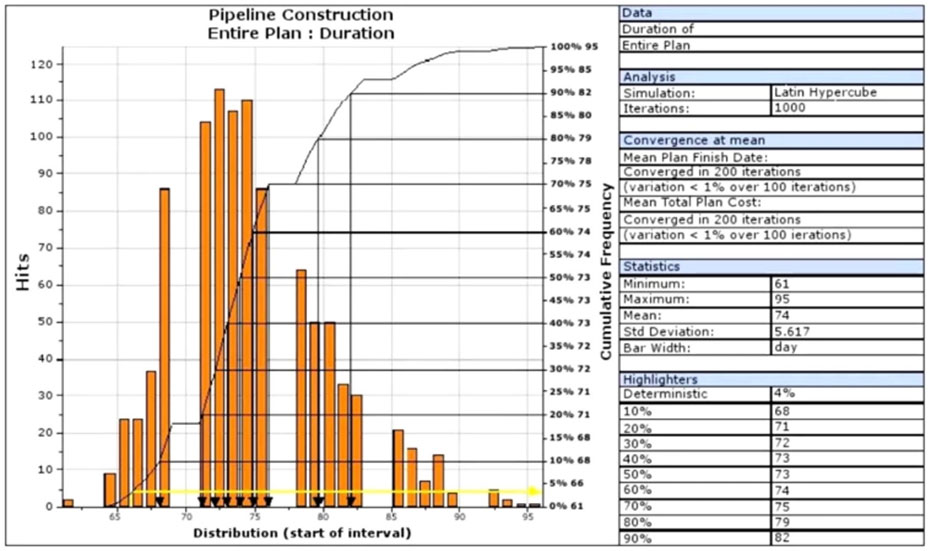
- 75 days
- 73.5 days
- 73 days
- 72.5 days
Answer: C
5A project risk manager is concerned about the low performance of risk management on a mission-critical project. After assessing the situation, the risk manager finds that the communication style may be the main contributor.
What could the project risk manager do to adjust the approach to influence team members to improve performance?
- Use follow-up emails, adopt an open door policy, and ask for feedback.
- Seek hidden agendas, vent frustrations, and allow others to vent frustrations.
- Provide continuous support, counseling, build trust, and open communications.
- Conduct one-on-one meetings, more frequent follow-up meetings, and implement the management by walking around technique.
Answer: D
6A project's risk manager successfully implements the risk management plan and the risk register. Furthermore, the risk analysis and the risk response planning are finalized. All results have been documented, and the project management plan and other project documents have been updated accordingly.
What should the risk manager do next?
- Perform a lessons learned document update with the defined risks.
- Perform regular reserve analysis to ensure that the assigned risk reserve budgets are sufficient.
- Perform risk date quality assessments.
- Perform continuous risk re-evaluation throughout the project life cycle to ensure risk management effectiveness.
Answer: D
7Very low = 1, Low = 2, Moderate = 3, High = 4, Very High = 5
A project manager must complete a report for a stakeholder who is concerned about the possibility of a funding shortfall. What is the most effective way to explain the risk to this stakeholder?
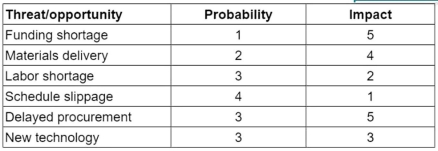
- The funding shortage is the lowest ranked/scored risk.
- The funding shortage is a significant risk.
- The funding shortage will have a very high impact on the project and is the highest priority.
- The funding shortage has a very low probability of occurring and is not a concern for the project.
Answer: D
8Which of the following success factors will enhance the Perform Qualitative Risk Analysis process as the risk occurrence gets closer?
- Agreed-upon definition
- Iterative analysis
- High quality information
- Agreed-upon approach
Answer: D
9A project team member identifies, but does not document, a risk early in the project, because it is considered to be trivial. This risk occurs later and negatively impacts the project.
What could the project manager do to avoid this situation?
- Conduct team meetings early in the project to ensure team member are familiar with risk identification requirements.
- Communicate the punishment and rewards policy to the project team during the project kick-off meeting.
- Provide project team members with access to simulation tools and decision tree diagrams.
- Provide team members with a risk management prompt list early in the project to ensure risks are not missed.
Answer: A
10A project in the execution phase at the customer's site has an issue concerning new parts that do not fit properly into a machine. The site project manager cannot find this high probability risk in the risk register.
What action should the site project manager take?
- Variance analysis
- Workaround
- Risk assessment
- Risk audit
Answer: B
Want the full bank of 173 questions for PMI-RMP? See all practice exams.