TOGAF Enterprise Architecture Combined Part 1 and Part 2 Examination (OGEA-103) — Free Practice Questions
10 free sample questions from a bank of 156, with the correct answers and explanations. No signup required — start practising right now.
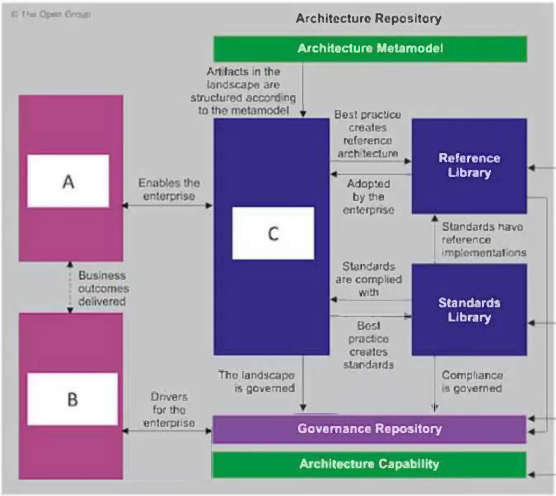
- A-Solution Landscape, B-Architecture Requirements Repository, C-Architecture Landscape
- A-Architecture Landscape, B-Architecture Requirements Repository, C-Solutions Landscape
- A-EA Landscape, B-Requirements Repository, C-Artifacts Landscape
- A-Architecture Requirements Repository, B-Solutions Repository, C-Architecture Landscape
The short version
A — Solution Landscape, Requirements Repository, and Architecture Landscape is the correct labelling. The illustration tests the Enterprise Repository structure from the TOGAF Enterprise Continuum, and only option A places each store in its standard position.
Key concepts in this question
- Enterprise Continuum: the TOGAF classification scheme for architecture and solution assets, spanning generic to organization-specific content.
- Architecture Landscape: the structured view of Architecture Building Blocks in use across the enterprise at all levels of granularity.
- Solution Landscape: the view of Solution Building Blocks that realize capabilities, including purchased, developed, and reused components.
- Exam illustration logic: TOGAF diagrams place landscapes as holdings and the requirements repository as the governing reference alongside them.
Why A is correct
Option A matches the standard TOGAF Enterprise Repository illustration. The Solution Landscape holds deployed and reusable solution assets, the Architecture Requirements Repository holds governing requirements and standards, and the Architecture Landscape holds the architectural representations of the enterprise. The three labels in option A follow the exact ordering and naming used in the standard figure. No other ordering preserves that mapping.
Why the others are wrong
- B. It swaps the two landscapes, placing Architecture Landscape where Solution Landscape belongs and vice versa.
- C. It uses non-standard EA Landscape and Artifacts Landscape terms that do not appear as labelled repository partitions in the standard.
OGEA-103 exam tip
Remember the pair as Architecture Landscape for what is described and Solution Landscape for what is built, with the Requirements Repository governing both from the middle.
- To obtain approval for the Statement of Architecture Work
- To create the initial version of the Architecture Roadmap
- To develop a vision of the business value to be delivered by the proposed enterprise architecture
- To select and implement tools to support the Architecture Capability
The short version
D — Select and implement tools to support the Architecture Capability. The Preliminary Phase builds the capability itself, not a specific architecture, so tooling, governance and principles belong here.
Key concepts in this question
- Preliminary Phase intent: it prepares the organization to do architecture by defining how architecture work will be governed, performed and supported.
- Architecture Capability versus architecture content: capability means organization model, governance process, tools, people and principles, while content means visions, roadmaps and designs.
- Establish the Architecture Capability: the standard lists defining the organization model, defining governance processes and resources, selecting and implementing supporting tools, and defining principles.
- Determine desired capability: reviewing context, scoping affected elements and setting a maturity target happens before any ADM cycle.
Why D is correct
D names an explicit Establish the Architecture Capability objective from the Preliminary chapter. Tooling creates the working environment for later phases with governance and principles. Other options describe later phase outputs. The vendor objectives list confirms D, so D is settled.
Why the others are wrong
- A. Approval of the Statement of Architecture Work belongs to Phase A, where the architecture project is authorized, not to Preliminary capability setup.
- B. The initial Architecture Roadmap is generated in Phases E and F from gap analysis and work packages, not in Preliminary.
- C. A vision of business value delivered by the proposed enterprise architecture is the Architecture Vision developed in Phase A, not a Preliminary objective.
OGEA-103 exam tip
Remember Preliminary equals prepare the enterprise for architecture: model, governance, tools, principles; if an option mentions vision, roadmap or statement of work, place it in A, E or F.
- Architecture Principles
- Business Scenarios
- Requirements Management
- Gap Analysis
The short version
B — Business Scenarios define requirements and consensus for the Architecture Vision. Phase A uses scenarios to ground the vision in real business needs rather than abstract principles or later gap work.
Key concepts in this question
- Architecture Vision purpose: Phase A sets scope, stakeholders, value and high level direction, and needs a business-grounded requirements source.
- Business Scenarios technique: structured descriptions of a business problem in business and architectural terms, with actors, roles, processes and desired outcomes.
- Consensus building: scenarios give stakeholders a shared story to validate, which surfaces requirements, constraints and success measures early.
- Placement in ADM: scenarios figure most prominently in Phase A, then get reused to validate later domain architectures and requirements management.
Why B is correct
B is correct because the standard positions Business Scenarios as the Phase A technique to define requirements and build consensus with management and stakeholders. Scenarios link vision language to operations so the vision reflects agreed value. Principles guide decisions, requirements handling runs centrally, and gap analysis validates later work. Vendor prose confirms this Phase A role.
Why the others are wrong
- A. Architecture Principles constrain and guide decisions across the ADM, but they are inputs and governance rules, not the elicitation method for vision content.
- C. Requirements Management is the central process that handles requirements throughout the ADM, not the Phase A document development technique itself.
- D. Gap Analysis compares Baseline to Target in Phases B to D and E, and cannot create the initial vision before those architectures exist.
OGEA-103 exam tip
Link Business Scenarios to Phase A vision every time: scenarios equal business requirements plus stakeholder consensus at the start of the cycle.
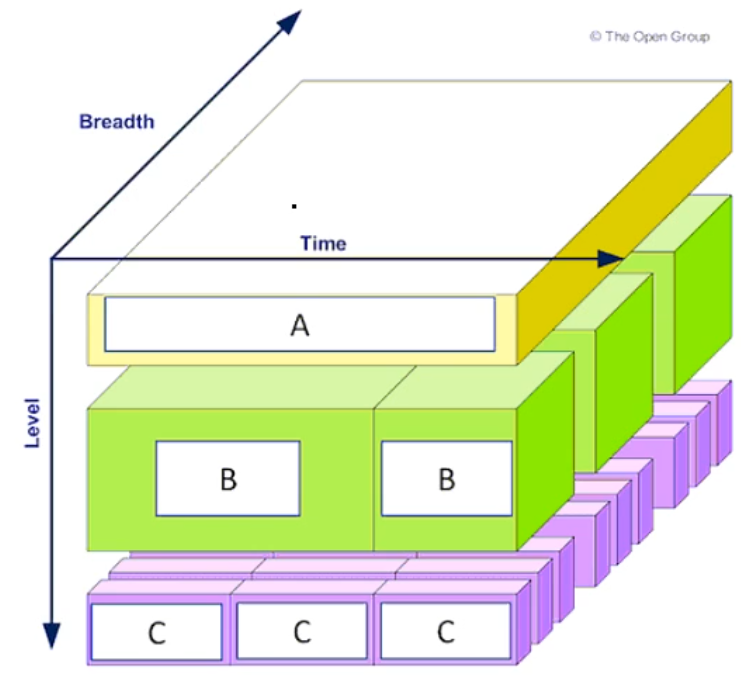
- A-Enterprise Strategic Architecture, B-Segment Architecture, C-Capability Architecture
- A-Corporate Capability, B-Portfolio Capability, C-Project Capability
- A-Architecture Vision, B-Business Architecture, C-Architecture Development
- A-Strategy Architecture, B-Tactic Architecture, C-Operational Architecture
The short version
A — Enterprise Strategic, Segment, and Capability Architecture is the correct classification. The diagram tests the three levels of the Architecture Landscape partitioning model, and only option A names all three levels exactly as defined in the standard.
Key concepts in this question
- Architecture Landscape partitioning: organizing architectures by breadth, depth, and purpose to manage complexity and governance.
- Capability Architecture: a focused architecture addressing a specific business capability or shared concern across segments.
- Granularity discipline: higher levels constrain lower levels, while lower levels elaborate detail without changing strategic intent.
Why A is correct
The TOGAF classification model for Architecture Landscapes defines exactly three nested levels. Enterprise Strategic Architecture sits at the top and sets enterprise direction, Segment Architecture partitions that direction into manageable enterprise portions, and Capability Architecture addresses discrete capabilities in depth. Option A reproduces that A-B-C ordering with the exact standard terms. The figure in the question follows that nested hierarchy, so the labels align one to one.
Why the others are wrong
- B. It lists capability maturity ideas that describe organization scope, not the three landscape architecture levels.
- C. It names ADM activity groupings, mixing Vision and development stages with architecture domains rather than landscape partitions.
- D. It invents a Strategy, Tactic, and Operational ladder that sounds plausible but is not the TOGAF landscape classification.
OGEA-103 exam tip
Memorize the ladder as Enterprise to Segment to Capability, meaning whole to part to focused ability, and reject any answer that replaces those three nouns.
- You propose that this engagement define the baseline Technology Architecture first in order to assess the current infrastructure capacity and capability for the company. Then the focus should be on transition planning and incremental architecture deployment. This will identify requirements to ensure that the projects are sequenced in an optimal fashion so as to realize the change.
- You propose that the team focus on architecture definition including development of business models, with emphasis on defining the change parameters to support this new business strategy that the CEO has identified. Once understood, the team will be in the best position to identify the requirements, drivers, issues, and constraints for the change.
- You propose that the priority is to produce a new Request for Architecture Work leading to development of a new Architecture Vision. The trade-off method should be applied to identify and select an architecture satisfying the stakeholders. For an efficient change the EA team should be aligned with the organization’s planning, budgeting, operational, and change processes.
- You propose that the team uses the architecture definition document and focus on architecture development starting simultaneously phases B, C and This is because the CEO has identified the need to change. This will ensure that the change can be defined in a structured manner and address the requirements needed to realize the change.
The short version
C — Restart with a new Request for Architecture Work and Architecture Vision using trade-off analysis. With no fixed scope, vision or objectives after a fundamental business change, the ADM must re-anchor before defining architectures.
Key concepts in this question
- Radical business shift: lentil fields repurposed, third-party processing ceased, new markets and varied end products mean prior scope and vision are obsolete.
- Request for Architecture Work: the sponsor trigger that redefines scope, constraints, success and governance mandate when direction changes fundamentally.
- Architecture Vision in Phase A: re-establishes stakeholders, value, capabilities and trade-offs so later domain work has a stable target.
- Trade-off method: structured comparison of alternative target architectures against stakeholder criteria to select a viable direction under uncertainty.
Why C is correct
C is correct because there is no fixed scope, vision or objectives and the EA team is new. TOGAF requires a fresh Request leading to a new Vision before B, C and D work when the CEO redefines the business. Trade-off analysis selects an architecture satisfying stakeholders. Starting with technology or parallel domains would lock in assumptions without mandate. Vendor logic supports Request plus Vision first.
Why the others are wrong
- A. Starting with technology baseline and transition planning skips mandate and vision, optimizing infrastructure too early.
- B. Focusing only on business models and change parameters without a formal Request and Vision leaves scope, sponsorship and trade-offs undefined.
- D. Launching Phases B, C and D simultaneously assumes a stable vision and requirements exist, which the scenario explicitly says they do not.
OGEA-103 exam tip
If the scenario stresses no scope, no vision and a new business direction, choose Request for Architecture Work plus new Vision first, then trade-offs.
- Implementation Strategy
- Transition Plan
- Migration Plan
- Implementation Governance Model
The short version
D — The Implementation Governance Model carries projects into governed implementation. It connects delivery work to architecture oversight, standards and compliance as build starts.
Key concepts in this question
- Transition to implementation: Phase G hands approved architectures to builders, where drift, reinterpretation and pressure to shortcut are highest.
- Implementation Governance Model: roles, processes, checkpoints, contracts and escalation paths that keep projects aligned to target architecture.
- Versus planning artifacts: strategy, transition and migration plans say what and when to build, while the governance model says how conformance will be assured.
- Architecture Contracts tie-in: the model operationalizes contracts through compliance reviews, dispensations and monitored change requests.
Why D is correct
D is correct because only the Implementation Governance Model ensures a project moving into build also moves into appropriate governance. It aligns delivery with oversight, standards, progress tracking and risk control. Strategy describes approach, transition and migration plans describe sequencing, but none establishes oversight. Vendor prose confirms this distinction.
Why the others are wrong
- A. Implementation Strategy is the high level approach for how implementation will occur, not the governance mechanism that assures conformance.
- B. Transition Plan moves the enterprise from one state to another across phases, but does not focus on governance oversight of builders.
- C. Migration Plan details logistics of moving from current to future state, with governance only as a secondary concern, not its primary purpose.
OGEA-103 exam tip
Hear governance in transition to build and pick Implementation Governance Model; hear sequencing or logistics and pick transition or migration plan.
- Strategy, Segment, Capability, Budget
- Strategy, Portfolio, Project, Solution Delivery
- Breadth, Depth, Time Period, Architecture Domains
- Business, Data, Application, Technology
The short version
C — Breadth, Depth, Time Period and Architecture Domains bound the effort. These four dimensions set how much, how detailed, how far ahead and which domains the architecture covers.
Key concepts in this question
- Scoping necessity: without explicit scope, architecture efforts sprawl across business units, detail levels and time horizons.
- Breadth: the extent of enterprise coverage, from single project to whole enterprise or extended enterprise.
- Depth and Time Period: depth sets level of detail and rigor, while time period sets the planning horizon and increment structure.
- Architecture Domains: whether Business, Data, Application and Technology are all in scope or only selected domains are addressed.
Why C is correct
C is correct because TOGAF defines exactly these four dimensions for scoping an architecture effort. Together they let sponsors and architects agree on coverage, detail, horizon and domain mix before work starts, and they prevent confusion with EA purposes or domain names. Strategy, Portfolio, Project and Solution Delivery describe purposes of an EA capability, while Business, Data, Application and Technology list domains, not scope dimensions. Vendor links confirm C and warn against the purposes distractor.
Why the others are wrong
- A. Strategy, Segment, Capability and Budget mix landscape levels with funding, none of which are the four scope dimensions.
- B. Strategy, Portfolio, Project and Solution Delivery are purposes of an EA capability in the leaders guide, not dimensions for scoping one architecture.
- D. Business, Data, Application and Technology are the architecture domains themselves, which is only one of the four dimensions.
OGEA-103 exam tip
Memorize scope as BDTA: Breadth, Depth, Time, Architecture Domains; if you see Strategy Portfolio Project Solution, think purposes, not scope.
- Implications
- Rationale
- Statement
- Name
The short version
B — Rationale explains why the principle matters in business terms. It sells adherence by showing benefits, relationships and precedence, not just what to do.
Key concepts in this question
- Architecture Principles template: Name, Statement, Rationale and Implications give a consistent, enforceable form for each principle.
- Rationale role: business language justification, benefits of adherence, link to business operations, relation to other principles and guidance on balancing conflicts.
- Implications role: what must change in resources, costs, tasks and standards, plus the answer to how does this affect me.
- Statement and Name role: concise, memorable rule and its clear, unambiguous declaration without justification.
Why B is correct
B is correct because the Rationale section is defined to highlight the business benefits of adhering to the principle, using business terminology and pointing to similarity with business operation principles. It also describes relationships to other principles and when one takes precedence. Implications covers costs and impacts of adoption, Statement gives the rule, and Name gives identity. Vendor prose confirms rationale states benefits while implications covers impact of following or not following.
Why the others are wrong
- A. Implications highlights requirements, costs, activities and impacts for business and IT, including incongruence of current systems, not the benefits case.
- C. Statement provides the precise, declarative rule itself so everyone knows what is mandated, without explaining why it pays off.
- D. Name gives a short, memorable label for quick reference, with no room for benefits, terminology or trade-off guidance.
OGEA-103 exam tip
Map Rationale to why and benefits, Implications to how it hits me in cost and tasks, Statement to what the rule is.
- The ADM is sequential. Iteration is applied within phases.
- The ADM is iterative, over the whole process, between phases, and within phases.
- The ADM is iterative between phases B to D, and between Phases E and F.
- The level of detail is defined once and applies to all iterations.
The short version
B — The ADM is iterative over the whole process, between phases, and within phases. TOGAF explicitly rejects a purely sequential reading of the cycle, and only option B captures all three iteration scopes.
Key concepts in this question
- Architecture Development Method: the cyclical TOGAF process for developing, governing, and realizing enterprise architecture.
- Iteration over the whole process: repeating the full ADM cycle so each pass refines the enterprise toward its target.
- Iteration within phases: repeating steps inside a single phase as stakeholder feedback and analysis deepen understanding.
- Capability-based progression: each iteration expands coverage, detail, and realization rather than attempting everything at once.
Why B is correct
The standard ADM introduction states that iteration applies at three levels. Architects iterate across the whole ADM from Preliminary through Change Management, iterate between phases when outputs in one phase reshape work in another, and iterate within a single phase through its technique steps. Option B is the only choice that names all three scopes together. It therefore matches the normative description referenced in the verified TOGAF documentation link.
Why the others are wrong
- A. It wrongly calls the ADM sequential and restricts iteration to inside phases, omitting the whole-cycle and between-phase loops.
- C. It narrows iteration to only B to D and E to F, which understates the standard claim that every phase boundary can iterate.
- D. It asserts detail is fixed once for all iterations, while TOGAF expects detail and breadth to evolve with each iteration and purpose.
OGEA-103 exam tip
Recall iteration as whole, between, and within, and choose the answer that lists all three rather than a partial subset of phases.
- Project, and Solution Delivery.
- Discreet, and Cohesive.
- Subordinate, and Superior Architecture.
- Segment, and End-to-end Target Architecture.
The short version
A — Strategy, Portfolio, Project, and Solution Delivery are the four framing purposes. The sentence quotes the standard list that scopes planning horizon, depth, breadth, and repository content, and only option A completes it correctly.
Key concepts in this question
- Architecture purpose: the reason for undertaking architecture work, which determines rigor, detail, and governance applied.
- Strategy purpose: enterprise-wide direction setting with long horizon and broad breadth but deliberately shallow depth.
- Solution Delivery purpose: project execution support where architecture guides build, integration, and deployment decisions.
- EA Repository alignment: each purpose implies which artifacts are produced, retained, and governed in the repository.
Why A is correct
The TOGAF ADM Practitioners guidance defines exactly four purposes that frame an Architecture Project, namely Strategy, Portfolio, Project, and Solution Delivery. Strategy sets direction, Portfolio groups related change, Project delivers a specific change, and Solution Delivery supports implementation. Option A supplies the two missing terms Project and Solution Delivery in the correct order after Strategy and Portfolio. The cited practitioners reference confirms this closed list.
Why the others are wrong
- B. It offers Discreet and Cohesive, which describe style qualities rather than standard architecture purposes.
- C. It offers Subordinate and Superior Architecture, which confuse hierarchy language with the fixed four-purpose list.
- D. It offers Segment and End-to-end Target Architecture, which are landscape and artifact ideas rather than the four framing purposes.
OGEA-103 exam tip
Lock in the four-word chain Strategy, Portfolio, Project, Solution Delivery as a scope ladder from broad direction to concrete build.
Want the full bank of 156 questions for TOGAF Enterprise Architecture Combined Part 1 and Part 2 Examination (OGEA-103)? See all practice exams.