NSE7_SDW-7.0 — Free Practice Questions
10 free sample questions from a bank of 61, with the correct answers and explanations. No signup required — start practising right now.
1Which diagnostic command can you use to show the member utilization statistics measured by performance SLAs for the last 10 minutes?
- diagnose sys sdwan intf-sla-log
- diagnose sys sdwan health-check
- diagnose sys sdwan log
- diagnose sys sdwan sla-log
Answer: A
2Refer to the exhibits.
Exhibit A - Exhibit B - Exhibit A shows the system interface with the static routes and exhibit B shows the firewall policies on the managed FortiGate.
Based on the FortiGate configuration shown in the exhibits, what issue might you encounter when creating an SD-WAN zone for port1 and port2?
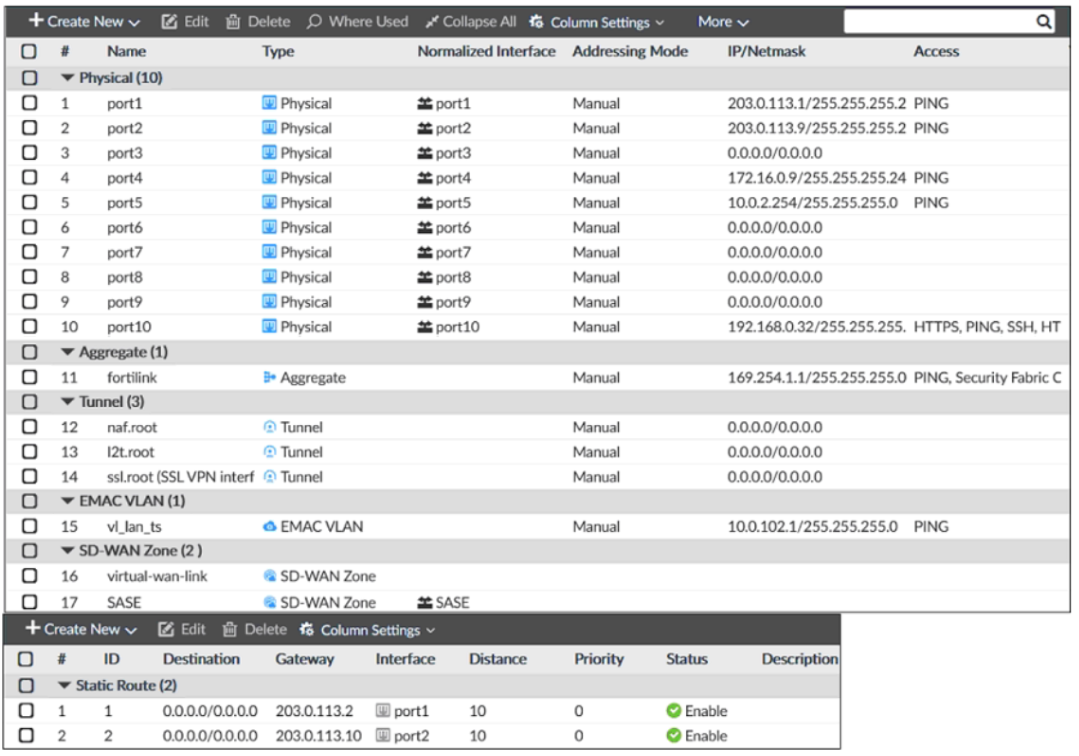

- port1 is assigned a manual IP address.
- port1 is referenced in a firewall policy.
- port2 is referenced in a static route.
- port1 and port2 are not administratively down.
Answer: B
3Which two statements are correct when traffic matches the implicit SD-WAN rule? (Choose two.)
- The sdwan_service_id flag in the session information is 0.
- All SD-WAN rules have the default setting enabled.
- Traffic does not match any of the entries in the policy route table.
- Traffic is load balanced using the algorithm set for the v4-ecmp-mode setting.
Answer:
4Refer to the exhibit. An administrator is troubleshooting SD-WAN on FortiGate. A device behind branch1_fgt generates traffic to the 10.0.0.0/8 network. The administrator expects the traffic to match SD-WAN rule ID 1 and be routed over T_INET_0_0. However, the traffic is routed over T_INET_1_0.
Based on the output shown in the exhibit, which two reasons can cause the observed behavior? (Choose two.)
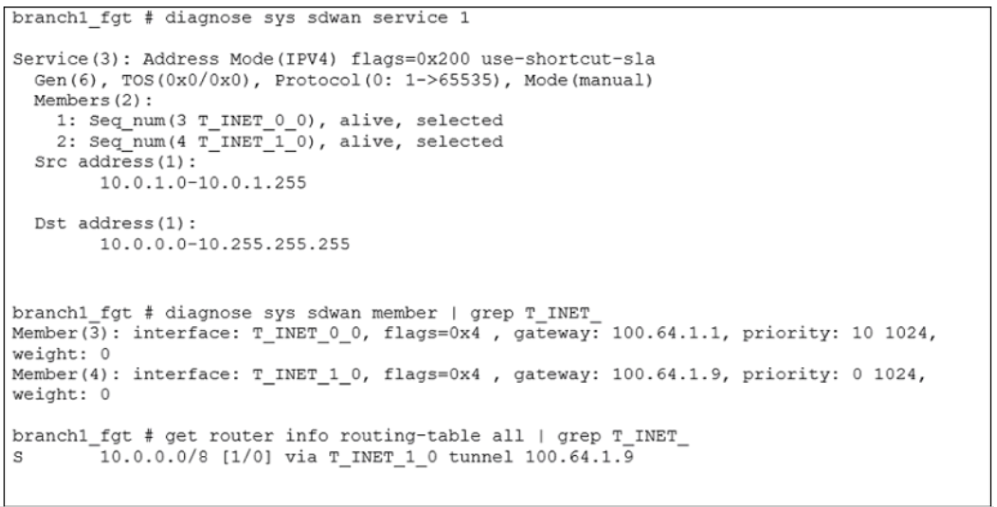
- The traffic matches a regular policy route configured with T_INET_1_0 as the outgoing device.
- T_INET_1_0 has a lower route priority value (higher priority) than T_INET_0_0.
- T_INET_0_0 does not have a valid route to the destination.
- T_INET_1_0 has a higher member configuration priority than T_INET_0_0.
Answer:
5Refer to the exhibit. Based on the exhibit, which two actions does FortiGate perform on sessions after a firewall policy change? (Choose two.)

- FortiGate flushes all sessions.
- FortiGate terminates the old sessions.
- FortiGate does not change existing sessions.
- FortiGate evaluates new sessions.
Answer:
6Which two statements about SD-WAN central management are true? (Choose two.)
- The objects are saved in the ADOM common object database.
- It does not support meta fields.
- It uses templates to configure SD-WAN on managed devices.
- It supports normalized interfaces for SD-WAN member configuration.
Answer:
7Refer to the exhibit. Which conclusion about the packet debug flow output is correct?

- The total number of daily sessions for 10.1.10.1 exceeded the maximum number of concurrent sessions configured in the traffic shaper, and the packet was dropped.
- The packet size exceeded the outgoing interface MTU.
- The number of concurrent sessions for 10.1.10.1 exceeded the maximum number of concurrent sessions configured in the traffic shaper, and the packet was dropped.
- The number of concurrent sessions for 10.1.10.1 exceeded the maximum number of concurrent sessions configured in the firewall policy, and the packet was dropped.
Answer: C
8Which are two benefits of using CLI templates in FortiManager? (Choose two.)
- You can reference meta fields.
- You can configure interfaces as SD-WAN members without having to remove references first.
- You can configure FortiManager to sync local configuration changes made on the managed device, to the CLI template.
- You can configure advanced CLI settings.
Answer:
9Refer to the exhibits.
Exhibit A - Exhibit B - Exhibit A shows the SD-WAN performance SLA and exhibit B shows the SD-WAN member status, the routing table, and the performance SLA status.
If port2 is detected dead by FortiGate, what is the expected behavior?
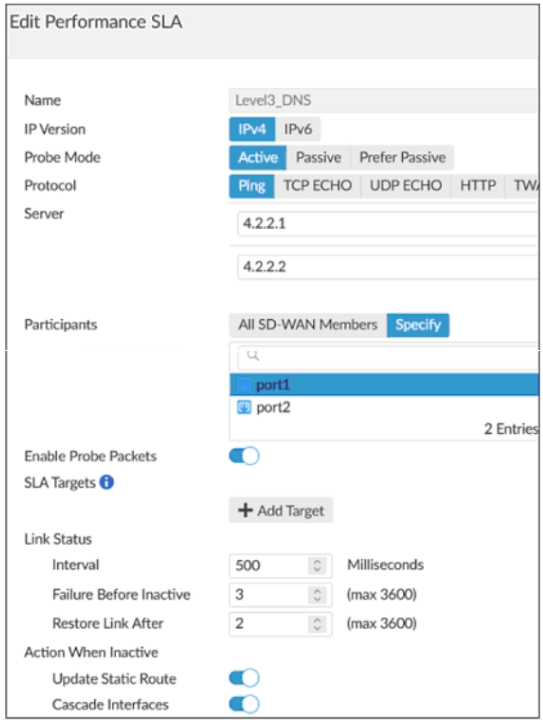
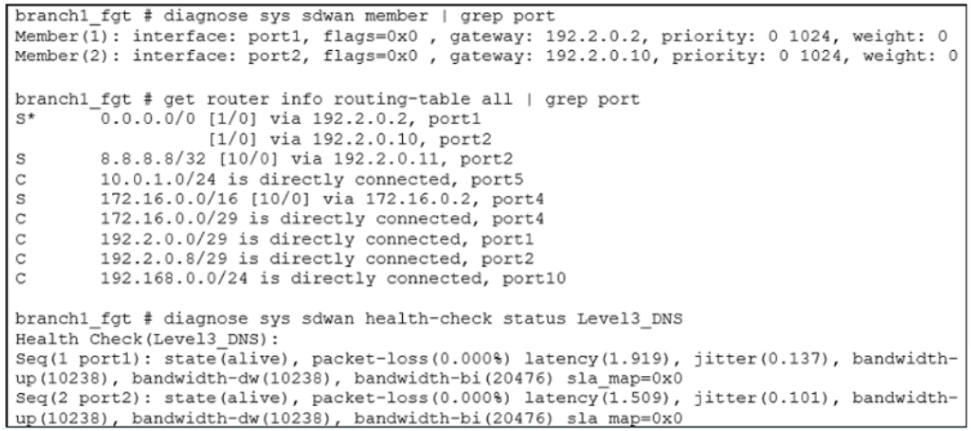
- Port2 becomes alive after three successful probes are detected.
- FortiGate removes all static routes for port2.
- The administrator manually restores the static routes for port2, if port2 becomes alive.
- Host 8.8.8.8 is reachable through port1 and port2.
Answer: B
10Refer to the exhibit. The device exchanges routes using IBGP.
Which two statements are correct about the IBGP configuration and routing information on the device? (Choose two.)

- Each BGP route is three hops away from the destination.
- ibgp-multipath is disabled.
- additional-path is enabled.
- You can run the get router info routing-table database command to display the additional paths.
Answer:
Want the full bank of 61 questions for NSE7_SDW-7.0? See all practice exams.