Fortinet NSE 6 - FortiNAC 7.6 Administrator — Free Practice Questions
10 free sample questions from a bank of 70, with the correct answers and explanations. No signup required — start practising right now.
- Secondary
- Worker
- Primary
- Manager
The short version
C — N+1 clusters build primary-first. The manager seeds from the primary.
Key concepts in this question
- Primary holds the authoritative dataset for cluster formation.
- Secondaries, workers, and managers join an existing primary.
Why C is correct
Primary-first is the documented N+1 build order.
Why the others are wrong
- A. Secondaries replicate; they do not seed.
- B. Workers compute; they do not found clusters.
- D. The manager orchestrates; the primary seeds.
FortiNAC exam tip
N+1 build order = primary first.
- The port will be provisioned to the isolation network.
- The port will be added to the Access Point Management group.
- The port will be provisioned for the normal state host, but the second host will have access to only the isolation portal page.
- The port will be provisioned as an uplink to a hub or unmanaged switch.
The short version
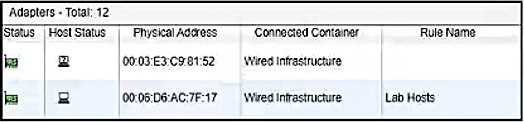
D — two MACs on one access port means a hub, so FortiNAC treats it as an uplink. A single port cannot carry two different VLAN outcomes at once.
Key concepts in this question
- Layer-2 poll learning: two hosts on the same port reveals a downstream hub or unmanaged switch.
- Single isolation VLAN limit: one port holds one VLAN, so split enforcement is impossible.
- Enforcement-group conflict: Role-Based Access plus Forced Registration demand different networks for different states.
Why D is correct
The exhibit lists two physical addresses learned on the same port after a successful layer-2 poll, proving a hub sits downstream. The port sits in both Role-Based Access and Forced Registration groups, so compliant and rogue hosts would need different networks, but the switch offers only a single isolation VLAN. FortiNAC cannot satisfy both outcomes on one VLAN-switched port, so it provisions the port as an uplink to a hub or unmanaged switch and exempts it from per-host provisioning rather than breaking one host.
Why the others are wrong
- A. Isolation would wrongly force the compliant host offline together with the rogue host.
- B. Access Point Management is for access points, with no access-point evidence here.
- C. Split provisioning is impossible on a single-VLAN port serving two hosts.
FortiNAC exam tip
Two hosts, one port, conflicting states equals hub uplink.
- A FortiNAC-F device designated as a secondary
- At least two FortiNAC-F devices designated as primary
- A dedicated VLAN for primary and secondary synchronization
- A FortiNAC-F manager
The short version
A and D — N+1 needs a designated secondary plus the FortiNAC manager. Failover target plus orchestrator.
Key concepts in this question
- Secondary designation provides the +1 failover capacity.
- The manager coordinates the N+1 topology.
Why A and D are correct
The two documented N+1 requirements.
Why the others are wrong
- B. Multiple primaries describe other topologies, not N+1.
- C. Dedicated sync VLANs are not the framed requirement.
FortiNAC exam tip
N+1 = secondary + manager.
- RADIUS group attribute
- Device profiling rule
- Model configuration
- Security rule
The short version
D — the security rule decides the tags. FortiNAC-F passes the firewall tags its security rule produces for dynamic address groups.
Key concepts in this question
- Firewall tags: NAC-computed labels consumed by FortiGate.
- Security rule: the policy object that yields tag values.
- Profiling/model contrast: identification feeds rules; rules decide tags.
Why D is correct
The values passed to FortiGate come from the FortiNAC-F security rule driving dynamic address-group membership.
Why the others are wrong
- A. RADIUS group attributes authenticate users; they set no firewall tags.
- B. Profiling rules identify devices; tags flow from security rules.
- C. Model configuration describes inventory, not tag values.
FortiNAC exam tip
Tags follow security rules; profiling only feeds them.
- DDNS
- HTTP/HTTPS
- DHCP
- NTP
- DNS
The short version
B, C, E — L3 isolation lifelines are HTTP/S, DHCP, and DNS. Portal, address, resolve.
Key concepts in this question
- HTTP/HTTPS serves the captive/remediation portal.
- DHCP + DNS give isolated hosts function.
Why B, C and E are correct
The three documented minimum isolation protocols (FNC-8.5 Q28 confirms DNS/DHCP/Web pattern).
Why the others are wrong
- A. DDNS is not an isolation requirement.
- D. NTP is not in the minimum set.
FortiNAC exam tip
Isolation minimum = HTTP/S, DHCP, DNS.
- When the port is connected to another modeled infrastructure device
- When the port is configured as a trunk port on the infrastructure device
- When the port shows more than 20 MAC addresses connected at the same time
- When the port is added to the Access Point Management group
The short version
C — 20+ MACs makes a learned uplink. Same threshold as FNC-8.5 Q7.
Key concepts in this question
- Learned uplinks exempt aggregation ports from endpoint enforcement.
- The 20-MAC default marks downstream infrastructure.
Why C is correct
Threshold-uplink promotion, matching FNC-8.5 Q7's confirmed answer.
Why the others are wrong
- A. Modeled devices show differently than learned uplinks.
- B. Trunk config alone does not promote.
- D. AP groups are explicit assignments, not learned states.
FortiNAC exam tip
20 MACs = learned uplink.
- 192.168.200.10
- 192.168.100.20
- 192.168.100.75
- 192.168.10.254
The short version
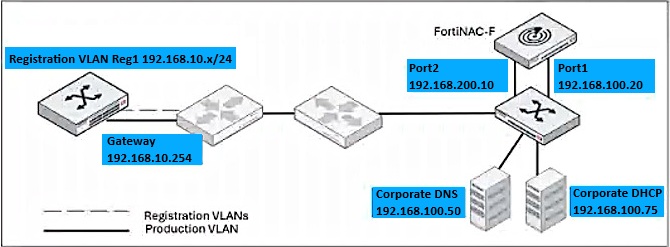
A — DHCP relay for the registration network points at the FortiNAC registration interface (.200.10). Same answer as Q35's duplicate.
Key concepts in this question
- Layer 3 registration relays DHCP to FortiNAC's registration-network address.
- The .200.10 address is the registration interface in this topology.
Why A is correct
Duplicate Q35 banked identically; cross-duplicate agreement.
Why the others are wrong
- B/C. The .100.x addresses belong to other networks.
- D. The .10.254 address is not the registration relay target.
FortiNAC exam tip
Duplicate relay stems = same relay address.
- The devices match more than one device profiling rule.
- The device profiling rule has registration set to manual.
- The devices have persistent agents installed, and the point of connection has PA optimization enabled.
- The confirm device profiling rule option is not enabled.
The short version
B — matched-but-unknown with No registration means manual. The rule requires an admin to register the device.
Key concepts in this question
- Profiled view: matched devices awaiting disposition.
- Manual registration: admin confirms before the device is known.
- Multi-match contrast: overlaps show differently, not as unknown-No.
Why B is correct
A profiling rule set to manual registration leaves matched devices unknown with registration No until confirmed.
Why the others are wrong
- A. Multi-matches flag conflicts, not unknown-No rows.
- C. Agent plus PA optimization affects visibility, not registration state.
- D. No such confirm option gates this view.
FortiNAC exam tip
Unknown plus No means manual registration is waiting. Confirm to clear.
- The devices can have scheduled connection status polling.
- The device will have historic connection logs.
- The devices can be associated with a logged on user.
- The devices will have connection logs.
The short version
A — modeled endpoints gain scheduled connection-status polling. Inventory presence enables check-ins.
Key concepts in this question
- Device modeling enrolls endpoints in polling schedules.
- Historic/user/connection logs are side benefits, not the advantage framed.
Why A is correct
Scheduled polling is the documented modeling advantage.
Why the others are wrong
- B. Historic logs accrue regardless.
- C. User association is a separate mapping.
- D. Connection logs are not the framed advantage.
FortiNAC exam tip
Model it = poll it on schedule.
- Endpoint information is pulled from the managed CAs by the FortiNAC-F manager at a set interval.
- Endpoint information is updated in real time when a host status changes.
- Endpoint information is pushed to the FortiNAC-F manager based on an administratively configured scheduled task.
- Endpoint information is updated when an administrator synchronizes with each CA.
The short version
A — the manager pulls endpoint data from CAs on a schedule. Interval polling, top-down.
Key concepts in this question
- Manager-to-CA pulls refresh the manager database periodically.
- Real-time, push, and manual-sync framings misstate the mechanism.
Why A is correct
Scheduled pulls are the documented update mechanism.
Why the others are wrong
- B. Status changes do not push in real time.
- C. No admin-scheduled push task exists.
- D. Manual sync is not the routine path.
FortiNAC exam tip
Manager updates = scheduled pulls.
Want the full bank of 70 questions for Fortinet NSE 6 - FortiNAC 7.6 Administrator? See all practice exams.