AWS Certified Machine Learning - Specialty — Free Practice Questions
10 free sample questions from a bank of 369, with the correct answers and explanations. No signup required — start practising right now.
1A large mobile network operating company is building a machine learning model to predict customers who are likely to unsubscribe from the service. The company plans to offer an incentive for these customers as the cost of churn is far greater than the cost of the incentive.
The model produces the following confusion matrix after evaluating on a test dataset of 100 customers: Based on the model evaluation results, why is this a viable model for production?

- The model is 86% accurate and the cost incurred by the company as a result of false negatives is less than the false positives.
- The precision of the model is 86%, which is less than the accuracy of the model.
- The model is 86% accurate and the cost incurred by the company as a result of false positives is less than the false negatives.
- The precision of the model is 86%, which is greater than the accuracy of the model.
Answer: C
2A Machine Learning Specialist has completed a proof of concept for a company using a small data sample, and now the Specialist is ready to implement an end- to-end solution in AWS using Amazon SageMaker. The historical training data is stored in Amazon RDS.
Which approach should the Specialist use for training a model using that data?
- Write a direct connection to the SQL database within the notebook and pull data in
- Push the data from Microsoft SQL Server to Amazon S3 using an AWS Data Pipeline and provide the S3 location within the notebook.
- Move the data to Amazon DynamoDB and set up a connection to DynamoDB within the notebook to pull data in.
- Move the data to Amazon ElastiCache using AWS DMS and set up a connection within the notebook to pull data in for fast access.
Answer: B
3A Data Scientist is developing a binary classifier to predict whether a patient has a particular disease on a series of test results. The Data Scientist has data on
400 patients randomly selected from the population. The disease is seen in 3% of the population.
Which cross-validation strategy should the Data Scientist adopt?
- A k-fold cross-validation strategy with k=5
- A stratified k-fold cross-validation strategy with k=5
- A k-fold cross-validation strategy with k=5 and 3 repeats
- An 80/20 stratified split between training and validation
Answer: B
4A technology startup is using complex deep neural networks and GPU compute to recommend the company's products to its existing customers based upon each customer's habits and interactions. The solution currently pulls each dataset from an Amazon S3 bucket before loading the data into a TensorFlow model pulled from the company's Git repository that runs locally. This job then runs for several hours while continually outputting its progress to the same S3 bucket. The job can be paused, restarted, and continued at any time in the event of a failure, and is run from a central queue.
Senior managers are concerned about the complexity of the solution's resource management and the costs involved in repeating the process regularly. They ask for the workload to be automated so it runs once a week, starting Monday and completing by the close of business Friday.
Which architecture should be used to scale the solution at the lowest cost?
- Implement the solution using AWS Deep Learning Containers and run the container as a job using AWS Batch on a GPU-compatible Spot Instance
- Implement the solution using a low-cost GPU-compatible Amazon EC2 instance and use the AWS Instance Scheduler to schedule the task
- Implement the solution using AWS Deep Learning Containers, run the workload using AWS Fargate running on Spot Instances, and then schedule the task using the built-in task scheduler
- Implement the solution using Amazon ECS running on Spot Instances and schedule the task using the ECS service scheduler
Answer: A
5A Machine Learning Specialist prepared the following graph displaying the results of k-means for k = [1..10]: Considering the graph, what is a reasonable selection for the optimal choice of k?
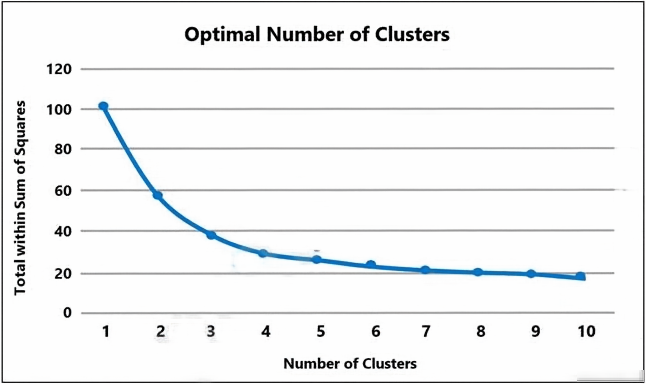
- 1
- 4
- 7
- 10
Answer: B
6A media company with a very large archive of unlabeled images, text, audio, and video footage wishes to index its assets to allow rapid identification of relevant content by the Research team. The company wants to use machine learning to accelerate the efforts of its in-house researchers who have limited machine learning expertise.
Which is the FASTEST route to index the assets?
- Use Amazon Rekognition, Amazon Comprehend, and Amazon Transcribe to tag data into distinct categories/classes.
- Create a set of Amazon Mechanical Turk Human Intelligence Tasks to label all footage.
- Use Amazon Transcribe to convert speech to text. Use the Amazon SageMaker Neural Topic Model (NTM) and Object Detection algorithms to tag data into distinct categories/classes.
- Use the AWS Deep Learning AMI and Amazon EC2 GPU instances to create custom models for audio transcription and topic modeling, and use object detection to tag data into distinct categories/classes.
Answer: A
7A Machine Learning Specialist is working for an online retailer that wants to run analytics on every customer visit, processed through a machine learning pipeline.
The data needs to be ingested by Amazon Kinesis Data Streams at up to 100 transactions per second, and the JSON data blob is 100 KB in size.
What is the MINIMUM number of shards in Kinesis Data Streams the Specialist should use to successfully ingest this data?
- 1 shards
- 10 shards
- 100 shards
- 1,000 shards
Answer: B
8A Machine Learning Specialist is deciding between building a naive Bayesian model or a full Bayesian network for a classification problem. The Specialist computes the Pearson correlation coefficients between each feature and finds that their absolute values range between 0.1 to 0.95.
Which model describes the underlying data in this situation?
- A naive Bayesian model, since the features are all conditionally independent.
- A full Bayesian network, since the features are all conditionally independent.
- A naive Bayesian model, since some of the features are statistically dependent.
- A full Bayesian network, since some of the features are statistically dependent.
Answer: D
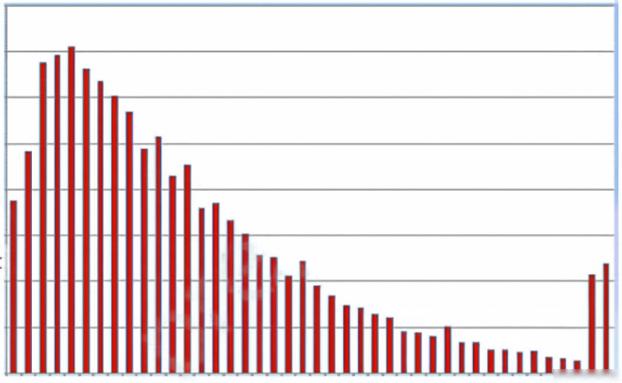
9A Data Scientist is building a linear regression model and will use resulting p-values to evaluate the statistical significance of each coefficient. Upon inspection of the dataset, the Data Scientist discovers that most of the features are normally distributed. The plot of one feature in the dataset is shown in the graphic. What transformation should the Data Scientist apply to satisfy the statistical assumptions of the linear regression model?
- Exponential transformation
- Logarithmic transformation
- Polynomial transformation
- Sinusoidal transformation
Answer: B
10A Machine Learning Specialist is assigned to a Fraud Detection team and must tune an XGBoost model, which is working appropriately for test data. However, with unknown data, it is not working as expected. The existing parameters are provided as follows. Which parameter tuning guidelines should the Specialist follow to avoid overfitting?
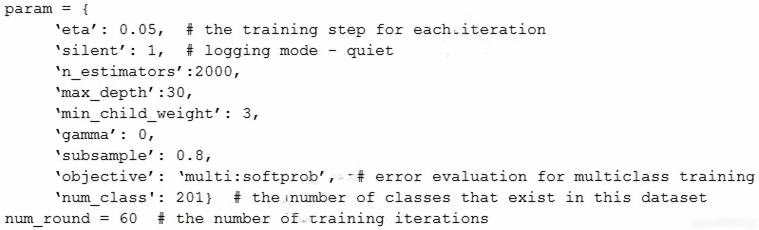
- Increase the max_depth parameter value.
- Lower the max_depth parameter value.
- Update the objective to binary:logistic.
- Lower the min_child_weight parameter value.
Answer: B
Want the full bank of 369 questions for AWS Certified Machine Learning - Specialty? See all practice exams.