MD-100 — Free Practice Questions
10 free sample questions from a bank of 460, with the correct answers and explanations. No signup required — start practising right now.
1Your network contains an Active Directory domain. All users have been issued with new computers that run Windows 10 Enterprise. All users have Microsoft 365
E3 licenses.
A user named Mia Hamm has an Active Directory user account named MHamm and a computer named Computer1. Mia Hamm reports that Computer1 is not activated.
You need to ensure that Mia Hamm can activate Computer1.
What should you do?
- Assign a Windows 10 Enterprise license to MHamm, and then activate Computer1.
- From the Microsoft Deployment Toolkit (MDT), redeploy Computer1.
- From System Properties on Computer1, enter a Volume License Key, and then activate Computer1.
- Instruct Mia Hamm to perform a local AutoPilot Reset on Computer1, and then activate Computer1.
Answer: D
2SIMULATION -
You have a computer named Computer1 that runs Windows 10.
Computer1 has a folder named C:\Folder1.
You need to meet the following requirements:
✑ Provide a user named Jon Ross with the ability to modify the permissions of C:\Folder1.
✑ Ensure that the principle of least privilege is maintained.
What should you do?
To complete this task, sign in to the required computer or computers.
Answer:
3Your network contains an Active Directory domain. The domain contains computers that run Windows 10.
You must ensure that Windows BitLocker Drive Encryption is enabled on all client computers, even though a Trusted Platform Module (TPM) chip is installed in only some of them.
You need to accomplish this goal by using one Group Policy object (GPO).
What should you do?
- Enable the Allow enhanced PINs for startup policy setting, and select the Allow BitLocker without a compatible TPM check box.
- Enable the Enable use of BitLocker authentication requiring preboot keyboard input on slates policy setting, and select the Allow BitLocker without a compatible TPM check box.
- Enable the Require additional authentication at startup policy setting, and select the Allow BitLocker without a compatible TPM check box.
- Enable the Control use of BitLocker on removable drives policy setting, and select the Allow BitLocker without a compatible TPM check box.
Answer: C
4SIMULATION -
You have a computer named Computer1. Computer1 runs Windows 10 Pro.
You have a mobile device. You use Bluetooth to pair the mobile device to Computer1.
You want to enable dynamic lock on Computer1.
What should you do?
To complete this task, sign in to the required computer or computers.
Answer:
5HOTSPOT -
Your network contains an Active Directory domain. The domain contains computers that run Windows 10.
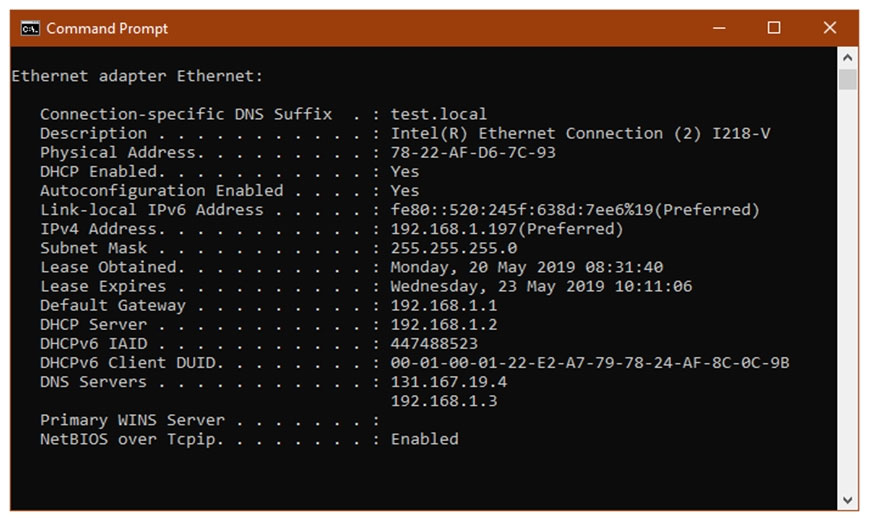
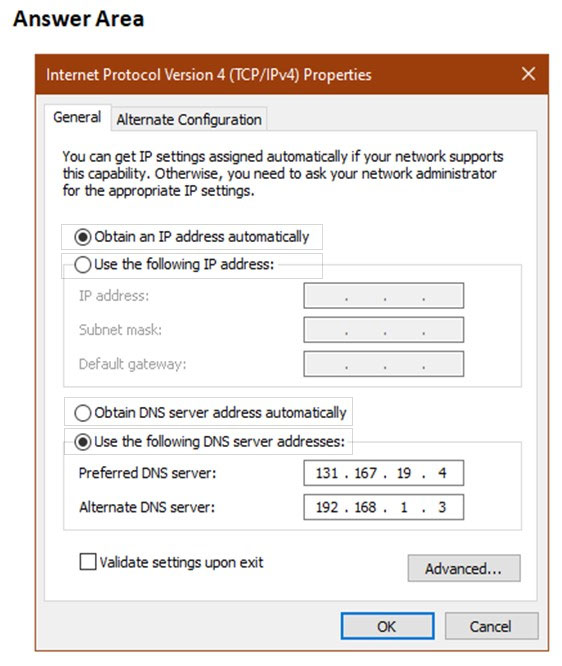
A user named Mia Hamm has a computer named Computer1. Mia Hamm reports that when she logs on to Computer1, she cannot access servers on the network but she can access computers on the internet.
You run the ipconfig command on Computer1 and receive the following output. You successfully ping the default gateway, the DNS servers, and the DHCP server.
You need to resolve the connectivity problem on Computer1.
Which setting should you configure? To answer, select the appropriate options in the answer area.
Hot Area:
Answer:
6SIMULATION -
You have a computer named Computer1. Computer1 runs Windows 10 Pro. Computer1 has a cellular connection and a Wi-Fi connection.
You want to prevent Computer1from using the cellular connection unless a you manually connects to the cellular network.
What should you do?
To complete this task, sign in to the required computer or computers.
Answer:
7You have a computer named Computer1. Computer1 runs Windows 10 Pro.
Computer1 is experiencing connectivity issues.
You need to view the IP addresses of any remote computer that Computer1 has an active TCP connection to.
Should you do?
- In Windows Administrative Tools, open Performance Monitor.
- In the Control Panel, open Network and Internet. Then select Network and Sharing Center.
- In Windows Administrative Tools, open Resource Monitor.
- In the Setting app, open Update and Security. Then open Windows Security and select Firewall and Network protection.
Answer: C
8You have a computer named Computer1. Computer1 runs Windows 10 Pro.
You attempt to start Computer1 but you receive the following error message:
Bootmgr is missing.
You need to be able to start Computer1.
What should you do?
- Start the computer in recovery mode and run the bootrec /rebuildbcd command.
- Start the computer in recovery mode and run the diskpart /repair command.
- Start the computer in recovery mode and run the bcdboot /s command.
- Start the computer in recovery mode and run the bootcfg /debug command.
Answer: A
9Your company has several mobile devices that run Windows 10.
You need configure the mobile devices to meet the following requirements:
✑ Windows updates may only be download when mobile devices are connect to Wi-Fi.
✑ Access to email and the Internet must be possible at all times.
What should you do?
- Open the Setting app and select Update & Security. Then select and configure Change active hours.
- Open the Setting app and select Network & Internet. Then select Change connection properties, and set the Metered connection option for cellular network connections to On.
- Open the Setting app and select Network & Internet. Then select Data Usage and set a data limit.
- Open the Setting app and select Update & Security. Then select and configure Delivery Optimization.
Answer: B
10Your company has an on-premises network that contains an Active Directory domain. The domain is synced to Microsoft Azure Active Directory (Azure AD). All computers in the domain run Windows 10 Enterprise.
You have a computer named Computer1 that has a folder named C:\Folder1.
You want to use File History to protect C:\Folder1.
Solution: You enable File History on Computer1. You then enable archiving for Folder1.
Does this meet the goal?
- Yes
- No
Answer: B
Want the full bank of 460 questions for MD-100? See all practice exams.