Home/Juniper/JN0-664: Service Provider Routing and Switching, Professional (JNCIP-SP)/Free questions
JN0-664: Service Provider Routing and Switching, Professional (JNCIP-SP) — Free Practice Questions
10 free sample questions from a bank of 59, with the correct answers and explanations. No signup required — start practising right now.
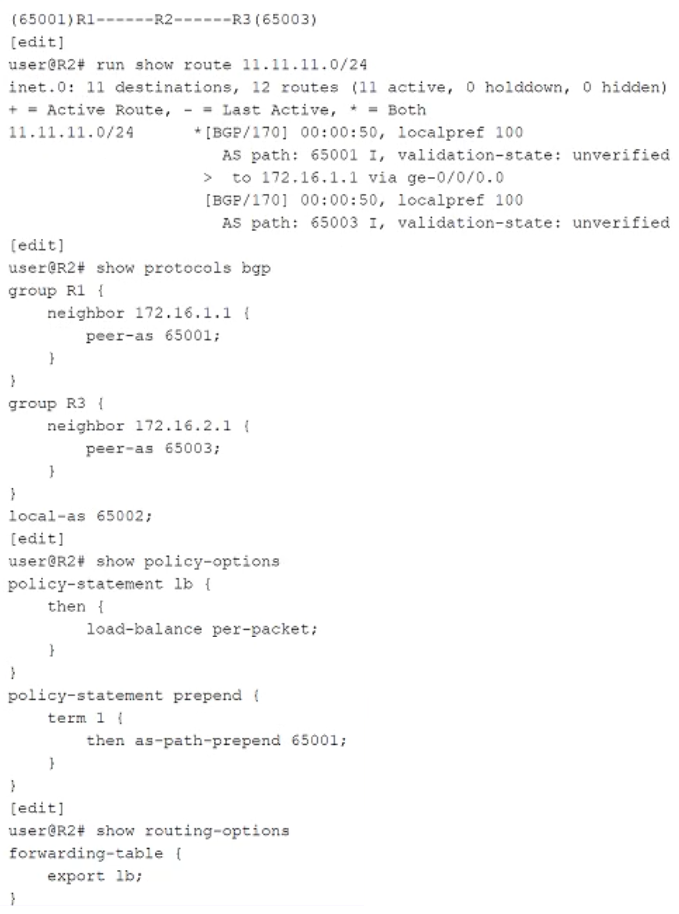
1Click the Exhibit button.
R2 is receiving the same route from R1 and R3. You must ensure that you can load balance traffic for that route.
Referring to the exhibit, which configuration change will allow load balancing?
- Configure the multipath parameter under the global BGP configuration.
- Apply the prepend policy as an import policy under group R1.
- Configure the multipath multiple-as parameter under the global BGP configuration.
- Apply the prepend policy as an import policy under group R3.
Answer: C
2Click the Exhibit button.
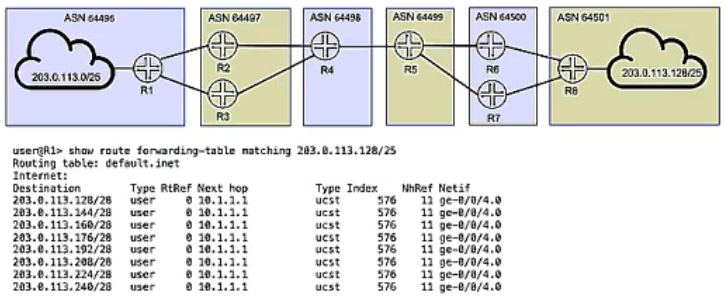
You are troubleshooting the connection between AS 64496 and AS 64497 and notice that only one of the paths is being used for traffic forwarding.
Referring to the exhibit, which three actions will ensure that R1 is configured properly for load balancing BGP routes? (Choose three.)
- Verify that the routing table on R1 has BGP routes for 203.0.113.128/25 with multiple next hops.
- Verify that the multipath option is configured under protocols bgp on both R2 and R3.
- Verify that there is a load balancing export policy under routing-options for the received BGP routes on R1.
- Verify that the multipath option is configured under protocols bgp on R1.
- Verify that an import load balancing policy exists under protocols bgp for the received BGP routes on R1.
Answer: A, C, D
3After a recent power outage, your manager asks you to investigate ways to automatically reduce the impact caused by suboptimal routing in your OSPF and OSPFv3 network after devices reboot.
Which three configuration statements accomplish this task? (Choose three.)
- set protocols ospf3 realm ipv4-unicast overload timeout 900
- set protocols ospf overload
- set protocols ospf overload timeout 900
- set protocols ospf3 overload
- set protocols ospf3 overload timeout 900
Answer: A, C, E
4You are configuring anycast RP for load balancing and redundancy in your PIM-SM domain. You want to share active sources between RPs.
In this scenario, what are two solutions that will accomplish this task? (Choose two.)
- Configure MSDP on each RP router.
- Configure anycast PIM with the rp-set statement on each RP router.
- Configure anycast PIM with the rp-set statement on each source DR router.
- Configure MSDP on each source DR router.
Answer: A, B
5Which two statements are correct about VPLS tunnels? (Choose two.)
- BGP-signaled VPLS tunnels require manual provisioning of sites.
- LDP-signaled VPLS tunnels only support control bit 0.
- LDP-signaled VPLS tunnels use auto-discovery to provision sites.
- BGP-signaled VPLS tunnels can use either RSVP or LDP between the PE routers.
Answer: B, D
6Click the Exhibit button.
Referring to the exhibit, which two statements are true? (Choose two.)
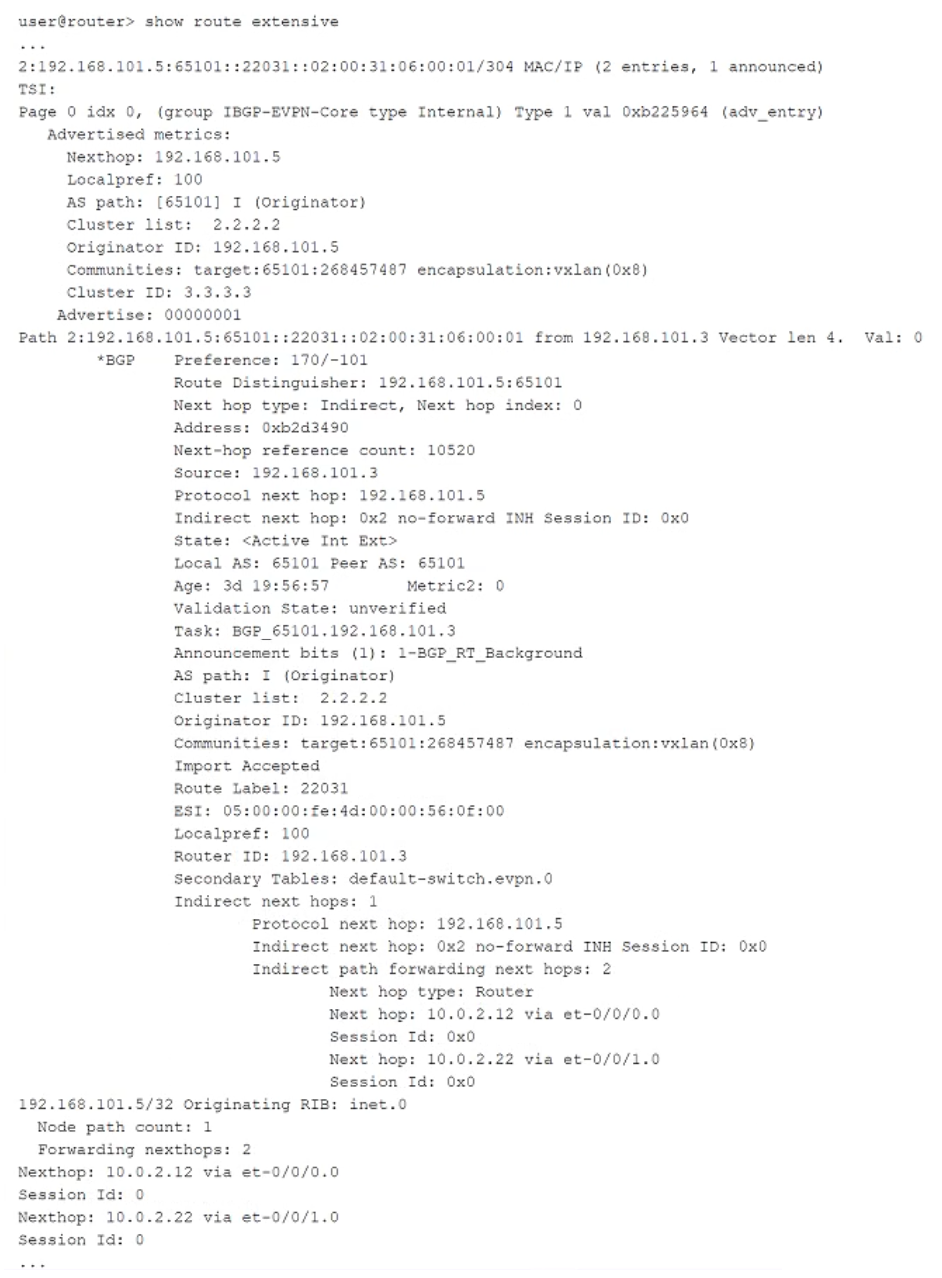
- The devices advertising this route into EVPN are 10.0.2.12 and 10.0.2.22.
- This route is learned through EBGP.
- The device advertising this route into EVPN is 192.168.101.5.
- This is an EVPN Type-2 route.
Answer: C, D
7Click the Exhibit button.
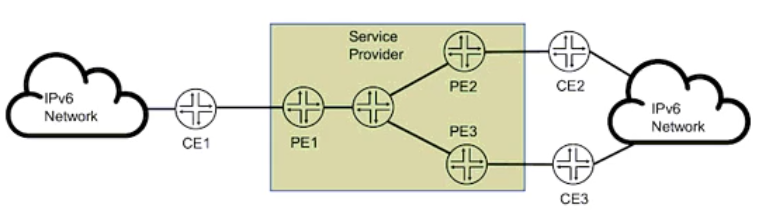
You are running a service provider network and must transport a customer's IPv6 traffic across your IPv4-based MPLS network using BGP. You have already configured mpls ipv6-tunneling on your PE routers.
Which two statements are correct about the BGP configuration in this scenario? (Choose two.)
- You must configure family inet6 labeled-unicast between PE routers.
- You must configure family inet6 add-path between PE and CE routers.
- You must configure family inet6 unicast between PE and CE routers.
- You must configure family inet6 unicast between PE routers.
Answer: A, C
8When using 0SPFv3 for an IPv4 environment, which statement is correct?
- OSPFv3 only supports IPv4.
- OSPFv3 is not backward compatible with IPv4.
- OSPFv3 supports both IPv6 and IPv4, but not in the same routing instance.
- OSPFv3 supports IPv4 only on interfaces with family inet6 defined.
Answer: D
9You are a network architect for a service provider and want to offer Layer 2 services to your customers. You want to use EVPN for Layer 2 services in your existing MPLS network.
Which two statements are correct in this scenario? (Choose two.)
- Segment routing must be configured on all PE routers.
- EVPN uses Type 2 routes to advertise MAC address and IP address pairs learned using ARP snooping.
- EVPN uses Type 3 routes to join a multicast tree to flood traffic.
- VXLAN must be configured on all PE routers.
Answer: B, C
10You are configuring a Layer 3 VPN between two sites. You are configuring the vrf-target target: 65100:100 statement in your routing instance.
In this scenario, which two statements describe the vrf-target configuration? (Choose two.)
- This value is used to identify BGP routes learned from the remote PE device.
- This value is used to add a target community to BGP routes advertised to the local CE device.
- This value is used to add a target community to BGP routes advertised to the remote PE device.
- This value is used to identify BGP routes learned from the local CE device.
Answer: A, C
Want the full bank of 59 questions for JN0-664: Service Provider Routing and Switching, Professional (JNCIP-SP)? See all practice exams.