JN0-650: Enterprise Routing and Switching, Professional (JNCIP-ENT) — Free Practice Questions
10 free sample questions from a bank of 10, with the correct answers and explanations. No signup required — start practising right now.
1Click the Exhibit button.
You want to limit port access to only one device at a time.
Referring to the exhibit, which configuration change will accomplish this task?
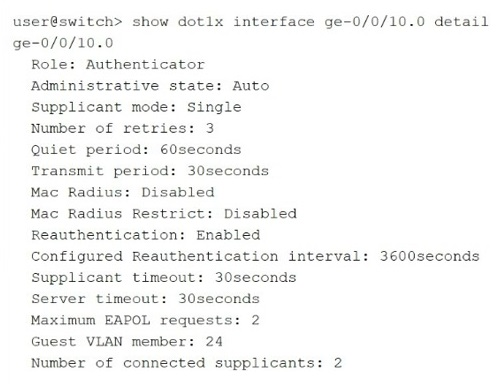
- Enable MAC RADIUS restrict.
- Change the supplicant mode to multiple.
- Change the supplicant mode to single-secure.
- Change the maximum EAPOL request to 1.
Answer: C
2Your OSPF network consists of a mix of 1GbE and 10GbE interfaces. By default, all interfaces have the same cost in your OSPF network. You are asked to ensure that the 10GbE interfaces are more preferred when available.
In this scenario, which two statements would accomplish this behavior? (Choose two.)
- You should define the reference bandwidth as 10G, which will assign the 1GbE interfaces a higher cost.
- You should manually assign the interface metric for each 10GbE interface to be higher than the 1GbE interfaces in your OSPF network.
- You should define the reference bandwidth as 1G, which will assign the 1GbE interfaces a higher cost.
- You should manually assign the interface metric for each 1GbE interface to be higher than the 10GbE interfaces in your OSPF network.
Answer: A, D
3You have two multicast receivers connected to the same VLAN. You notice that the switch that they are connected to is forwarding multicast traffic out of all the ports in the same VLAN, instead of just the two ports for the connected multicast receivers.
In this scenario, what would you configure to optimize multicast forwarding?
- promiscuous mode
- spanning tree
- IGMP snooping
- IRB interface
Answer: C
4You are implementing an EVPN-VXLAN edge-routed bridging design using Layer 3 gateway operations.
In this scenario, which statement is correct?
- Each distribution switch has unique IP addresses for IRB interfaces; routing protocols run on IRB interfaces.
- Distribution switches share the same anycast IP addresses for IRB interfaces; routing occurs at the distribution layer.
- Only core switches have IRB interfaces; all Layer 3 routing happens in the core.
- IRB interfaces are disabled; all routing happens through external routers only.
Answer: B
5Which statement about LLDP and LLDP-MED operations on EX Series devices is correct?
- LLDP only operates on interfaces configured for Layer 2.
- EX Series devices flood LLDP frames across a Layer 2 domain to calculate a network topology.
- EX Series devices support LLDP-MED power negotiation, enabling dynamic allocation of PoE power based on endpoint device needs.
- LLDP-MED focuses on discovering network connectivity devices like routers and switches.
Answer: C
6Click the Exhibit button.
Referring to the exhibit, leaf2 is elected the designated forwarder.
Which two statements are correct if server2 generates a broadcast frame? (Choose two.)
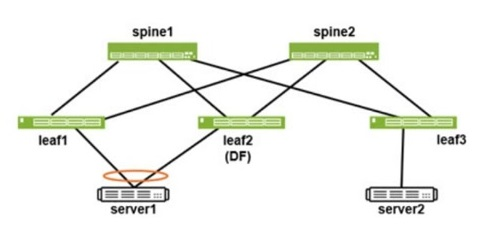
- The broadcast frame will be forwarded to leaf1 and leaf2.
- The broadcast frame will not be forwarded to leaf1.
- Only leaf2 will forward the broadcast frame to server1.
- Only leaf1 will forward the broadcast frame to server1.
Answer: A, C
7Which two statements correctly describe how EX Series switches use captive portal for Layer 2 authentication? (Choose two.)
- The captive portal is the default Layer 2 authentication method that is applied before other methods such as 802.1X or MAC RADIUS.
- The captive portal authentication allowlist works for devices that do not have HTTP capabilities.
- The captive portal is configured on Layer 3 interfaces and does not participate in Layer 2 authentication on EX Series switches.
- The captive portal is used as a fallback mechanism for clients that fail 802.1X or MAC RADIUS authentication.
Answer: B, D
8Click the Exhibit button.
Referring to the exhibit, which two statements are correct? (Choose two.)
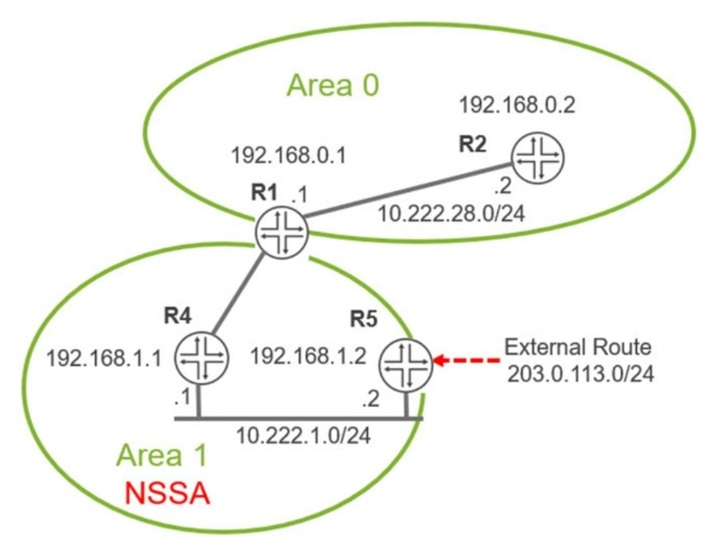
- R1 will advertise the 203.0.113.0/24 route as an OSPF Type 7 LSA into Area 0.
- R5 will advertise the 203.0.113.0/24 route as an OSPF Type 5 LSA into Area 1.
- R1 will advertise the 203.0.113.0/24 route as an OSPF Type 5 LSA into Area 0.
- R5 will advertise the 203.0.113.0/24 route as an OSPF Type 7 LSA into Area 1.
Answer: C, D
9You are deploying a new campus switching environment using EX Series switches. This new environment includes IP phones requiring Power over Ethernet (PoE) and end-user client PCs attached to a single switch port that will be configured with 802.1X authentication.
Considering the default configuration on an EX Series access switch and the configuration requirements to support this deployment, which two statements are correct? (Choose two.)
- Configuration for the voice VLAN for all relevant access ports must be added.
- Configuration for PoE on all relevant access ports must be added.
- Configuration for LLDP and LLDP-MED on all relevant access ports must be added.
- Configuration for 802.1X on all relevant access ports must be added.
Answer: A, D
10Which two statements are correct about multicast routing tables? (Choose two.)
- inet.2 is used when the multi cast forwarding topology differs from unicast forwarding.
- MBGP and IS-IS place routes in inet.1 directly.
- inet.0 is used for RPF checks.
- IS-IS and OSPFv3 place routes in inet.2 directly.
Answer: A, C
Want the full bank of 10 questions for JN0-650: Enterprise Routing and Switching, Professional (JNCIP-ENT)? See all practice exams.