Service Provider Routing and Switching, Specialist (JNCIS-SP) — Free Practice Questions
10 free sample questions from a bank of 10, with the correct answers and explanations. No signup required — start practising right now.
- IS-IS
- OSPFv2
- BGP
- IGMP
The short version
A and C — IS-IS and BGP are the two protocols that build IPv6 routing state dynamically.
IS-IS advertises IPv6 reachability in IPv6-specific TLVs inside the same adjacency it already uses for IPv4, and BGP carries IPv6 prefixes in MP-BGP; OSPFv2 is IPv4-only by definition and IGMP never installs unicast routes.
Key concepts
- IS-IS: a link-state IGP whose packet format is address-family agnostic. IPv6 prefixes travel in TLV 236 (IPv6 Reachability) and IPv6 interface addresses in TLV 232, so one adjacency serves both address families.
- MP-BGP: multiprotocol BGP, where IPv6 routes are carried as AFI 2 / SAFI 1 NLRI and the reachable next hop is advertised separately inside the MP_REACH_NLRI attribute.
- OSPFv2: version 2 of OSPF, defined by RFC 2328 for IPv4 only. IPv6 needs OSPFv3 (RFC 5340), a separate protocol and separate instance type on Junos.
- IGMP: Internet Group Management Protocol, an IPv4 host-to-router multicast group membership protocol. It populates no routing table; it only tells a router which receivers exist on a link.
Why A and C are correct
- A. IS-IS is a network-layer routing protocol that does not parse IP itself, so the Level-1 and Level-2 adjacencies already formed for IPv4 can also advertise IPv6 reachability. With IPv6 enabled on the IS-IS interface and the IS-IS instance, Junos computes a single SPF per level that installs IPv4 and IPv6 next hops from the same topology database.
- C. BGP reached IPv6 through multiprotocol extensions: a distinct address family (
address-family ipv6 unicast) carries the IPv6 prefix together with its reachable next hop. That is how IPv6 reachability is propagated between domains and toward providers, and it is why BGP is the protocol actually used for IPv6 peering at scale.
Why the others are wrong
- B. OSPFv2 is an IPv4-only protocol (RFC 2328). The IPv6 instance of OSPF is OSPFv3, a different protocol with its own packet format, addressing and instance type in Junos. An OSPFv2 process can neither originate nor compute an IPv6 route, so it can never be part of an IPv6 dynamic routing solution.
- D. IGMP is a multicast group membership protocol running between hosts and the local router. It performs no path computation, creates no prefix entries, and is IPv4-only (its IPv6 counterpart is MLD). It is a local link protocol, not a dynamic routing protocol.
JN0-364 exam tip
Classify the protocol first: address-family agnostic (IS-IS, BGP) or IPv4-baked (OSPFv2, IGMP). The classic distractor pair is "OSPFv2 for IPv6" — IPv6 OSPF is always OSPFv3.
- The route with the lower origin code.
- The route with the higher local preference.
- The route with the shorter AS path.
- The route with the lowest MED value.
The short version
B — The route with the higher local preference is selected.
Junos runs the BGP best-path algorithm as an ordered cascade, and local preference is the first attribute compared; AS path length, origin and MED are only examined later, and only if the earlier attributes are tied.
Key concepts
- Local preference: an unsigned integer (default 100) that only carries meaning inside an AS. The highest local preference wins; it is the primary traffic-steering knob and is set with import/export policy (
then local-preference). - AS path: the ordered list of AS numbers the route has traversed. It is compared only after local preference and provides loop prevention as a side effect.
- Origin: the IGP/EGP/Incomplete attribute, ranked below AS path in the decision process.
- MED (multi-exit discriminator): a hint about the preferred entry point, compared after AS path and origin, and in Junos only among paths learned from the same neighboring AS.
- Decision order: local preference, then AS path, then origin and MED, then eBGP over iBGP, then lowest IGP metric toward the next hop, then oldest route.
Why B is correct
The best-path algorithm is not a scoring system; it is a sequence of filters applied in a fixed order, and the first attribute that differs between two candidate paths ends the comparison. Local preference sits at the top of that sequence, so a path carrying the higher local-preference value is installed as active regardless of the fact that its AS path is one hop longer. Local preference is deliberately placed above AS path so an operator can force traffic toward a preferred exit or transit path with policy even when that means a longer AS traversal — which is exactly the trade-off described in the question.
Why the others are wrong
- A. A lower origin code (IGP beats EGP beats Incomplete) is checked only after local preference and AS path have failed to discriminate. Here local preference already separated the two paths, so the origin values are never consulted.
- C. AS path length is the second step in the cascade, not the first. A shorter AS path only wins when the candidate paths have equal local preference, so it loses here despite being the "shorter" path.
- D. MED is compared even later — after local preference, AS path and origin — and only between paths received from the same neighboring AS. It is a tiebreaker, not a selector, so the lowest MED cannot win once local preference has decided the outcome.
JN0-364 exam tip
Burn this order in: local preference, then AS path, then origin/MED, then eBGP over iBGP, then IGP metric. Whatever attribute differs first wins outright — nothing below it is even evaluated.
- label swap
- label pop
- label push
- label rewrite
The short version
C — Imposing a label on an unlabeled packet is a label push.
The push operation happens at the ingress (tail-end) LSR that takes a native IP packet and builds the LSP hop by hop; swap is the transit operation and pop is the egress operation.
Key concepts
- Label push: the operation at the ingress LSR that reads the IP destination, consults the FIB for an LSP, copies the packet and prepends the outgoing label. Nothing is removed — a label is added, which is why "push" is sometimes called "impose".
- Label swap: the transit operation at a penultimate hop: read the incoming label, look it up in the LIB, replace it with the outgoing label for the next hop, and forward.
- Label pop: the egress operation at the penultimate/penultimate-hop router that removes the top label and forwards the packet as IP again; the penultimate hop popping the label is the usual way to avoid a second lookup at the egress.
- PHP (penultimate hop popping): the common design where the second-to-last LSR removes the label so the egress only performs an IP lookup.
- Ingress/transit/egress roles: ingress (tail end) pushes, transit swaps, egress pops — the three operations that define LSR behaviour in the MPLS data plane.
Why C is correct
An unlabeled packet entering an LSR has no label stack at all, and the only way an MPLS frame appears is for some router to build the stack. That build is the push: the ingress router matches the IP prefix in the FIB to an LSP, duplicates the packet, and prepends the label allocated for the LSP's outgoing interface. The terminology is deliberately symmetric — push adds a label, swap replaces a label, pop removes one — and "impose" is used in vendor and IETF documentation as the exact synonym for push.
Why the others are wrong
- A. A label swap requires an incoming label to swap. At the point where an unlabeled IP packet first enters the MPLS domain there is no top label to replace, so a swap is impossible; a swap only happens on a transit hop that already carries a label.
- B. A label pop is a removal operation performed on a labeled packet, typically at the penultimate hop before the egress router. Removing a label from an unlabeled packet accomplishes nothing and would not produce a forwarding decision.
- D. "Label rewrite" is not one of the three MPLS forwarding operations (push/swap/pop). Rewriting is what happens at the header level when a label is swapped for another value, but there is no such forwarding operation called "label rewrite" in MPLS terminology.
JN0-364 exam tip
Push in, swap in the middle, pop at the end — memorize the three operations in ingress/transit/egress order and every "what is this operation" question becomes free.
- inet6.0
- mpls.0
- inet.0
- inet.3
The short version
B — The MPLS Label Information Base lives in the mpls.0 table.
mpls.0 is the label table that maps each incoming label to its forwarding (swap/pop) action, while inet.0 and inet.3 are IP routing tables and inet6.0 is the IPv6 unicast table.
Key concepts
- mpls.0: the MPLS label table, equivalent of a label FIB. Each entry maps a label plus optional interface to a swap label, a pop action, or a forwarding next hop.
- LIB (Label Information Base): the MPLS equivalent of a routing table, populated by LDP, RSVP-TE or static label configuration. In Junos it is realised as the mpls.0 table.
- inet.0: the primary IPv4 unicast routing table, holding the RIB routes that feed the inet.0 FIB.
- inet.3: the VPN IPv4 routing table (RFC 4364 "VPN inet"), used for MPLS L3VPN route installation.
- inet6.0: the primary IPv6 unicast routing table, the IPv6 counterpart of inet.0.
Why B is correct
MPLS forwarding is a two-step lookup: first the incoming label is resolved in the label table, and the result of that lookup either points directly at an outgoing interface and next-hop label or resolves to the IP prefix that is then looked up in the unicast table. Junos implements the first step in a dedicated table named mpls.0, and that table is the LIB — it holds every label binding learned from LDP, signalled by RSVP-TE, or configured statically, keyed by label and (for labeled interfaces) input interface. Because the label stack is protocol-specific, it can never live in an IP routing table, so inet.0, inet.3 and inet6.0 are all wrong by construction.
Why the others are wrong
- A. inet6.0 is the IPv6 unicast routing table. It holds IPv6 prefixes and next hops for ordinary IP forwarding; it has no notion of a 20-bit MPLS label and is never consulted for a labeled packet.
- C. inet.0 is the IPv4 unicast routing table used to resolve IP prefixes, and for the L3VPN instance it holds VRF routes as well. It does not store label bindings, so an MPLS label lookup would miss entirely.
- D. inet.3 is the VPN IPv4 routing table used to install MPLS L3VPN routes from the BGP VPN table. Its entries are IP prefixes with VPN attributes, not label-to-action bindings, so it is not the LIB.
JN0-364 exam tip
Learn the table map as: mpls.0 = labels, inet.0/inet6.0 = unicast IPv4/IPv6, inet.3/inet.6 = VPN tables. Any "which table" question is then a lookup in that map.
- inet.0
- inet.1
- inet.2
- inet.3
The short version
A — inet.0, by default, holds the list of ingress LSPs.
Every RSVP-signalled or statically configured LSP that originates on this router is recorded in the ingress LSP list, which lives in inet.0 unless an operator deliberately points it elsewhere.
Key concepts
- Ingress LSP: an LSP whose head-end (tail-end for the traffic) is this router. Ingress LSPs are what the local router must forward traffic into.
- RSVP-TE: the signalling protocol that creates ingress LSPs on demand via Path/Resv messages; the reservation is installed as an ingress LSP.
- Ingress LSP list: the set of LSPs with this router as head end, used to install forwarding state; by default these are kept in the inet.0 routing table.
- inet.1 / inet.2 / inet.3: the alternate and VPN inet tables. inet.1 and inet.2 are the multicast inet tables used when the multicast forwarding topology differs from unicast, and inet.3 is the VPN IPv4 table.
Why A is correct
An ingress LSP is only useful if the router keeps a record of it that the forwarding path can use, so every RSVP-TE or static LSP whose head end is local is installed as an ingress LSP entry in a routing table on the head-end router. Junos defaults that storage to inet.0, which is why show route and the ingress LSP output list the LSPs there by default. The inet.1, inet.2 and inet.3 tables exist for completely different purposes — alternate multicast topologies and VPN routes — and have no role in storing LSPs, so the only table in the list that can hold the ingress LSP list is inet.0.
Why the others are wrong
- B. inet.1 is an alternate inet table used when the multicast forwarding topology must differ from the unicast one (for example a separate RPF or multicast-only route set). It is not the default store for LSPs.
- C. inet.2 serves the same multicast-alternate-topology purpose on the R2 device family; like inet.1 it exists for multicast routing separation, not for ingress LSP bookkeeping.
- D. inet.3 is the VPN IPv4 routing table into which BGP VPN routes are installed. LSPs are MPLS objects, not VPN routes, so they are never recorded there by default.
JN0-364 exam tip
The trick: RSVP-TE creates ingress LSPs, and ingress LSPs default to inet.0 — while inet.1/inet.2 are multicast-alternate and inet.3 is VPN. Remember which table means what before you answer.
- The accept-data parameter must be added to the VRRP configuration.
- The preempt parameter must be added to the VRRP configuration.
- The backup router requires the track parameter to track the primary router's interface.
- Both routers running VRRP will require a static ARP entry to be configured for the VRRP VIP
The short version
B — The preempt parameter must be added to the VRRP group.
Preemption lets a higher-priority router take the master role back the moment it returns, which is what "the configured primary must always be active when available" requires; nothing about the VIP's reachability needs an extra VRRP element.
Key concepts
- VRRP (Virtual Router Redundancy Protocol): a first-hop redundancy protocol that elects a master for a virtual IP address and keeps a backup ready to take over. IPv6 VRRP runs over ND and sends unsolicited neighbour advertisements.
- VRRP priority: 1-254, default 100. Higher wins; on a tie the higher IP address wins.
- Preempt: when enabled, a higher-priority router that has recovered takes the master role back instead of waiting for the current master to expire. Without it, priority is only honoured at initial election.
- Virtual IP (VIP): the gateway address shared by all members. After an election the master answers for it with gratuitous ARP (IPv4) or unsolicited NA (IPv6), so hosts can ping their gateway regardless of which router is master.
- VRRP group: the Junos configuration unit (
interfaces ... unit ... family inet|inet6 address vrrp-group N) that holds priority, preempt, track and accept-data.
Why B is correct
The requirement has two halves: the primary router must be the one in service whenever it is up, and hosts must keep reaching the shared gateway. Both are satisfied by normal VRRP operation plus preemption. With preempt, the moment the primary router's VRRP interface is up and its priority (default 100) is higher than the backup's, it sends a priority advertisement, takes over as master, and starts answering for the virtual IP. That is precisely "always active when available". Reachability of the gateway VIP is automatic: whichever device is master responds to neighbour discovery for the VIP, so a ping from a server succeeds in either state.
Why the others are wrong
- A.
accept-datacontrols whether the VRRP group accepts and forwards packets addressed to the virtual IP; it says nothing about which router wins an election. It cannot make the primary reclaim the master role, so it does not satisfy the requirement. - C. Tracking is applied to the backup to watch the primary's health and trigger a takeover or a priority drop. Tracking reacts to failure; it does not cause a healthy, higher-priority primary to preempt an active backup, which is the behaviour asked for.
- D. VRRP is precisely the mechanism that removes the need for static ARP/NDP entries. The master advertises the VIP with gratuitous ARP or unsolicited neighbour advertisement, and both routers answer as the first hop for their hosts; adding static mappings for the VIP on both routers would actually conflict with VRRP's own advertisement.
JN0-364 exam tip
"Primary must always win" = preempt. "Backup must react to the primary dying" = track. Keep those two straight — they are the most common VRRP questions on the MPLS exams.
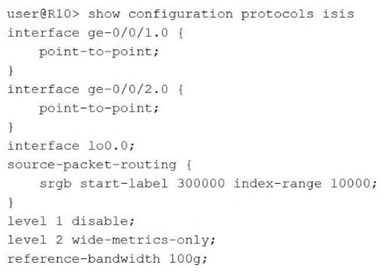
- R10 must tag its internal IPv4 BGP prefixes with a BGP prefix SID
- R10 must be configured with an explicit IPv4 node SID.
- R10 must be configured with an explicit binding SID.
- R10 must be configured with explicit IPv4 adjacency SID.
The short version
B — R10 must be configured with an explicit IPv4 node SID.
An SR shortest-path LSP that terminates on a router is steered by that router's node SID; with a common SRGB the nine other routers cannot compute a path to R10 until R10 advertises its node SID.
Key concepts
- Node SID: a segment identifier that identifies a node (router) rather than a prefix. On Junos it is derived from the IS-IS router ID plus the SRGB base, or set explicitly with
set protocols isis node-sid. - Prefix SID: identifies a prefix and is advertised in the IS-IS SR extension TLVs; it steers traffic to a loopback or subnet, not to the router itself.
- SRGB (Segment Routing Global Block): the common label range shared by all routers, so that label = base + index and every router agrees on the mapping.
- IS-IS SR extension TLVs: TLV 236 (SR-Capabilities), TLV 135 (Prefix-SID) and TLV 137 (adjacency SID) carry segment identifiers to the other routers.
- SR-MPLS shortest path: with an identical SRGB, an ingress router builds a label stack of node SIDs by walking the topology, so the whole list of routers must advertise their node SIDs.
Why B is correct
The nine routers want a shortest-path SR LSP whose destination is R10 itself. In segment routing the identifier that resolves to a router is its node SID, and node SIDs are only useful if the target actually advertises one. With an identical SRGB everywhere, each router can only push a label onto its own stack if it knows the index that corresponds to R10, and that knowledge comes from R10's own SR advertisement. Configuring an explicit IPv4 node SID on R10 causes the node-SID sub-TLV for IPv4 to be advertised in the IS-IS SR extension TLVs, and the other nine routers then include that segment in their shortest-path computation and build a valid LSP to R10.
Why the others are wrong
- A. Tagging R10's internal IPv4 BGP prefixes with a prefix SID describes how to reach those prefixes (typically a loopback), not how to reach the router as a node. It does not publish the node segment the other routers need for a path terminating on R10.
- C. A binding SID is not advertised in the IGP; it is a local, device-specific label that maps a segment list to a forwarding path inside the router's own segment table. Configuring one changes nothing about what the rest of the fabric computes.
- D. An adjacency SID identifies a link adjacent to R10 and steers traffic over that specific neighbour link. It does not advertise R10's own identity, so it cannot make the other routers build a shortest-path LSP to R10.
JN0-364 exam tip
Prefix SID gets you to the prefix; node SID gets you to the router; adjacency SID gets you over one specific link. If the question's LSP terminates on a device, the answer is node SID.
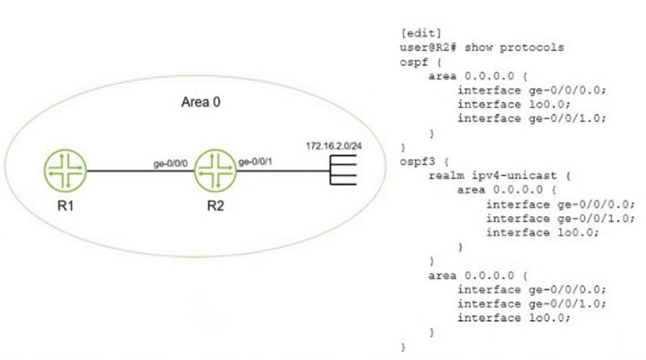
- There will not be a route in R1 for network 172.16.2.0/24.
- There will only be an OSPFv3 entry in R1 for network 172.16.2.0/24.
- There will only be an OSPFv2 entry in R1 for network 172.16.2.0/24.
- There will be an OSPFv2 and OSPFv3 entry in R1 for network 172.16.2.0/24.
The short version
D — R1 will hold both an OSPFv2 and an OSPFv3 entry for 172.16.2.0/24.
The configuration in the exhibit brings the interface that owns 172.16.2.0/24 into the OSPF area under both protocol families and contains no filter, redistribution change or preference override, so each instance independently floods and installs an intra-area route.
Key concepts
- OSPFv2: the IPv4 instance of OSPF; advertises IPv4 interface addresses and IPv4 prefixes as Type 1/2/3/4/5 LSAs.
- OSPFv3: the IPv6 instance (RFC 5340); it uses link-local addressing for adjacencies and Type 8/9/10 LSA formats, and it is configured independently of the OSPFv2 instance.
- Area membership: an interface becomes an OSPF area interface when it is placed under
protocols ospf area X(and, for IPv6,protocols ospfv3 area X); the connected prefix is then advertised as an intra-area route. - Independent instances: on Junos, OSPFv2 and OSPFv3 are two protocols with separate LSAs, separate databases and separate routes, even though they can share the same area number on the same interfaces.
- Filtering/redistribution: an export filter, a
no-redistributeor an area-range would change what is leaked; none of those mechanisms is invoked by the configuration shown.
Why D is correct
The exhibit simply brings the interface that owns 172.16.2.0/24 into the OSPF area. Because both the ospf (IPv4) and the ospfv3 (IPv6) instances are running and the adjacency is already established on that interface, each instance independently originates an intra-area LSA for the connected prefix and floods it. R1 therefore installs one OSPFv2 route and one OSPFv3 route for the same IPv4 prefix — a normal, expected result on a dual-stack link, since the two protocols never share an LSA. Nothing in the configuration suppresses one of the instances or filters the LSA, so the prefix must be present from both.
Why the others are wrong
- A. This would require an export filter, an area-range mismatch or a policy that blocks 172.16.2.0/24 in both instances. The configuration shown only adds the interface to the area, so a route certainly exists — this statement contradicts normal OSPF behaviour.
- B. OSPFv3 by design does not carry or install IPv4 unicast prefixes; it only advertises IPv6 reachability. An OSPFv3-only entry for an IPv4 prefix cannot be produced by any legitimate OSPFv3 mechanism.
- C. The mirror-image error: it would require the OSPFv2 side alone to install the route while the OSPFv3 instance was silent, which is not what an IPv4 connected prefix inside a running OSPFv3 area does. Both instances advertise it independently.
JN0-364 exam tip
On a dual-stack OSPF link, one IPv4 prefix legitimately produces two routes — one from OSPFv2 and one from OSPFv3 — because the instances share nothing but the wire.
- Participating interfaces must be configured with both IPv4 and IPv6 protocol families and addresses.
- The router ID used must be based on a 128-bit identifier value.
- The router ID used must be based on a 32-bit identifier value.
- Participating interfaces are only required to be configured with the IPv6 protocol family and address.
The short version
C and D — The OSPF router ID is a 32-bit value, and the participating interfaces only need the IPv6 family and an IPv6 address.
The router ID is an LSDB identifier, not an address, so it keeps its 32-bit form under OSPFv3, and an IPv6-only OSPF design does not require IPv4 addresses on the transit interfaces.
Key concepts
- Router ID: a 32-bit value, formatted like an IPv4 address, that uniquely identifies an OSPF router within an area and is used as the LSDB key, the originating-router ID and the tiebreaker for DR/BDR election.
- Router ID selection: on Junos it defaults to the highest IP address of a configured interface if that interface is
unit 0; otherwise it must be set explicitly underprotocols ospf router-id. - OSPFv3 address families: OSPFv3 is configured under
protocols ospfv3, and the interface address family must match —family inet6for IPv6. - IPv6 link-local adjacencies: OSPFv3 uses the mandatory link-local address fe80::/64 for the neighbor relationship, so no global IPv4 (or even global IPv6) address is needed on the link.
- Interface prerequisites: an interface must have the protocol family enabled (
interface ... family inet6) and an address in that family before OSPFv3 will form an adjacency on it.
Why C and D are correct
- C. A 32-bit router ID: the OSPF router ID never changed size when IPv6 arrived. It is a 4-octet LSDB identifier whose value is chosen from, or manually set like, an IPv4-style address; OSPFv3 uses exactly the same 32-bit router ID in its LSAs. Using a 128-bit value would break the LSDB format entirely.
- D. IPv6 family and address only: an interface that will run OSPFv3 needs the IPv6 protocol family enabled and an IPv6 address configured. Because the adjacency is built on link-local addresses, nothing on that interface requires an IPv4 address or the IPv4 family — a pure IPv6 OSPF network is perfectly valid and is exactly what a new IPv6 environment asks for.
Why the others are wrong
- A. Requiring both IPv4 and IPv6 families on every participating interface adds work that is not needed for an IPv6 OSPF deployment. Dual-stack interfaces are only necessary when you actually want the IPv4 instance to run too; they are not a requirement for OSPFv3.
- B. A 128-bit identifier is the IPv6 address size, not the OSPF router ID size. The router ID is a 4-byte LSA identifier carried in every OSPF LSA header; a 128-bit value has no place in the protocol.
JN0-364 exam tip
"Router ID" always means 32 bits, even in OSPFv3 — that is the single most-tested fact in the IPv6 OSPF configuration questions.
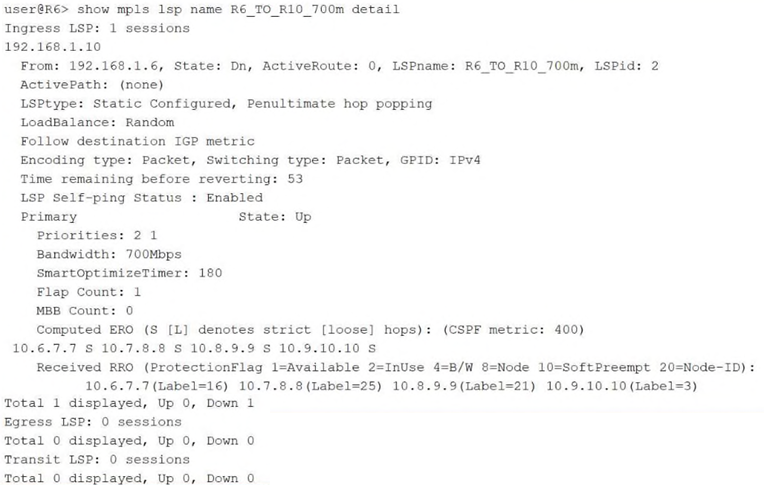
- This LSP has reserved 700 Mbps of bandwidth at priority levels 2, 1, and 0.
- This LSP has reserved 700 Mbps of bandwidth at priority levels 2, 3, 4, 5, 6, and 7.
- This LSP has reserved 700 Mbps of bandwidth at priority levels 1, 2, 3, 4, 5, and 7.
- This LSP has reserved 700 Mbps of bandwidth at priority levels 2, 3, 4, 5, 6, and 7.
The short version
B — The LSP reserves 700 Mbps at priority levels 2, 3, 4, 5, 6, and 7.
The ingress LSP is configured with a high priority of 2 and a low priority of 7, so the RSVP-TE reservation covers that whole band and excludes priorities 1 and 0.
Key concepts
- RSVP-TE bandwidth reservation: the Path/Resv messages reserve the configured bandwidth on every link along the LSP path for the specified priority class.
- Priority (high): the highest (most important) priority the reservation applies to; on Junos this is the
priorityvalue in the LSP or interface. - Priority-low: the lowest priority for which the reservation is valid. Setting it explicitly bounds the reservation band; leaving it at 0 means the reservation extends down to priority 0.
- Priority class 0-7: the RSVP priority classes, where 0 is highest priority (preemption honoured first) and 7 is lowest. An LSP that reserves across 2-7 will be admitted before — and can preempt — LSPs in classes 0 and 1.
- Percentage vs. absolute reservation: a bandwidth configured as a percentage is computed against the interface's available bandwidth; 700 Mbps on a 1 GbE link is 70 percent.
Why B is correct
An RSVP-TE reservation is not an all-or-nothing claim on a link; it is a claim on a band of priority classes. The exhibit shows the LSP configured with a high priority of 2 and a low priority of 7, which makes the 700 Mbps reservation valid for every priority from 2 down to 7 — that is, priority classes 2, 3, 4, 5, 6 and 7 on every link of the path. Because priority-low is 7 rather than 0, classes 1 and 0 are explicitly excluded: higher-priority LSPs can still be admitted on the same link without preemption. This is the standard way to protect a bandwidth-hungry LSP from the strict priority-0 traffic that RSVP-TE treats as most urgent.
Why the others are wrong
- A. Levels 2, 1 and 0 would be the correct band only if no low priority boundary were configured, so that the reservation from priority 2 extended all the way down to priority 0. The exhibit sets priority-low to 7, which stops the reservation at 7 and leaves 1 and 0 unreserved.
- C. This list skips class 6 and includes class 1, which matches neither the configured band nor the default. The reservation is contiguous from the high priority to the low priority; you cannot pick and choose classes in the middle.
- D. This option repeats the wording of option B verbatim, so it is not a distinct statement that could be credited separately. The substantive point stands as stated in B: the reservation covers the contiguous band 2 through 7, not 2-1-0, and it excludes priority classes 1 and 0.
JN0-364 exam tip
A bandwidth reservation always covers a contiguous band from the high priority to the low priority. Priority 2 with no low value means 2, 1, 0; priority 2 with priority-low 7 means 2 through 7.
Want the full bank of 10 questions for Service Provider Routing and Switching, Specialist (JNCIS-SP)? See all practice exams.