Mist AI, Associate (JNCIA-MistAI) — Free Practice Questions
10 free sample questions from a bank of 59, with the correct answers and explanations. No signup required — start practising right now.
- Capacity
- Signal Quality
- Ethernet
- WiFi interference
Answer: B
The short version
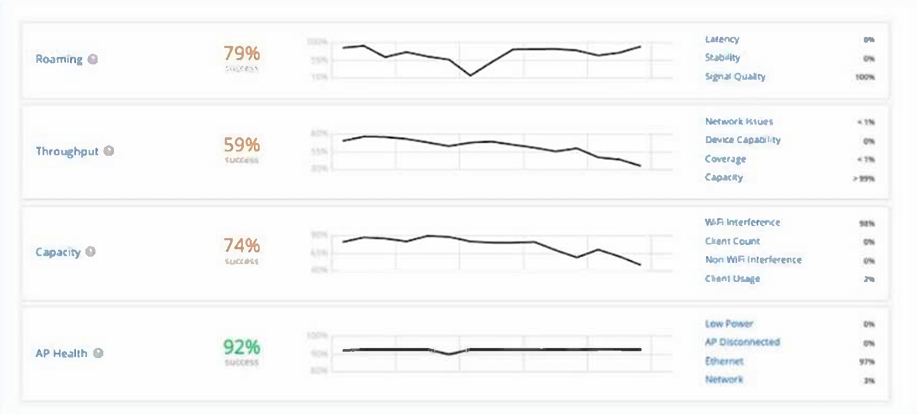
Signal Quality. In the exhibit the Roaming SLE's only non-zero classifier is Signal Quality at 100%.
Key concepts
- Each SLE lists its own classifiers with their share of the failures.
- Roaming 79% success: Latency 0%, Stability 0%, Signal Quality 100%.
- Throughput, Capacity and AP Health have entirely different classifier lists.
Why B is correct
The Roaming row of the SLE panel shows 79% success and three classifiers: Latency 0%, Stability 0% and Signal Quality 100%. With every sub-threshold roaming SLE in this window attributed to Signal Quality, and none to latency or stability, the classifier responsible is Signal Quality. The other options come from different SLEs - Ethernet sits under AP Health, and Capacity appears as a classifier under Throughput - so none of them can explain a roaming failure.
Why the others are wrong
- A. Capacity is a Throughput classifier at 98%; it does not appear in the Roaming classifier list.
- C. Ethernet is an AP Health classifier at 97%; Roaming has no Ethernet classifier.
- D. WiFi interference is a Capacity classifier; it does not appear under Roaming.
JN0-253 exam tip
Read the classifier list printed beside the SLE the question names. The answer is always one of the four classifiers on that row.
- Use Wired Assurance with the Monitoring option.
- Use WiFi Management and Assurance with LLDP enabled on all switches.
- Use Juniper Mist Marvis Actions.
- Use Juniper Mist Asset Visibility.
The short version
D — Asset Visibility gives one Mist view for mixed wired plus wireless inventory. Wireless is Juniper-only but wired mixes Juniper and non-Juniper switches, so the need is display of every device together. Asset Visibility is the settled key because it is built for cross-vendor inventory display.
Key concepts in this question
- Mist cloud: central GUI for wireless, wired, Marvis and inventory that joins Juniper telemetry with learned third-party neighbors.
- Wired Assurance: full config plus telemetry for adopted Juniper EX and QFX switches, not a passive view for third-party hardware.
- LLDP: link advertisements that expose neighbor topology but alone do not onboard non-Juniper switches as inventory.
- Asset Visibility: discovery and fingerprinting for clients, APs and switches including non-Juniper gear in one asset table.
- Marvis Actions: AI insights and fixes for root cause, not an onboarding or inventory display mechanism.
Why D is correct
Asset Visibility fits because the requirement is display across heterogeneous wired plant. Mist learns third-party switches and shows them beside Juniper APs in shared asset and topology views. That satisfies the must-ensure clause that all devices appear in one GUI, while Wired Assurance alone leaves non-Juniper switches outside scope.
Why the others are wrong
- A. Wired Assurance assumes adopted Juniper switches, so it cannot present third-party switches as displayed assets.
- B. WiFi plus LLDP aids wireless optimization and neighbor awareness but creates no single wired inventory with non-Juniper gear.
- C. Marvis Actions gives AI insights and fixes, but does not onboard or list mixed-vendor switching inventory.
JN0-253 exam tip
For single-pane display of Juniper plus non-Juniper wired gear choose Asset Visibility; reserve Wired Assurance for Juniper-only management.
- 100% of all Juniper Mist objects are configurable using webhooks.
- Webhooks are a push from Juniper Mist, and APIs are a pull by the client.
- There is an hourly limit to the number of webhooks that an organization can have.
- There is an hourly limit to the number of API calls that an organization can have.
Answer: BD
The short version
Webhooks push from Mist, the API is pulled by the client, and the hourly limit applies to API calls.
Key concepts
- A webhook is an HTTP POST that Mist sends to a URL you register.
- The REST API is called by your client to read or change Mist objects.
- An organization is limited to a number of API calls per hour.
Why BD are correct
The two true statements describe the two directions of integration. Webhooks are initiated by Mist: when the selected event occurs, Mist POSTs to your endpoint, which is what lets your monitoring system receive events. The API runs the other way - your client issues requests - and because that is client-driven and potentially high volume, Mist enforces a per-organization hourly limit on API calls. Webhooks are not counted against that limit, and not every object is webhook-configurable, so the remaining options are both false.
Why the others are wrong
- A. Not every Mist object can be configured through webhooks; webhook coverage is a subset of the API surface.
- C. The hourly limit is on API calls per organization, not on the number of webhooks an organization may register.
JN0-253 exam tip
Push = webhook, pull = API, and the rate limit belongs to the API. The phrase "100% of all objects" is a red flag on any webhook option.
- Microsoft Azure Active Directory
- Okta Workforce Identity
- Meta Social Verify
- RESTful API Fingerprinting
Answer: AB
The short version
Microsoft Azure Active Directory and Okta Workforce Identity.
Key concepts
- Access Assurance sources identity from external directories for 802.1X.
- Azure AD (Entra ID) is a first-party supported integration.
- Okta Workforce Identity is supported as a SAML identity provider.
Why AB are correct
Enterprise 802.1X needs an enterprise directory, and the two named here are the supported integrations: Microsoft Azure Active Directory and Okta Workforce Identity. Both feed the user and group attributes that Access Assurance uses to assign roles and therefore to enforce policy. Meta Social Verify is a consumer social login and is not an enterprise directory, and RESTful API fingerprinting is an identification technique rather than a directory service at all.
Why the others are wrong
- C. Meta Social Verify is a consumer social-login service, not an enterprise directory for 802.1X.
- D. RESTful API fingerprinting is a technique for identifying devices over an API, not an external directory service.
JN0-253 exam tip
Access Assurance directory integrations are enterprise IdPs: Azure AD and Okta. Anything consumer-facing or protocol-shaped is a distractor.
- 15
- 21
- 82
- 18
Answer: A
The short version
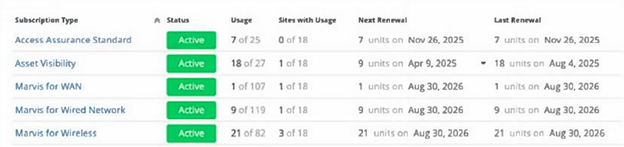
- The table shows 18 sites in the organisation and only 3 of them using Marvis for Wireless.
Key concepts
- "Sites with Usage" reads 3 of 18 for Marvis for Wireless.
- Unused subscriptions exist at 18 minus 3 sites.
- The Usage column reads 21 of 82 - in use out of purchased.
Why A is correct
Two numbers from the same row give the answer. Sites with Usage reads "3 of 18", so the organisation has 18 sites and Marvis for Wireless is running at 3 of them, leaving subscriptions unused at 18 - 3 = 15 sites. The other options are the remaining numbers on the row: 21 is the in-use subscription count and 82 is the purchased subscription count, neither of which is a count of sites, and 18 is the total before the subtraction.
Why the others are wrong
- B. 21 is the number of Marvis for Wireless subscriptions in use, not a count of sites.
- C. 82 is the number of subscriptions purchased, not a count of sites.
- D. 18 is the total number of sites before subtracting the 3 that are using Marvis for Wireless.
JN0-253 exam tip
Check the column header before the number. "Sites with Usage 3 of 18" means unused sites = 18 - 3 = 15.
- Wireless Assurance
- IoT Assurance
- Asset Visibility
- User Engagement
Answer: C
The short version
Asset Visibility - it tracks where important devices and objects are inside a building.
Key concepts
- Asset Visibility produces a floor-plan view of assets.
- It uses vBLE, BLE-tagged assets and Wi-Fi signals.
- User Engagement measures the mobile client experience instead.
Why C is correct
Asset Visibility is built for exactly this: locating important devices and objects inside a building and showing them on a floor plan, using vBLE from the APs together with BLE-tagged assets and Wi-Fi signals. That is the wording of the question. Wireless Assurance covers Wi-Fi service levels, IoT Assurance covers onboarding constrained devices, and User Engagement measures how the mobile client experience is going - none of which is indoor asset positioning.
Why the others are wrong
- A. Wireless Assurance provides Wi-Fi service levels and troubleshooting, not asset location.
- B. IoT Assurance covers the onboarding and monitoring of constrained IoT devices, not indoor positioning of assets.
- D. User Engagement measures the mobile client experience using vBLE; it is not the asset-tracking feature.
JN0-253 exam tip
Asset Visibility = where the things are. User Engagement = how the phone experience is. Both use vBLE, so read the noun.
- organizations
- template policies
- radio management
- WLANs
Answer: BD
The short version
Template policies and WLANs. Radio management belongs to an RF template or a device profile.
Key concepts
- A WLAN template is a collection of WLAN policies, tunnelling policies and WxLAN policies.
- Radio settings - channels, power, RRM - live in an RF template or a device profile.
- Organizations contain templates; they are not configured inside one.
Why BD are correct
Mist documents a WLAN template as a collection of WLAN policies, tunnelling policies and WxLAN policies, which corresponds to template policies and WLANs - options B and D. Radio management is deliberately excluded: the Wireless Assurance guide states that radio resource management and other radio settings are configured on the AP, in a device profile, or in an RF template. Organizations are the container that templates live in, so option A is not a template element either.
Why the others are wrong
- A. Organizations are the container templates are created in; they are not a configuration element inside a WLAN template.
- C. Radio management is configured on the AP, in a device profile or in an RF template, not in a WLAN template.
JN0-253 exam tip
WLAN template = SSIDs and access policies. RF template = radios, channels, power. Keep the two apart and this question is easy.
- They include a set of interface configurations.
- They can be assigned to multiple ports.
- They include a set of routing configurations.
- They must be assigned to only one port.
Answer: AB
The short version
A port profile bundles interface configuration and can be assigned to many ports.
Key concepts
- Port profiles hold interface-level settings such as VLAN and 802.1x parameters.
- The same profile can be applied to any number of ports.
- Switch port configuration, not routing configuration, is what a profile carries.
Why AB are correct
A port profile exists so that interface setup is defined once and reused. It holds the interface configuration - description, VLAN, 802.1x parameters - and one profile can be attached to many ports, either statically or by dynamic assignment, which is A and B. It contains no routing configuration, because a switch access or trunk port profile does not build routing instances, and nothing limits it to one port, which would defeat the entire purpose of defining it.
Why the others are wrong
- C. A port profile carries interface configuration such as VLAN and 802.1x settings, not routing configuration.
- D. Nothing restricts a port profile to one port; reuse across ports is the main reason to define one.
JN0-253 exam tip
Port profile = interface config, reusable across ports. Routing or single-port constraints are the two things it does not do.
- Microservices are developed as a suite of applications and rely on developers to deliver updates to the entire suite at once.
- Microservices must share a common database to ensure data integrity.
- Microservices are designed to be dependent on each other to ensure that if one process fails, the remaining processes will not continue to operate.
- Microservices communicate with each other using APIs.
Answer: D
The short version
Microservices communicate with each other using APIs.
Key concepts
- Each microservice is deployed and updated independently.
- Service-to-service communication is over network APIs.
- Failure of one service must not stop the others.
Why D is correct
The defining property of a microservice is that it is small and independently deployable, with a well-defined interface, and those interfaces are network APIs. That is D. Option A describes a monolithic application suite requiring a coordinated release, which is the model microservices replace. Option B adds a shared database, which is a coupling point that removes the independence. Option C inverts the resilience requirement: the design goal is that the remaining processes keep operating when one fails, not that they stop.
Why the others are wrong
- A. Shipping updates to the whole application suite at once is the monolithic model microservices replace.
- B. A shared database couples the services and removes the independent deployment microservices exist to provide.
- C. Microservices are designed so the failure of one does not stop the remaining processes; this option says the opposite.
JN0-253 exam tip
Microservices: independent, API-to-API, fail independently. Shared database or coordinated release means you are looking at a monolith.
- Switch configurations at the site level are an additional way to apply a switch template to a specific site.
- Switch configurations at the site level are required to manually configure individual switches.
- Site-level switch configurations override org-level templates.
- Organizational-level templates override site-level switch configurations.
Answer: AC
The short version
Site-level switch configuration is another way to apply a switch template to a site, and it overrides the org-level template.
Key concepts
- Switch templates are defined at the organization level and applied at site level.
- More specific configuration wins: site-level overrides organization-level.
- Individual switches are never hand-configured in a template-driven design.
Why AC are correct
Two true statements. A switch configuration created at the site level is simply a more specific way of applying a switch template to that site, which is the purpose of the mechanism. And because precedence in Mist follows specificity, the site-level configuration overrides the organization-level template - so D is exactly backwards. B is wrong because hand-configuring individual switches is precisely what templates exist to avoid.
Why the others are wrong
- B. Site-level switch configuration applies a template to the site; it is not a mechanism for configuring switches one at a time by hand.
- D. Precedence runs from general to specific, so the organization-level template does not override the site-level configuration.
JN0-253 exam tip
Mist precedence: site-level configuration beats organization-level templates. If an option says the org template wins, the hierarchy is inverted.
Want the full bank of 59 questions for Mist AI, Associate (JNCIA-MistAI)? See all practice exams.