Fortinet FCSS - FortiSASE 25 Administrator — Free Practice Questions
10 free sample questions from a bank of 40, with the correct answers and explanations. No signup required — start practising right now.
- cloud access security broker (CASB)
- SD-WAN
- zero trust network access (ZTNA)
- thin edge
The short version
B and C — SPA app access rides SD-WAN plus ZTNA. Branch path and identity path.
Key concepts in this question
- SD-WAN carries site-to-app flows.
- ZTNA brokers user-to-app access.
Why B and C are correct
The two documented SPA facilitators (cross-exam consistent).
Why the others are wrong
- A. CASB governs SaaS, not corporate apps.
- D. Thin edge extends sites; it does not broker access.
FortiSASE exam tip
SPA app access = SD-WAN + ZTNA.
- proxy auto-configuration (PAC) file
- FortiSASE certificate authority (CA) certificate
- FortiClient software
- tunnel policy
The short version
A and B — SWG onboarding needs a PAC file plus the SASE CA. Steer browsers, trust inspection.
Key concepts in this question
- PAC files direct browsers to the proxy.
- CA certificates let endpoints trust TLS inspection.
Why A and B are correct
The two documented SWG-onboarding components.
Why the others are wrong
- C. FortiClient software onboards agents, not SWG browsers.
- D. Tunnel policies serve tunnel users, not SWG.
FortiSASE exam tip
SWG onboard = PAC + CA.
- It secures internet access both on and off the network.
- It uses zero trust network access (ZTNA) tags to perform device compliance checks.
- It eliminates the requirement for an on-premises firewall.
- It simplifies management and provisioning.
The short version
A and C — microbranch value: secure everywhere plus no on-prem firewall. Cover off-net, delete boxes.
Key concepts in this question
- On/off-network security follows unmanaged devices anywhere.
- Firewall elimination removes per-site appliances.
Why A and C are correct
The two documented microbranch advantages (6v split).
Why the others are wrong
- B. ZTNA tags gate access; they are not the microbranch advantage framed.
- D. Simplified provisioning is real but not banked here.
FortiSASE exam tip
Microbranch = secure anywhere, fewer boxes.
- sanctioned and unsanctioned Software-as-a-Service (SaaS) applications usage
- FortiClient vulnerability assessment
- SD-WAN performance
- FortiSASE administrator and system events
The short version
A — FortiSASE reports reveal sanctioned and unsanctioned SaaS usage. Shadow-IT discovery reporting.
Key concepts in this question
- SaaS-usage reports surface sanctioned and shadow applications.
- Vuln, SD-WAN, and admin events report elsewhere.
Why A is correct
SaaS-visibility reporting is the documented report content.
Why the others are wrong
- B. Vuln assessments live in endpoint reports.
- C. SD-WAN performance lives in SD-WAN analytics.
- D. Admin events live in admin logs.
FortiSASE exam tip
SaaS reports = sanctioned + shadow.
- SSL deep inspection for encrypted web traffic
- malware protection with sandboxing capabilities
- web application firewall (WAF) for web applications
- intrusion prevention system (IPS) for web traffic
The short version
A and B — SWG web-threat defense pairs SSL deep inspection with sandbox malware protection. See inside encryption, detonate the unknown.
Key concepts in this question
- SSL deep inspection exposes encrypted threats.
- Sandboxing judges unknown payloads.
Why A and B are correct
The two documented SWG protections.
Why the others are wrong
- C. WAF guards hosted apps, not SWG browsing.
- D. IPS is not the SWG web-threat pair member here.
FortiSASE exam tip
SWG threats = decrypt + detonate.
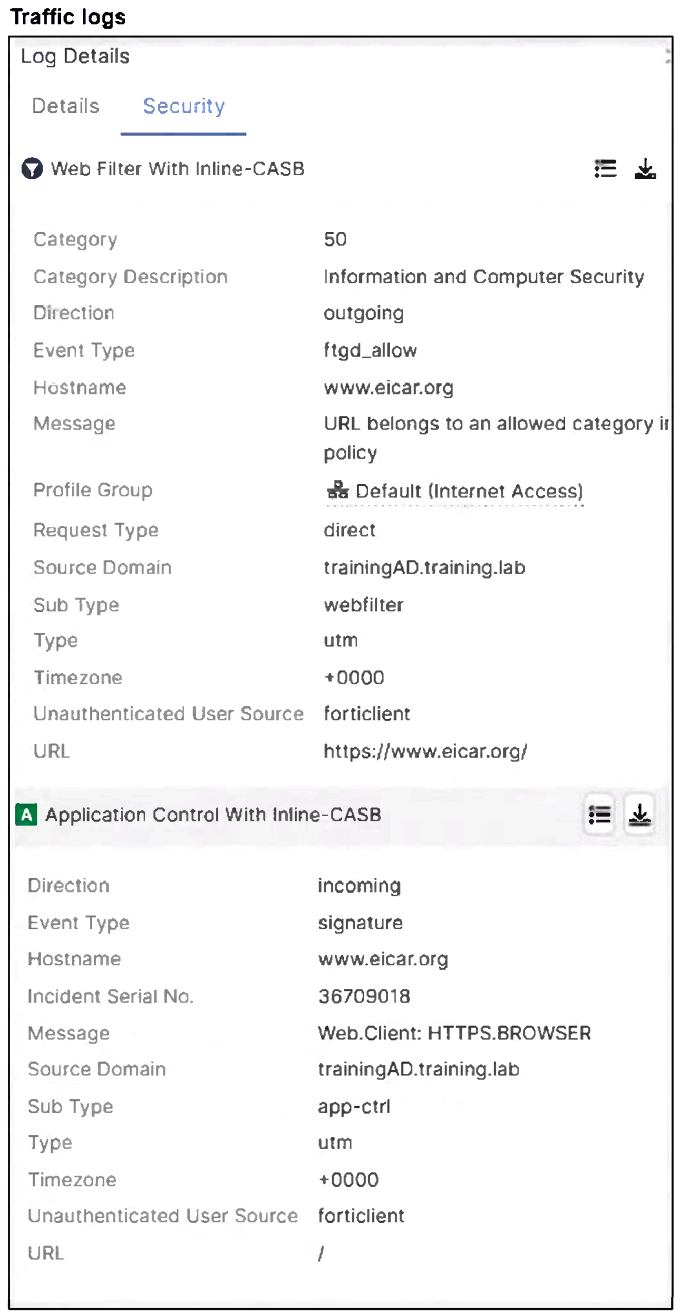
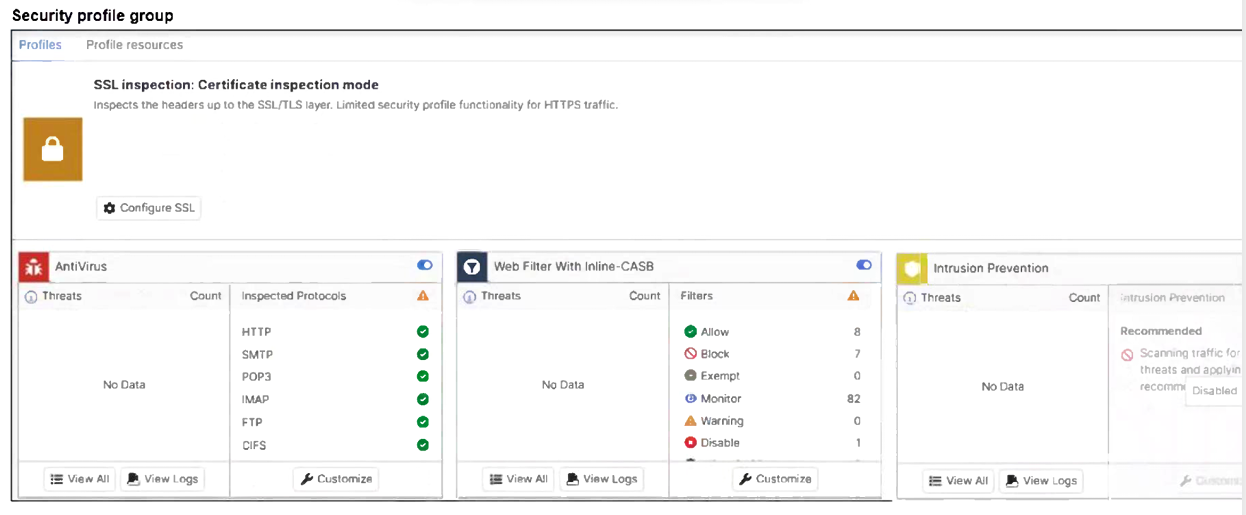
- Web filter is allowing the URL.
- Deep inspection is not enabled.
- Application control is exempting all the browser traffic.
- Intrusion prevention is disabled.
The short version
B — eicar sailing through means TLS hid it: deep inspection is off. Encrypted downloads dodge AV blind.
Key concepts in this question
- HTTPS downloads need decryption before AV scanning.
- Without deep inspection, AV profiles never see the payload.
Why B is correct
Missing decryption is the documented eicar-pass cause (4v2).
Why the others are wrong
- A. Allowed URLs still get AV-scanned when decrypted.
- C. App-control exemptions are a different bypass.
- D. IPS state does not gate AV scanning.
FortiSASE exam tip
Eicar over HTTPS passes = enable deep inspection.
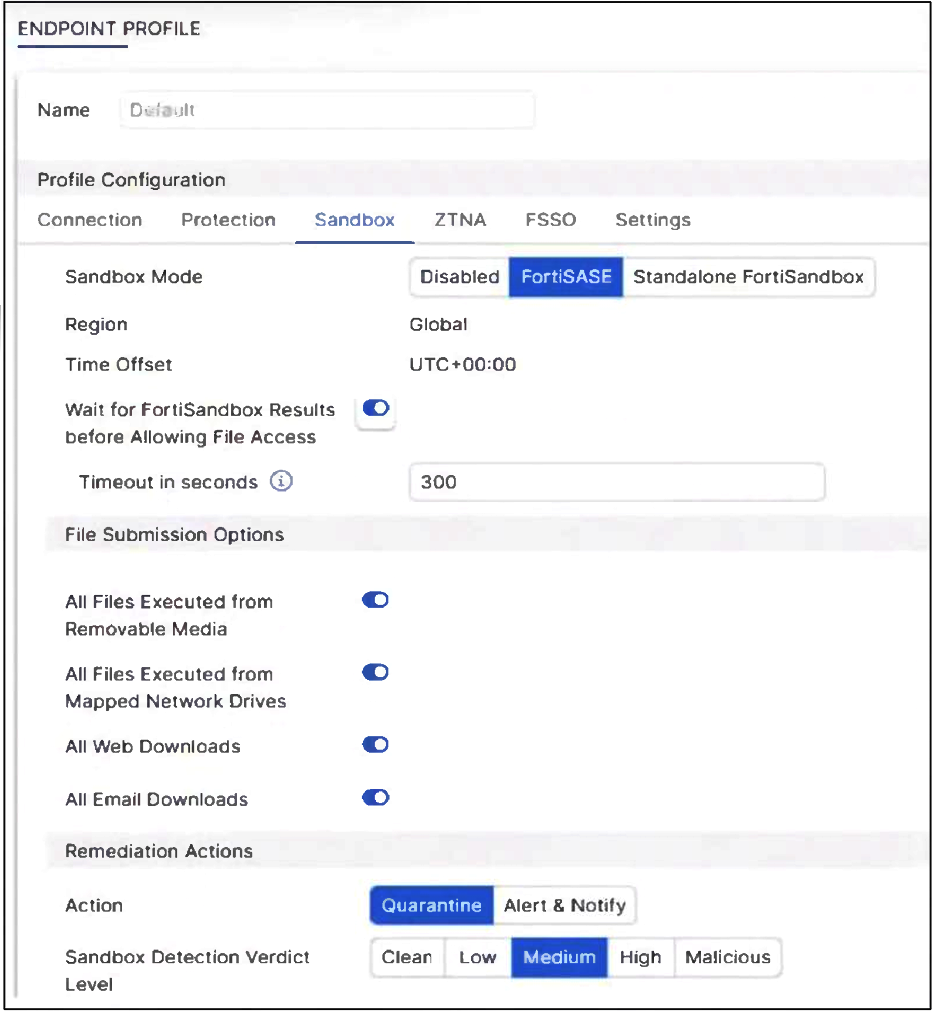
- Only endpoints assigned a profile for sandbox detection will be processed by the sandbox feature.
- FortiClient quarantines only infected files that FortiSandbox detects as medium level.
- All files executed on a USB drive will be sent to FortiSandbox for analysis.
- All files will be sent to a on-premises FortiSandbox for inspection.
The short version
A and C — profile-gated FortiSASE cloud sandbox submits USB-executed files for analysis. Sandbox Mode is FortiSASE with removable-media submission enabled.
Key concepts in this question
- Profile-gated sandboxing: only endpoints with sandbox detection in their endpoint profile are processed.
- Removable-media submission: files executed from removable media are forwarded for sandbox analysis.
- Cloud versus on-premises mode: FortiSASE mode uses cloud sandboxing, not a standalone appliance.
Why A and C are correct
The exhibit shows the Default endpoint profile with Sandbox Mode set to FortiSASE and All Files Executed from Removable Media enabled, so assigned endpoints have USB-executed files sent to the FortiSASE cloud sandbox for analysis.
Why the others are wrong
- B. The Medium verdict level is a threshold that triggers quarantine at Medium and above, not only Medium detections.
- D. Sandbox Mode is FortiSASE cloud in the exhibit, so files are not sent to an on-premises FortiSandbox.
FortiSASE exam tip
Sandbox exhibit = check mode, submission toggles, then threshold.
- Configure a network lockdown policy on the endpoint profiles.
- Configure a geography address object as the source for a deny policy.
- Configure geofencing to restrict access from the required countries.
- Configure source IP anchoring to restrict access from the specified countries.
The short version
C — country blocks ride geofencing. Borders for SASE attachments.
Key concepts in this question
- Geofencing admits or denies POP connections by country.
- Lockdown, geo-objects, and anchoring serve other ends.
Why C is correct
Country-gated access is the documented geofencing use.
Why the others are wrong
- A. Lockdown policies manage endpoints, not countries.
- B. Geo-object deny policies are firewall work, not the SASE feature.
- D. Anchoring fixes egress IPs; it does not block countries.
FortiSASE exam tip
Country block = geofencing.
- To provide access to private applications using the bookmark portal
- To provide device compliance checks using ZTNA tags
- To secure internet traffic for branch users
- To manage branch location endpoints
The short version
C — on-ramp secures branch internet traffic. Site pipe, cloud scrubbing.
Key concepts in this question
- SD-WAN on-ramp backhauls branch internet to SASE inspection.
- Portals, posture, and endpoint management are other features.
Why C is correct
Branch-internet security is the documented on-ramp benefit.
Why the others are wrong
- A. Bookmark portals serve contractors, not branches.
- B. Posture checks run on endpoints, not on-ramps.
- D. Endpoint management is EMS work.
FortiSASE exam tip
On-ramp benefit = branch internet.
- zero trust network access (ZTNA) tags
- tunnel profile
- FortiSASE certificate authority (CA) certificate
- real-time protection
The short version
B and C — onboarding pushes tunnel profiles plus the SASE CA. Connectivity plus trust.
Key concepts in this question
- Tunnel profiles connect endpoints to POPs.
- CA certificates let endpoints trust inspection.
Why B and C are correct
The two documented auto-pushed settings (cross-exam consistent).
Why the others are wrong
- A. ZTNA tags sync via policy, not onboarding push.
- D. Real-time protection is endpoint config, not pushed SASE state.
FortiSASE exam tip
Onboarding push = tunnel + CA.
Want the full bank of 40 questions for Fortinet FCSS - FortiSASE 25 Administrator? See all practice exams.