Fortinet FCSS - FortiSASE 24 Administrator — Free Practice Questions
10 free sample questions from a bank of 23, with the correct answers and explanations. No signup required — start practising right now.
- Zero-trust tags can help in diagnosing connectivity issues.
- Zero-trust tags can determine the security posture of an endpoint.
- Zero-trust tags can be used to allow or deny access to network resources.
- Zero-trust tags can be assigned to endpoint profiles based on user groups.
The short version
B and C — zero-trust tags determine posture and gate resources. Assess, then admit.
Key concepts in this question
- Posture determination classifies endpoint health.
- Allow/deny gating enforces policy by that classification.
Why B and C are correct
The two documented tag advantages.
Why the others are wrong
- A. Tags do not diagnose connectivity.
- D. Profiles assign by groups; tags do not attach to profiles as framed.
FortiSASE exam tip
Tags = assess + admit.
- It is a 24x7x365 monitoring service of your FortiSASE environment.
- It can monitor endpoint resources in real-time.
- It can help troubleshoot user-to-application performance issues.
- It can help customers identify and mitigate potential risks to their network.
The short version
D — forensics analysis identifies and mitigates network risks. Proactive risk hunting.
Key concepts in this question
- Forensics analysis surfaces potential risks for mitigation.
- Monitoring services, endpoint telemetry, and performance triage are other features.
Why D is correct
Risk identification is the documented forensics role (7v2).
Why the others are wrong
- A. No 24x7 managed monitoring service as framed.
- B. Real-time endpoint resources are DEM/EMS territory.
- C. User-to-app performance is DEM's job.
FortiSASE exam tip
Forensics = find and fix risks.
- It can help IT and security teams ensure consistent security monitoring for remote users.
- It can be used to request a detailed analysis of the endpoint from the FortiGuard team.
- It requires a separate DEM agent to be downloaded from the FortiSASE portal and installed on the endpoint.
- It provides end-to-end network visibility from all the FortiSASE security PoPs to a specific SaaS application.
The short version
D — DEM watches end-to-end from PoPs to SaaS apps. Whole-path experience.
Key concepts in this question
- End-to-end visibility spans PoP egress to application.
- Monitoring consistency, team analysis, and separate agents miss the definition.
Why D is correct
PoP-to-SaaS visibility is the documented DEM description.
Why the others are wrong
- A. Security monitoring consistency is a side benefit.
- B. Team-requested analysis is SOCaaS, not DEM.
- C. No separate DEM agent download exists.
FortiSASE exam tip
DEM = PoP-to-app visibility.
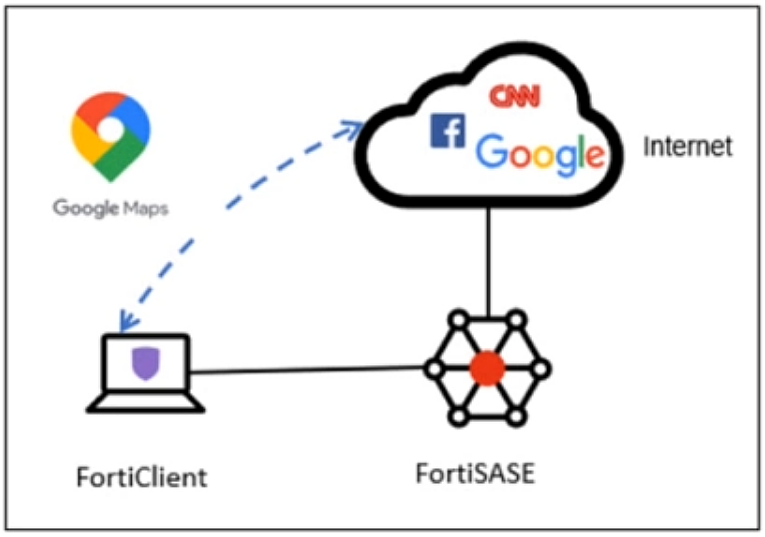
- Implement a ZTNA destination rule using Google Maps FQDN on FortiSASE to identify and redirect Google Maps traffic.
- Configure the Google Maps FQDN as a split tunneling destination on the FortiSASE endpoint profile.
- Exempt the Google Maps FQDN from the endpoint system proxy settings.
- Configure a split-tunnel VPN policy using Google Maps FQDN to exclude and redirect the traffic.
The short version
B — Google Maps FQDN as a split tunneling destination on the endpoint profile. Trusted traffic bypasses the SASE tunnel and leaves via the endpoint physical interface.
Key concepts in this question
- Split tunneling (steering bypass): named destinations are excluded from the FortiSASE cloud security tunnel to save bandwidth.
- FQDN destinations: resolved addresses are added to the route table in use and removed after disconnect.
- Full-tunnel default: without a bypass destination, all endpoint internet traffic is inspected on FortiSASE.
Why B is correct
Fortinet documents configuring split tunneling destinations on the endpoint profile so trusted traffic such as high-bandwidth apps bypasses FortiSASE and is redirected to the endpoint physical interface. The exhibit shows exactly this: Google Maps arcing past FortiSASE straight to the internet while other traffic enters the SASE cloud.
Why the others are wrong
- A. ZTNA destination rules steer private-application access to a FortiGate access proxy, not public internet bypass.
- C. Exempting the FQDN from system proxy settings only changes browser proxying, not VPN tunnel steering.
- D. There is no split-tunnel VPN policy object for this; steering bypass is configured as a destination in the endpoint profile.
FCSS_SASE_AD-24 exam tip
Inspect-all minus one app equals an FQDN steering bypass on the endpoint profile.
- It uses API to connect to the cloud applications.
- It detects data at rest.
- It provides visibility for unmanaged locations and devices.
- It is placed directly in the traffic path between the endpoint and cloud applications.
The short version
D — inline CASB sits in the endpoint-to-cloud traffic path. In-line by name, in-path by design.
Key concepts in this question
- Inline placement intercepts live cloud flows.
- API connectors, rest-data, and unmanaged visibility describe other CASB facets.
Why D is correct
In-path placement is the documented inline-CASB definition.
Why the others are wrong
- A. API connections describe API CASB, not inline.
- B. Data-at-rest is DLP territory.
- C. Unmanaged visibility is discovery work.
FortiSASE exam tip
Inline CASB = in the traffic path.
- Proxy auto-configuration (PAC) file
- FortiSASE SSL VPN gateway URL
- FortiSASE CA certificate
- FortiSASE invitation code
The short version
A and C — SWG onboarding needs a PAC file plus the SASE CA. Steer browsers, trust inspection.
Key concepts in this question
- PAC files direct browsers to the proxy.
- CA certificates let endpoints trust TLS inspection.
Why A and C are correct
The two documented SWG-onboarding components.
Why the others are wrong
- B. SSL VPN URLs serve tunnel users, not SWG onboarding.
- D. Invitation codes onboard agents, not SWG browsers.
FortiSASE exam tip
SWG onboard = PAC + CA.
- It enforces granular access policies based on user identities.
- It enforces multi-factor authentication (MFA) to validate remote users.
- It secures traffic from endpoints to cloud applications.
- It uses the identity & access management (IAM) portal to validate the identities of remote workers.
- It offers zero trust network access (ZTNA) capabilities.
The short version
A, C, E — remote-worker security means granular identity policies, secured cloud paths, and ZTNA. Who, where-safe, how-private.
Key concepts in this question
- Granular identity policies scope access per user.
- Cloud-path security plus ZTNA protect destinations and access.
Why A, C and E are correct
The three documented remote-access assurances (4v2).
Why the others are wrong
- B. MFA validates via authenticators, not as a SASE assurance as framed.
- D. IAM portals manage identities; they do not directly secure access.
FortiSASE exam tip
Remote security = identity policy + safe paths + ZTNA.
- All FortiSASE user-based deployments are supported.
- Data center redundancy is offered.
- All TCP-based applications are supported.
- The security posture of the device is secure.
The short version
C and D — ZTNA private access covers all TCP apps on posture-healthy devices. Every TCP service, verified endpoints.
Key concepts in this question
- TCP-wide coverage spans private applications.
- Posture health gates the access.
Why C and D are correct
The two documented ZTNA use-case statements.
Why the others are wrong
- A. Deployment coverage varies; all-deployments framing overstates.
- B. DC redundancy is architectural, not a use-case statement.
FortiSASE exam tip
ZTNA private = all TCP, healthy devices.
- SSO is recommended only for agent-based deployments.
- SSO users can be imported into FortiSASE and added to user groups.
- SSO overrides any other previously configured user authentication.
- SSO identity providers can be integrated using public and private access types.
The short version
C — SSO overrides all other FortiSASE authentication. Consistent across every SASE exam.
Key concepts in this question
- SSO precedence is uniform FortiSASE doctrine.
- Agent scope, imports, and IdP types are secondary facts.
Why C is correct
The documented SSO-override rule.
Why the others are wrong
- A. SSO serves agentless equally.
- B. Imports are admin workflow, not the SSO statement.
- D. Access-type IdP framing is not the headline truth.
FortiSASE exam tip
SSO = overrides everything.
- three
- one
- two
- four
The short version
C — provisioning selects two POPs. Primary plus backup.
Key concepts in this question
- Dual-POP selection bakes redundancy into onboarding.
- One, three, and four break the documented pair.
Why C is correct
Two-POP provisioning is the documented requirement (6v split).
Why the others are wrong
- A/B/D. Non-two counts mismatch the provisioning design.
FortiSASE exam tip
Provisioning POPs = two.
Want the full bank of 23 questions for Fortinet FCSS - FortiSASE 24 Administrator? See all practice exams.