Fortinet NSE 6 - FortiClient EMS 7.4 Administrator — Free Practice Questions
10 free sample questions from a bank of 50, with the correct answers and explanations. No signup required — start practising right now.
- Add the FortiGate IP address to the Fabric device configurations on FortiClient EMS.
- Authorize FortiGate on FortiClient EMS as a Fabric connector.
- Use the FortiClient EMS connector on FortiGate to connect to FortiClient EMS.
- Apply the ZTNA license on FortiGate.
The short version
B and C — share endpoint intel via EMS-side FortiGate authorization plus the FortiGate-side EMS connector. Authorize there, connect here.
Key concepts in this question
- Fabric connector authorization on EMS admits FortiGate.
- The EMS connector on FortiGate pulls endpoint data including ZTNA posture.
Why B and C are correct
Two-sided pairing is the documented ZTNA-sharing setup.
Why the others are wrong
- A. Fabric device IPs alone do not establish the connector pairing.
- D. ZTNA licensing enables features; it does not share data.
FortiClient EMS exam tip
Share endpoint intel = authorize + connect.
- Real-time protection must update AV signature database
- Real-time protection sends malicious files to FortiSandbox when the file is not detected locally
- Real-time protection is disabled
- Real-time protection must update the signature database from FortiSandbox
The short version
C — real-time protection ships disabled on Windows Server. Server workloads opt in deliberately.
Key concepts in this question
- Windows Server defaults disable real-time AV to protect server performance.
- Signature updates and sandbox submission are separate behaviors.
Why C is correct
Disabled-by-default is the documented server-install behavior.
Why the others are wrong
- A. Signature updates are independent of the enablement default.
- B. Sandbox submission is a detection-action setting, not the default state.
- D. FortiSandbox does not supply signature updates.
FortiClient EMS exam tip
Windows Server install = RTP off by default.
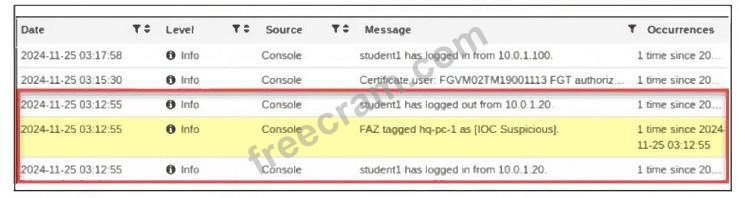
- The endpoint hq-pc-1 is tagged with the security posture tag IOC suspicious.
- The FortiClient EMS fabric connector is configured on FortiAnalyzer.
- The FortiClient EMS administrator manually tagged it using the console.
- The administrator student1 on FortiAnalyzer executed the playbook.
The short version
D — approved. The exhibit log line FAZ tagged hq-pc-1 as [IOC Suspicious] beside the student1 sessions shows a FortiAnalyzer-driven tag, matching a playbook execution rather than an EMS posture or manual tag.
Key concepts in this question
- IOC tagging via FortiAnalyzer: FAZ playbooks push IOC verdicts to EMS endpoints.
- Log correlation: the FAZ tag event sits between student1 logout/login lines, tying it to that operator session.
- Posture tags vs IOC tags: Zero Trust posture tags come from EMS rule sets, not from FAZ.
Why D is correct
- The highlighted message source is the FAZ integration tagging hq-pc-1 as IOC Suspicious.
- The surrounding Console lines place administrator student1 on the box at the identical timestamp, consistent with executing the FAZ playbook.
- FortiClient EMS 7.4 administration documentation describes IOC suspicious state arriving via the FortiAnalyzer fabric/playbook path.
Why the others are wrong
- A. No security posture (Zero Trust tagging rule) event is shown; the tag source is FAZ, not an EMS posture tag.
- B. The direction is reversed: nothing shows an EMS fabric connector configured on FortiAnalyzer, and that would not itself tag the endpoint.
- C. There is no manual console-tagging action in the log; the actor recorded is FAZ.
FCP_FCT_AD-7.4 exam tip
FAZ tagged as IOC Suspicious = playbook did it, not EMS posture.
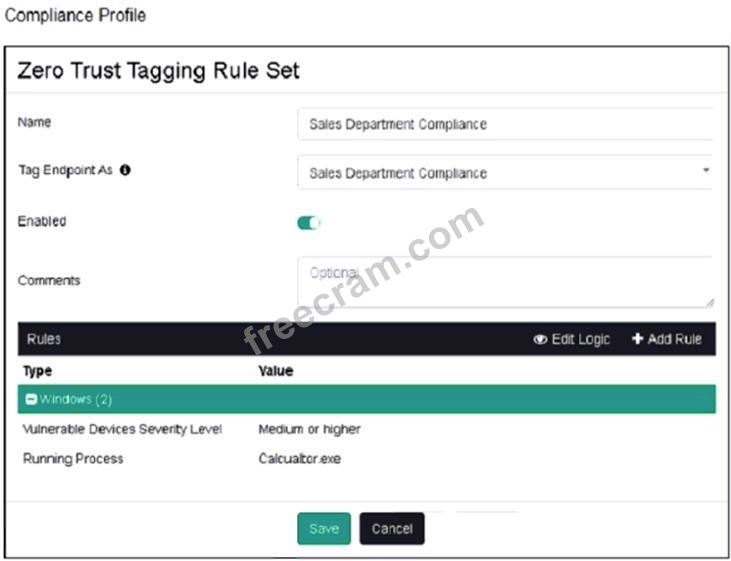
- Enable the web filter profile.
- Run Calculator application on the endpoint.
- Integrate FortiSandbox tor infected file analysis
- Patch applications that have vulnerability rated as high or above.
The short version
B and D — approved. The Sales Department Compliance rule set demands a running Calculator process and no medium-or-higher vulnerabilities, so the endpoint must run Calculator and patch qualifying apps.
Key concepts in this question
- Zero Trust tagging rules as compliance gates: running-process and vulnerability-severity rules must all pass.
- Vulnerable Devices Severity Level: Medium or higher means high/critical items fail compliance.
- Running Process rule: the named executable must be active on the endpoint.
Why B and D are correct
- The exhibit lists
Running Process: Calcualtor.exe, so launching Calculator satisfies that rule (B). - The exhibit lists
Vulnerable Devices Severity Level: Medium or higher, so patching high-or-above apps clears that rule (D). - No other rule types appear in the exhibit, so these two actions are exactly what compliance needs.
Why the others are wrong
- A. No web filter rule exists in this rule set, so enabling a web filter profile changes nothing.
- C. No sandbox-analysis rule exists in this rule set, and the typo-laden option is unrelated to the shown rules.
FCP_FCT_AD-7.4 exam tip
Compliance exhibit = satisfy literally the rules you see: process running, vulns patched.
- FortiClient EMS has full read-write access on the AD server.
- FortiClient installations on domain endpoints can deployed from FortiClient EMS.
- Endpoint profiles can be assigned to endpoints based on domain groups.
- Imported AD endpoints cannot be directly deleted on FortiClient EMS.
The short version
C and D — AD integration assigns profiles by domain group and preserves imported endpoints from direct deletion. Group-driven profiles, protected imports.
Key concepts in this question
- Domain-group profile assignment targets policies by AD membership.
- Imported AD endpoints cannot be deleted directly (AD owns the record).
Why C and D are correct
The two documented AD-integration truths.
Why the others are wrong
- A. EMS holds read-only AD access, not read-write.
- B. Domain-push deployment is not the integration mechanism.
FortiClient EMS exam tip
AD + EMS = group profiles on, direct deletes off.
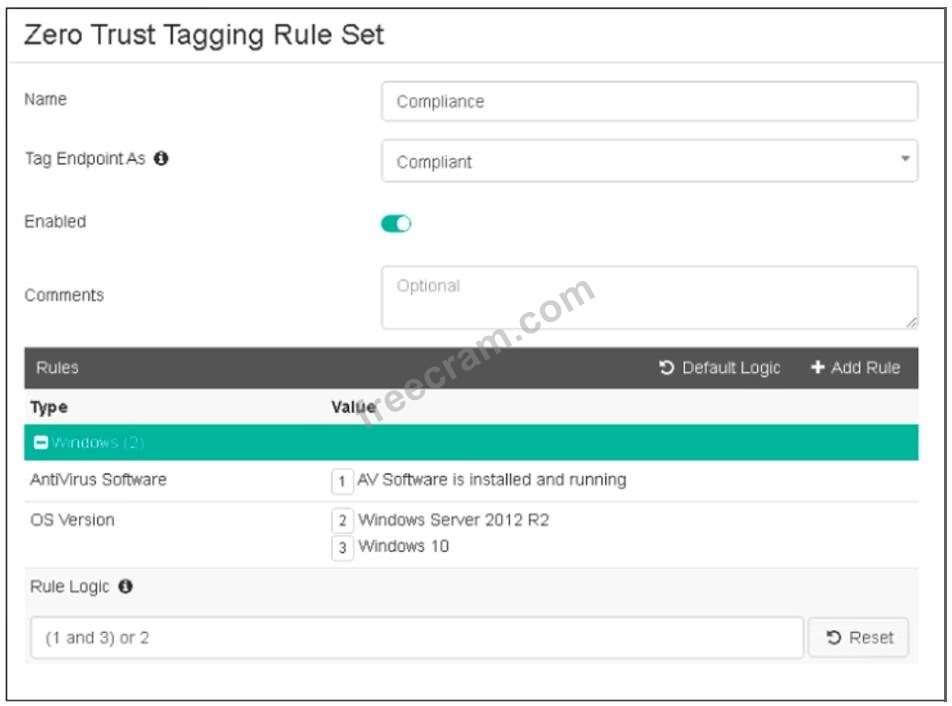
- The endpoint must satisfy that only Windows 10 is running.
- The endpoint must satisfy that only AV software is installed and running.
- The endpoint must satisfy that antivirus is installed and running and Windows 10 is running.
- The endpoint must satisfy that only Windows Server 2012 R2 is running.
The short version
C and D — approved. Rule Logic (1 and 3) or 2 means the tag applies when AV-plus-Windows-10 holds, or independently when Windows Server 2012 R2 holds.
Key concepts in this question
- Zero Trust tagging Rule Logic: numbered rules combine with AND/OR expressions.
- Compound condition (1 and 3): AV installed/running together with Windows 10.
- Standalone condition (2): Windows Server 2012 R2 alone suffices.
Why C and D are correct
- C restates the first sufficient branch exactly: antivirus installed and running (1) AND Windows 10 running (3).
- D restates the second sufficient branch exactly: Windows Server 2012 R2 running (2) alone.
- The exhibit's numbered rules and logic string leave no other reading.
Why the others are wrong
- A. Windows 10 alone is insufficient; rule 1 (AV) must also hold per
(1 and 3). - B. AV alone is insufficient; rule 3 (Windows 10) must also hold unless rule 2 matches.
FCP_FCT_AD-7.4 exam tip
Read the Rule Logic line first: (1 and 3) or 2 gives two winning combos.
- FortiClient EMS will assign the Sales policy
- FortiClient EMS will assign the Training policy
- FortiClient EMS will assign the Default policy
- FortiClient EMS will assign the Training policy for on-fabric endpoints and the Sales policy for the off-fabric endpoint
The short version
B — the student/trainingAD login maps to the Training policy. Domain-user match wins.
Key concepts in this question
- Endpoint policies match on user and domain criteria.
- student-in-trainingAD satisfies the Training policy scope (Q15 confirms the same mapping).
Why B is correct
User-plus-domain matching assigns Training — consistent across both duplicate questions.
Why the others are wrong
- A. Sales scope does not match this user/domain.
- C. Default applies only when nothing matches.
- D. Single-policy assignment results; no split assignment occurs.
FortiClient EMS exam tip
User + domain match = named policy, not Default.
- ZTNA full mode
- SSL VPN
- L2TP
- ZTNA IP/MAC littering mode
The short version
A — credential-less remote access is ZTNA full mode. Identity and posture replace passwords.
Key concepts in this question
- ZTNA full mode brokers access on certificate identity plus posture.
- VPN transports still demand credentials.
Why A is correct
Passwordless brokering is the documented ZTNA-full-mode outcome.
Why the others are wrong
- B. SSL VPN requires user credentials.
- C. L2TP requires credentials.
- D. IP/MAC filtering modes still layer credential checks.
FortiClient EMS exam tip
No credentials = ZTNA full mode.
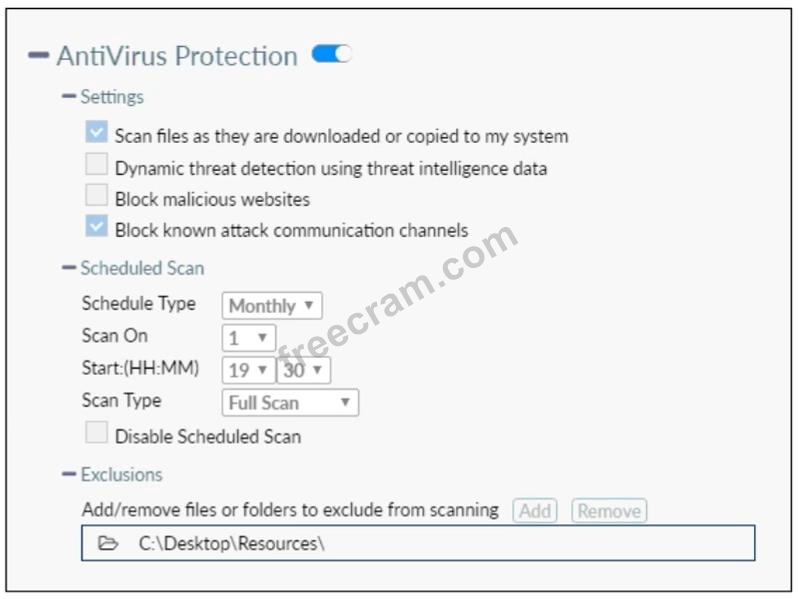
- FortiClient quarantines infected files and reviews later, after scanning them.
- FortiClient blocks and deletes infected files after scanning them.
- FortiClient scans infected files when the user copies files to the Resources folder.
- FortiClient copies infected files to the Resources folder without scanning them.
The short version
D — approved (flip from bank A). The exhibit's Exclusions list contains C:\Desktop\Resources\, so files copied there skip scanning and land without inspection.
Key concepts in this question
- Antivirus exclusions: listed files/folders are skipped by on-download/on-copy scans.
- Scan-on-download scope:
Scan files as they are downloaded or copiedapplies except where excluded. - Exhibit-first reading: the Resources path is the only setting distinguishing the options.
Why D is correct
- The profile checks scanning on download/copy AND excludes
C:\Desktop\Resources\. - An infected file copied into that excluded folder is therefore copied without being scanned.
- D is the only option describing this exclusion behavior shown in the exhibit.
Why the others are wrong
- A. Quarantine-after-scan cannot happen inside an excluded path that is never scanned.
- B. Nothing is blocked or deleted here; the file lands unscanned because of the exclusion.
- C. The exclusion means the opposite: files copied to Resources are NOT scanned there.
FCP_FCT_AD-7.4 exam tip
Excluded folder + infected file = copied, never scanned.
- A name of the deployment configuration in alphabetical order.
- A priority level of the deployment configuration.
- A status of the deployment configuration.
- A scheduled time configured on the deployment configuration.
The short version
B and C — competing deployment configs resolve by priority level and enabled status. Ranked, then live-only.
Key concepts in this question
- Priority level orders overlapping deployment configurations.
- Status gates whether a config participates at all.
Why B and C are correct
Priority-plus-status is the documented resolution pair.
Why the others are wrong
- A. Alphabetical names never decide assignment.
- D. Schedules trigger timing, not selection.
FortiClient EMS exam tip
Config clash = priority, then status.
Want the full bank of 50 questions for Fortinet NSE 6 - FortiClient EMS 7.4 Administrator? See all practice exams.