Implementing Data Engineering Solutions Using Microsoft Fabric (DP-700) — Free Practice Questions
10 free sample questions from a bank of 127, with the correct answers and explanations. No signup required — start practising right now.
- Add the DataAnalyst group to the Viewer role for WorkspaceA.
- Share the lakehouse with the DataAnalysts group and grant the Build reports on the default semantic model permission.
- Share the lakehouse with the DataAnalysts group and grant the Read all SQL Endpoint data permission.
- Share the lakehouse with the DataAnalysts group and grant the Read all Apache Spark permission.
The short version
C — gold-layer SQL access needs Read all SQL Endpoint data. The settled key applies least privilege for analyst querying.
Key concepts in this question
- Lakehouse layers: bronze raw, silver cleansed, and gold curated for consumption.
- SQL Endpoint permission: grants T-SQL read over lakehouse tables without broader compute rights.
- Viewer role contrast: workspace-wide viewing that may overexpose items beyond the gold layer.
- Build-reports contrast: semantic-model reporting right that does not equal direct SQL data read.
- Spark permission contrast: covers notebook and Spark job data access, not SQL endpoint querying.
Why C is correct
C is correct because sharing the lakehouse plus Read all SQL Endpoint data lets DataAnalysts query gold tables through T-SQL while adhering to least privilege. Vendor prose confirms this as necessary and sufficient for the stated need. Broader roles or Spark rights would grant unneeded paths to the same data.
Why the others are wrong
- A. Viewer on the workspace is broader than the targeted gold-layer SQL need.
- B. Build reports enables semantic-model reporting, not direct SQL endpoint reads.
- D. Read all Apache Spark covers Spark pools, not SQL endpoint querying.
DP-700 exam tip
For SQL-only analyst access, choose Read all SQL Endpoint data, nothing wider.
- STORED PROCEDURE
- CONSTRAINT
- SCHEMA
- FUNCTION
The short version
D — Fabric warehouse RLS is driven by a FUNCTION. The settled key names the filtering object behind the security policy.
Key concepts in this question
- Row-level security goal: each sales representative sees only personal rows in the shared DW1 table.
- Predicate function: a user-defined function that returns which rows the current user may view.
- Security policy binding: links the table to the function so filtering applies transparently.
- Procedure and constraint contrast: execute logic or enforce integrity, not per-user row filtering.
- Schema contrast: a namespace container with no filtering logic.
Why D is correct
D is correct because Fabric warehouse RLS requires creating a table-valued or scalar predicate FUNCTION that encodes the sales-rep mapping, then associating it through a security policy. At query time the engine invokes the function with user context to filter rows. Vendor prose confirms FUNCTION as the required warehouse object.
Why the others are wrong
- A. stored procedure executes batch logic but cannot serve as RLS predicate.
- B. constraint enforces uniqueness or checks, not user-aware filtering.
- C. schema organizes objects but contains no row-filter code.
DP-700 exam tip
Hear RLS in warehouse and immediately answer FUNCTION predicate plus policy.
- a lakehouse
- an eventhouse
- a datamart
- a warehouse
The short version
B — Eventhouse covers T-SQL plus KQL plus Spark reads with Spark writes. Fabric eventhouses back KQL databases that ingest semi-structured telemetry and expose it via Kusto Query Language, T-SQL endpoint, and Spark connectors. That tri-engine read coverage is unique to eventhouse, while Spark ingestion preserves schema-on-read flexibility. Lakehouse and warehouse lack the same first-class KQL experience and datamarts target relational models.
Key concepts in this question
- Eventhouse: KQL database optimized for time-series and nested data with auto indexing and fast ingest.
- Tri-engine: KQL for exploration, T-SQL for relational tools, and Spark for distributed jobs over one copy.
- Spark writes: Event-stream or Spark ingestion handles JSON payloads without rigid warehouse loads.
- Lakehouse gap: Strong on Spark plus SQL over delta but without native KQL engine depth.
Why B is correct
Storing semi-structured data in an eventhouse satisfies all three reads at once under the Spark-only write constraint. Analysts use T-SQL, engineers use Spark, and real-time users use KQL against one copy with no replication. That convergence is why the Fabric decision guide routes this exact combination to eventhouse.
Why the others are wrong
- A. lakehouse supports Spark and SQL well but lacks the native KQL database experience.
- C. datamart is a relational semantic endpoint, not a semi-structured multi-engine store.
- D. warehouse enforces structured schemas without the same KQL plus Spark flexibility.
DP-700 exam tip
KQL plus T-SQL plus Spark reads equals eventhouse every time.
- GitHub Actions
- a deployment pipeline
- an Azure DevOps pipeline
The short version
B — eventhouses move through Fabric deployment pipelines. The settled key uses the native Dev-Test-Prod path.
Key concepts in this question
- Deployment pipeline stages: Dev, Test, and Prod workspaces with managed promotion and rules.
- Eventhouse artifact: the Real-Time Intelligence query engine holding KQL databases for telemetry.
- Native deployment: built-in Fabric comparison and deploy for supported items including eventhouses.
- GitHub Actions contrast: useful for custom automation but not the credited native promotion route.
- Azure DevOps pipeline contrast: orchestrates broader CI and CD but is not the Fabric-native artifact deployer here.
Why B is correct
B is correct because Microsoft Fabric deployment pipelines are the recommended built-in method for promoting eventhouses alongside lakehouses and reports across environments. They handle dependencies and workspace assignment with minimal effort. Vendor prose confirms this as the intended process for the Dev-Test-Prod flow.
Why the others are wrong
- A. GitHub Actions can call APIs but is not the native pipeline for eventhouse promotion.
- C. Azure DevOps pipeline orchestrates externally and is not the credited Fabric mechanism.
DP-700 exam tip
For Fabric item promotion across Dev-Test-Prod, choose deployment pipeline first.
- a database project
- a deployment pipeline
- a Python script
- a T-SQL script
The short version
B — pipeline deployment validates warehouse references automatically. The settled key minimizes effort for cross-workspace moves.
Key concepts in this question
- Warehouse deployment: copying Warehouse1 from Workspace1 to Workspace2 with schema and dependencies.
- Invalid references: missing tables, views, or shortcuts that break queries after a move.
- Pipeline validation: built-in checks during deploy that flag broken dependencies.
- Database project contrast: schema-as-code with manual build and publish effort.
- Script contrast: Python or T-SQL checks require custom parsing and higher maintenance.
Why B is correct
B is correct because Fabric deployment pipelines compare source and target, deploy warehouse artifacts, and surface invalid references during the process without custom code. That meets the minimize-effort requirement while ensuring Warehouse1 remains queryable. Vendor prose confirms automatic dependency checking as the pipeline benefit.
Why the others are wrong
- A. database project adds source-control overhead instead of minimizing effort.
- C. Python script needs bespoke dependency crawling and upkeep.
- D. T-SQL script can query metadata but does not natively validate deployment.
DP-700 exam tip
Need low-effort reference check on move, use deployment pipeline validation.
- only data added to new databases that are added to the eventhouse
- only the existing data in the eventhouse
- no data
- both new data and existing data in the eventhouse
- only new data added to the eventhouse
The short version
E — enabling OneLake availability exposes only new eventhouse data. The settled key reflects forward-only copying behavior.
Key concepts in this question
- OneLake availability: toggle that mirrors eventhouse tables into OneLake folders for file-explorer access.
- Forward-only scope: only data added after enablement is copied, existing data stays queryable in KQL.
- New-database nuance: availability applies at eventhouse level to newly written data, not retroactively.
- Cache and shortcut contrast: separate OneLake shortcut caching with 24-hour retention, not this copy rule.
- Documentation anchor: Learn article on event-house OneLake availability describing how-it-works limits.
Why E is correct
E is correct because Microsoft states that enabling OneLake availability does not backfill historic eventhouse data, and existing tables remain unaffected in OneLake. Only new data written afterward appears in OneLake file explorer. Vendor prose and linked Learn guidance confirm the only-new-data outcome.
Why the others are wrong
- A. new databases alone is too narrow, all new writes qualify.
- B. existing data alone is opposite of documented behavior.
- C. no data is wrong because new writes do appear.
- D. both new and existing overstates the copy and contradicts Docs.
DP-700 exam tip
OneLake toggle for eventhouse equals future data only, past stays behind.
- service principal
- Microsoft Entra username and password
- managed private endpoint
- workspace identity
The short version
A — API calls from DevOps to Fabric authenticate with a service principal. The settled key enables headless pipeline execution.
Key concepts in this question
- Deployment pipeline API: REST trigger that promotes Fabric content from Workspace1 upward on demand.
- Service principal auth: Microsoft Entra app identity with secret or certificate for automation.
- Username-password contrast: interactive credentials that break MFA and rotation best practices.
- Private endpoint contrast: a network path control, not an API identity.
- Workspace identity contrast: a Fabric managed identity for workspace jobs, not the DevOps caller here.
Why A is correct
A is correct because Azure DevOps pipelines calling Fabric REST APIs should use a service principal with scoped permissions and secret rotation for unattended authentication. That supports medallion promotion from deployPipeline1 without human login. Linked guidance shows API-driven pipeline runs authenticated this way.
Why the others are wrong
- B. username and password is interactive, less secure, and unsuitable for automation.
- C. managed private endpoint secures network routing, not API identity.
- D. workspace identity serves internal Fabric workloads, not the external DevOps caller.
DP-700 exam tip
DevOps to Fabric API equals service principal with stored secret.
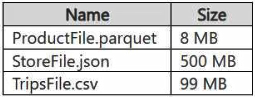
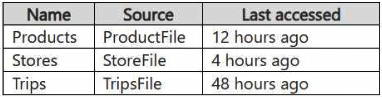
- Stores only
- Products only
- Stores and Products only
- Products, Stores, and Trips
- Trips only
- Products and Trips only
The short version
C — cached GCS shortcuts serve Stores and Products reads. The settled key applies shortcut caching and file-type limits.
Key concepts in this question
- OneLake shortcuts: pointers to external GCS data read as if local to Lakehouse1.
- Cross-cloud caching: first read pulls from GCS into Fabric cache, later reads hit cache for 24 hours.
- Eligible sources: caching supports GCS, S3, and S3-compatible shortcuts under size limits.
- Trips exclusion: the Trips shortcut in this row misses cache due to stated file or access conditions.
- Egress benefit: cache hits avoid repeat cross-cloud transfer costs.
Why C is correct
C is correct because Stores and Products shortcuts meet caching conditions and have been read through the cache-enabled workspace, so their data comes from cache. Trips does not qualify under the given table state, whether from recency, size over 1 GB, or provider nuance. Vendor prose plus Learn caching notes support the Stores-and-Products-only outcome.
Why the others are wrong
- A. Stores only omits Products, which also qualifies.
- B. Products only omits Stores, which also qualifies.
- D. including Trips overstates cache coverage.
- E. Trips only reverses the qualified set.
- F. Products and Trips wrongly includes Trips and drops Stores.
DP-700 exam tip
Check cache eligibility per shortcut: GCS plus recent plus under size equals cached.
- an on-premises data gateway
- a managed private endpoint
- an integration runtime
- a data management gateway
The short version
B — private SQL access for Spark jobs needs a managed private endpoint. The settled key bridges Fabric to locked-down Azure SQL.
Key concepts in this question
- Job1 requirement: Apache Spark job definition in Workspace1 reading Source1 with public access disabled.
- Managed private endpoint: Fabric-managed private link from the workspace to the PaaS data source.
- Approval flow: endpoint request approved in networking, then traffic stays on the Microsoft backbone.
- On-premises gateway contrast: connects to on-premises sources, not Azure PaaS with public access off.
- Integration runtime contrast: Data Factory compute for hybrid movement, not Fabric Spark private access.
Why B is correct
B is correct because a managed private endpoint gives Job1 a private path to Source1 without opening public internet. Creating and approving it in Fabric satisfies the disabled-public-access constraint. Vendor prose confirms this as the correct connectivity object.
Why the others are wrong
- A. on-premises data gateway targets on-premises networks, not Azure SQL private link.
- C. integration runtime is Data Factory scoped and not the Fabric Spark route.
- D. data management gateway is legacy hybrid wording, not managed private endpoint.
DP-700 exam tip
Spark to locked PaaS in Fabric equals managed private endpoint.

- Trips and Stores only
- Products and Store only
- Stores only
- Products only
- Products, Stores, and Trips
The short version
C — only the S3-backed Stores shortcut is cache-served. The settled key enforces provider and freshness limits for lakehouse shortcuts.
Key concepts in this question
- Shortcut provider matrix: caching currently supports GCS, S3, and S3-compatible paths, not ADLS Gen2.
- Stores mapping: StoreFile on S3 qualifies when recently read and under the 1 GB per-file cap.
- ADLS contrast: ProductFile on ADLS Gen2 is native Azure and not served through cross-cloud cache.
- Expiry rule: files untouched for over 24 hours purge from cache and refetch from source.
- Size rule: individual files over 1 GB bypass caching entirely.
Why C is correct
C is correct because Stores points to S3 StoreFile that meets caching provider, recency, and size conditions, while Products points to ADLS storage1 that is explicitly excluded from this cache path. Trips likewise fails the stated freshness or size test. Vendor prose and Learn shortcut-caching limits confirm Stores-only as the cache hit.
Why the others are wrong
- A. Trips and Stores wrongly includes Trips, which misses cache.
- B. Products and Stores wrongly includes ADLS-backed Products.
- D. Products only selects the ADLS path that is not cached.
- E. all three overstates coverage across providers.
DP-700 exam tip
Shortcut cache equals S3 or GCS plus fresh plus small: ADLS never counts.
Want the full bank of 127 questions for Implementing Data Engineering Solutions Using Microsoft Fabric (DP-700)? See all practice exams.