DP-600 — Free Practice Questions
10 free sample questions from a bank of 215, with the correct answers and explanations. No signup required — start practising right now.
1Case study -
This is a case study. Case studies are not timed separately. You can use as much exam time as you would like to complete each case. However, there may be additional case studies and sections on this exam. You must manage your time to ensure that you are able to complete all questions included on this exam in the time provided.
To answer the questions included in a case study, you will need to reference information that is provided in the case study. Case studies might contain exhibits and other resources that provide more information about the scenario that is described in the case study. Each question is independent of the other questions in this case study.
At the end of this case study, a review screen will appear. This screen allows you to review your answers and to make changes before you move to the next section of the exam. After you begin a new section, you cannot return to this section.
To start the case study -
To display the first question in this case study, click the Next button. Use the buttons in the left pane to explore the content of the case study before you answer the questions. Clicking these buttons displays information such as business requirements, existing environment, and problem statements. If the case study has an All Information tab, note that the information displayed is identical to the information displayed on the subsequent tabs. When you are ready to answer a question, click the Question button to return to the question.
Overview -
Contoso, Ltd. is a US-based health supplements company. Contoso has two divisions named Sales and Research. The Sales division contains two departments named Online Sales and Retail Sales. The Research division assigns internally developed product lines to individual teams of researchers and analysts.
Existing Environment -
Identity Environment -
Contoso has a Microsoft Entra tenant named contoso.com. The tenant contains two groups named ResearchReviewersGroup1 and ResearchReviewersGroup2.
Data Environment -
Contoso has the following data environment:
The Sales division uses a Microsoft Power BI Premium capacity.
The semantic model of the Online Sales department includes a fact table named Orders that uses Import made. In the system of origin, the OrderID value represents the sequence in which orders are created.
The Research department uses an on-premises, third-party data warehousing product.
Fabric is enabled for contoso.com.
An Azure Data Lake Storage Gen2 storage account named storage1 contains Research division data for a product line named Productline1. The data is in the delta format.
A Data Lake Storage Gen2 storage account named storage2 contains Research division data for a product line named Productline2. The data is in the CSV format.
Requirements -
Planned Changes -
Contoso plans to make the following changes:
Enable support for Fabric in the Power BI Premium capacity used by the Sales division.
Make all the data for the Sales division and the Research division available in Fabric.
For the Research division, create two Fabric workspaces named Productline1ws and Productine2ws.
In Productline1ws, create a lakehouse named Lakehouse1.
In Lakehouse1, create a shortcut to storage1 named ResearchProduct.
Data Analytics Requirements -
Contoso identifies the following data analytics requirements:
All the workspaces for the Sales division and the Research division must support all Fabric experiences.
The Research division workspaces must use a dedicated, on-demand capacity that has per-minute billing.
The Research division workspaces must be grouped together logically to support OneLake data hub filtering based on the department name.
For the Research division workspaces, the members of ResearchReviewersGroup1 must be able to read lakehouse and warehouse data and shortcuts by using SQL endpoints.
For the Research division workspaces, the members of ResearchReviewersGroup2 must be able to read lakehouse data by using Lakehouse explorer.
All the semantic models and reports for the Research division must use version control that supports branching.
Data Preparation Requirements -
Contoso identifies the following data preparation requirements:
The Research division data for Productline1 must be retrieved from Lakehouse1 by using Fabric notebooks.
All the Research division data in the lakehouses must be presented as managed tables in Lakehouse explorer.
Semantic Model Requirements -
Contoso identifies the following requirements for implementing and managing semantic models:
The number of rows added to the Orders table during refreshes must be minimized.
The semantic models in the Research division workspaces must use Direct Lake mode.
General Requirements -
Contoso identifies the following high-level requirements that must be considered for all solutions:
Follow the principle of least privilege when applicable.
Minimize implementation and maintenance effort when possible.
You need to ensure that Contoso can use version control to meet the data analytics requirements and the general requirements.
What should you do?
- Store at the semantic models and reports in Data Lake Gen2 storage.
- Modify the settings of the Research workspaces to use a GitHub repository.
- Modify the settings of the Research division workspaces to use an Azure Repos repository.
- Store all the semantic models and reports in Microsoft OneDrive.
Answer: C
2You have a Fabric warehouse that contains a table named Staging.Sales. Staging.Sales contains the following columns. You need to write a T-SQL query that will return data for the year 2023 that displays ProductID and ProductName and has a summarized Amount that is higher than 10,000.
Which query should you use?
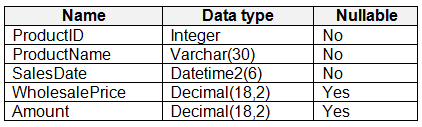
Answer:
3You have a Fabric tenant that contains JSON files in OneLake. The files have one billion items.
You plan to perform time series analysis of the items.
You need to transform the data, visualize the data to find insights, perform anomaly detection, and share the insights with other business users. The solution must meet the following requirements:
• Use parallel processing.
• Minimize the duplication of data.
• Minimize how long it takes to load the data.
What should you use to transform and visualize the data?
- the PySpark library in a Fabric notebook
- the pandas library in a Fabric notebook
- a Microsoft Power BI report that uses core visuals
Answer: A
4You have a Fabric tenant that contains customer churn data stored as Parquet files in OneLake. The data contains details about customer demographics and product usage.
You create a Fabric notebook to read the data into a Spark DataFrame. You then create column charts in the notebook that show the distribution of retained customers as compared to lost customers based on geography, the number of products purchased, age, and customer tenure.
Which type of analytics are you performing?
- diagnostic
- descriptive
- prescriptive
- predictive
Answer: B
5HOTSPOT -
You have a Fabric tenant that contains a semantic model. The model contains data about retail stores.
You need to write a DAX query that will be executed by using the XMLA endpoint. The query must return the total amount of sales from the same period last year.
How should you complete the DAX expression? To answer, select the appropriate options in the answer area.
NOTE: Each correct selection is worth one point.
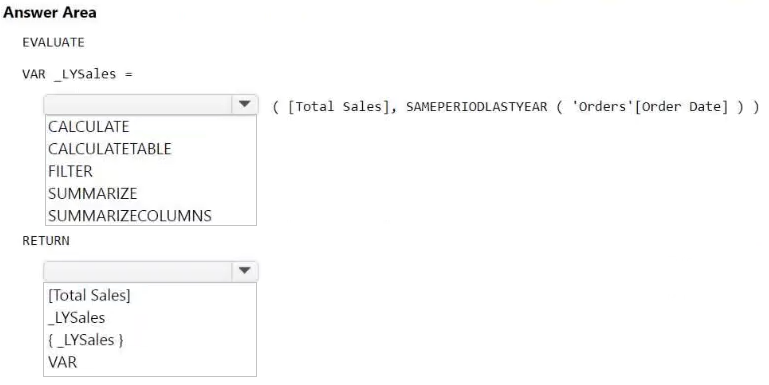
Answer:
6You have a Fabric workspace named Workspace1 that contains a dataflow named Dataflow1. Dataflow1 returns 500 rows of data.
You need to identify the min and max values for each column in the query results.
Which three Data view options should you select? Each correct answer presents part of the solution.
NOTE: Each correct answer is worth one point.
- Show column value distribution
- Enable column profile
- Show column profile in details pane
- Show column quality details
- Enable details pane
Answer:
7You have a Fabric tenant that contains a Microsoft Power BI report.
You are exploring a new semantic model.
You need to display the following column statistics:
• Count
• Average
• Null count
• Distinct count
• Standard deviation
Which Power Query function should you run?
- Table.schema
- Table.view
- Table.FuzzyGroup
- Table.Profile
Answer: D
8Note: This question is part of a series of questions that present the same scenario. Each question in the series contains a unique solution that might meet the stated goals. Some question sets might have more than one correct solution, while others might not have a correct solution.
After you answer a question in this section, you will NOT be able to return to it. As a result, these questions will not appear in the review screen.
You have a Fabric tenant that contains a lakehouse named Lakehouse1. Lakehouse1 contains a Delta table named Customer.
When you query Customer, you discover that the query is slow to execute. You suspect that maintenance was NOT performed on the table.
You need to identify whether maintenance tasks were performed on Customer.
Solution: You run the following Spark SQL statement:
DESCRIBE DETAIL customer -
Does this meet the goal?
- Yes
- No
Answer: B
9Note: This question is part of a series of questions that present the same scenario. Each question in the series contains a unique solution that might meet the stated goals. Some question sets might have more than one correct solution, while others might not have a correct solution.
After you answer a question in this section, you will NOT be able to return to it. As a result, these questions will not appear in the review screen.
You have a Fabric tenant that contains a new semantic model in OneLake.
You use a Fabric notebook to read the data into a Spark DataFrame.
You need to evaluate the data to calculate the min, max, mean, and standard deviation values for all the string and numeric columns.
Solution: You use the following PySpark expression:
df.explain().show()
Does this meet the goal?
- Yes
- No
Answer: B
10Note: This question is part of a series of questions that present the same scenario. Each question in the series contains a unique solution that might meet the stated goals. Some question sets might have more than one correct solution, while others might not have a correct solution.
After you answer a question in this section, you will NOT be able to return to it. As a result, these questions will not appear in the review screen.
You have a Fabric tenant that contains a semantic model named Model1.
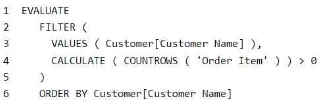
You discover that the following query performs slowly against Model1. You need to reduce the execution time of the query.
Solution: You replace line 4 by using the following code:
ISEMPTY ( RELATEDTABLE ( 'Order Item' ) )
Does this meet the goal?
- Yes
- No
Answer: B
Want the full bank of 215 questions for DP-600? See all practice exams.