DP-300 — Free Practice Questions
10 free sample questions from a bank of 443, with the correct answers and explanations. No signup required — start practising right now.
1You have 20 Azure SQL databases provisioned by using the vCore purchasing model.
You plan to create an Azure SQL Database elastic pool and add the 20 databases.
Which three metrics should you use to size the elastic pool to meet the demands of your workload? Each correct answer presents part of the solution.
NOTE: Each correct selection is worth one point.
- total size of all the databases
- geo-replication support
- number of concurrently peaking databases * peak CPU utilization per database
- maximum number of concurrent sessions for all the databases
- total number of databases * average CPU utilization per database
Answer: A, C, E
2You are designing a streaming data solution that will ingest variable volumes of data.
You need to ensure that you can change the partition count after creation.
Which service should you use to ingest the data?
- Azure Event Hubs Standard
- Azure Stream Analytics
- Azure Data Factory
- Azure Event Hubs Dedicated
Answer: D
3HOTSPOT -
You are building a database in an Azure Synapse Analytics serverless SQL pool.
You have data stored in Parquet files in an Azure Data Lake Storage Gen2 container.
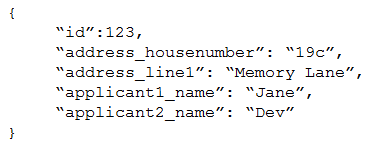
Records are structured as shown in the following sample. The records contain two applicants at most.
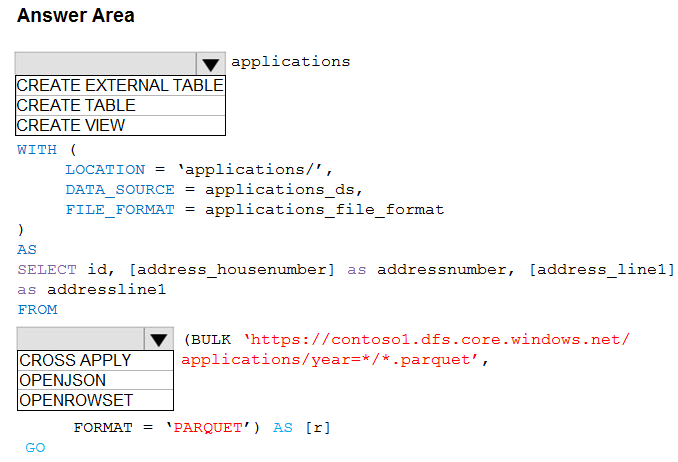
You need to build a table that includes only the address fields.
How should you complete the Transact-SQL statement? To answer, select the appropriate options in the answer area.
NOTE: Each correct selection is worth one point.
Hot Area:
Answer:
4You have an Azure Synapse Analytics Apache Spark pool named Pool1.
You plan to load JSON files from an Azure Data Lake Storage Gen2 container into the tables in Pool1. The structure and data types vary by file.
You need to load the files into the tables. The solution must maintain the source data types.
What should you do?
- Load the data by using PySpark.
- Load the data by using the OPENROWSET Transact-SQL command in an Azure Synapse Analytics serverless SQL pool.
- Use a Get Metadata activity in Azure Data Factory.
- Use a Conditional Split transformation in an Azure Synapse data flow.
Answer: A
5You are designing a date dimension table in an Azure Synapse Analytics dedicated SQL pool. The date dimension table will be used by all the fact tables.
Which distribution type should you recommend to minimize data movement?
- HASH
- REPLICATE
- ROUND_ROBIN
Answer: B
6HOTSPOT -
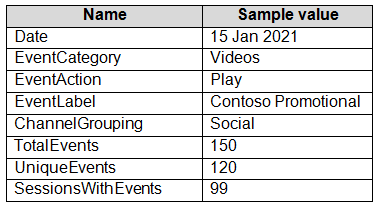
From a website analytics system, you receive data extracts about user interactions such as downloads, link clicks, form submissions, and video plays.
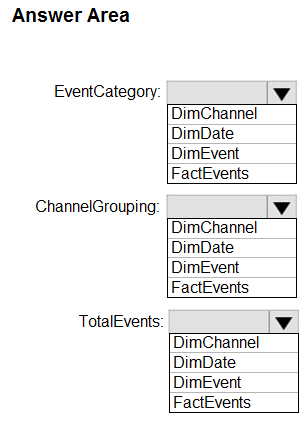
The data contains the following columns: You need to design a star schema to support analytical queries of the data. The star schema will contain four tables including a date dimension.
To which table should you add each column? To answer, select the appropriate options in the answer area.
NOTE: Each correct selection is worth one point.
Hot Area:
Answer:
7DRAG DROP -
You plan to create a table in an Azure Synapse Analytics dedicated SQL pool.
Data in the table will be retained for five years. Once a year, data that is older than five years will be deleted.
You need to ensure that the data is distributed evenly across partitions. The solutions must minimize the amount of time required to delete old data.
How should you complete the Transact-SQL statement? To answer, drag the appropriate values to the correct targets. Each value may be used once, more than once, or not at all.
You may need to drag the split bar between panes or scroll to view content.
NOTE: Each correct selection is worth one point.
Select and Place:
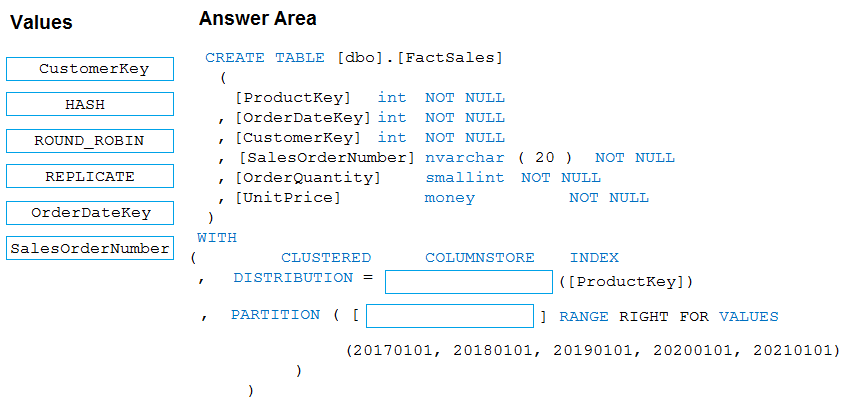
Answer:
8You have an Azure Synapse Analytics workspace named WS1 that contains an Apache Spark pool named Pool1.
You plan to create a database named DB1 in Pool1.
You need to ensure that when tables are created in DB1, the tables are available automatically as external tables to the built-in serverless SQL pool.
Which format should you use for the tables in DB1?
- JSON
- CSV
- Parquet
- ORC
Answer: C
9You are designing an anomaly detection solution for streaming data from an Azure IoT hub. The solution must meet the following requirements:
✑ Send the output to an Azure Synapse.
✑ Identify spikes and dips in time series data.
✑ Minimize development and configuration effort.
Which should you include in the solution?
- Azure SQL Database
- Azure Databricks
- Azure Stream Analytics
Answer: C
10You are creating a new notebook in Azure Databricks that will support R as the primary language but will also support Scala and SQL.
Which switch should you use to switch between languages?
- \\[ ]
- %
- \\[ ]
- @
Answer: B
Want the full bank of 443 questions for DP-300? See all practice exams.