Certified Integration Architect — Free Practice Questions
10 free sample questions from a bank of 76, with the correct answers and explanations. No signup required — start practising right now.
1A company is designing a Lightning Web Component (LWC) to display transactions aggregated from different sources. Their current system landscape is as follows:
1. Transactions are created at any time through their various on-premise and cloud-based systems.
2. All necessary transactions are replicated to a custom Transaction object in Salesforce. It is updated periodically so it only has a subset of the necessary transactions between updates.
3. Middleware supports publish-subscribe interactions and provides RESTful Enterprise APIs that can retrieve transactions from on-premise and cloud-based systems.
The company wants to address a usability concern regarding incomplete data displayed on the LWC component.
What should the integration architect specify so the LWC will be able to display all the required transactions?
- Publish a Platform Event, have the middleware subscribe and update the custom object on receipt of Platform Event.
- Call the Enterprise APIs directly from the LWC's JavaScript code and redisplay the LWC on receipt of the API response.
- Use the Continuation class to call the Enterprise APIs and then process the response in a callback method.
- Let the Lightning Data Service with an @wire adapter display new values when the custom object records change.
Answer: C
2A new Salesforce program has the following high-level abstract requirement: Business processes executed on Salesforce require data updates between their internal systems and Salesforce.
Which three relevant details should a Salesforce Integration Architect seek to specifically solve for integration architecture needs of the program? (Choose three.)
- Integration Style - Process-based, Data-based, and Virtual integration.
- Timing aspects, real-time/near real-time (synchronous or asynchronous), batch and update frequency.
- Source and Target system, Directionality, and data volume & transformation complexity, along with any middleware that can be leveraged.
- Integration skills, SME availability, and Program Governance details.
- Core functional and non-functional requirements for User Experience design, Encryption needs, Community, and license choices.
Answer: A, B, C
3An integration architect has received a request to prevent employees that leave the company from accessing data in Salesforce after they are deactivated in the company’s HR system.
What should the integration architect determine before recommending a solution?
- Data access prevention requirements, then identify frequency
- Inbound integration requirements, then identify frequency
- Data access prevention requirements, integration requirements, and system constraints
Answer: B
4A company’s cloud-based single page application consolidates data local to the application with data from on-premise and third-party systems. The diagram below typifies the application’s combined use of synchronous and asynchronous calls. The company wants to use the average response time of its application’s user interface as a basis for certain alerts. For this purpose, the following occurs:
1. Log every call start and finish date and time to a central analytics data store.
2. Compute response time uniformly as the difference between the start and finish date and time (A to H in the diagram).
Which computation represents the end-to-end response time from the user’s perspective?
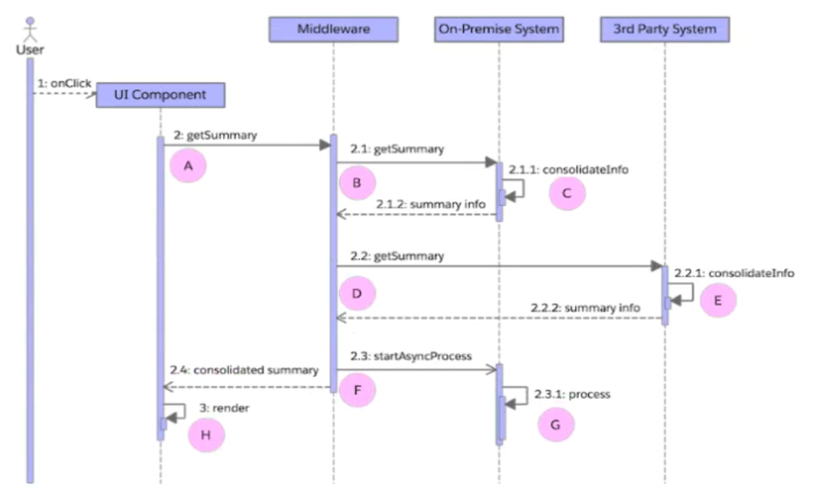
- Sum of A to H
- Sum of A to F
- Sum A and H
Answer: C
5Northern Trail Outfitters has a registration system that is used for workshops offered at its conferences. Attendees use Salesforce Community to register for workshops, but the scheduling system manages workshop availability based on room capacity. It is expected that there will be a big surge of requests for workshop reservations when the conference schedule goes live.
Which integration pattern should be used to manage the influx in registrations?
- Batch Data Synchronization
- Remote Process Invocation Request and Reply
- Remote Process Invocation Fire and Forget
Answer: A
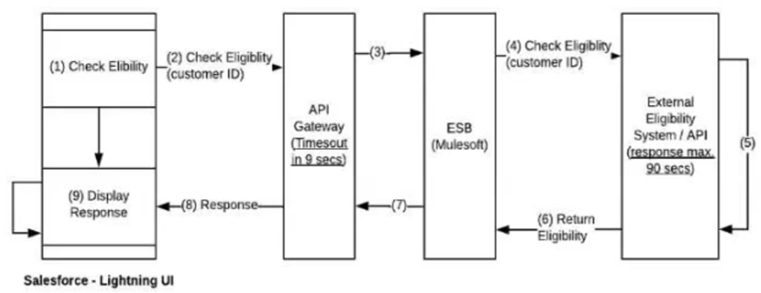
6An enterprise architect has requested the Salesforce integration architect to review the following (see diagram and description) and provide recommendations after carefully considering all constraints of the enterprise systems and Salesforce platform limits. • About 3,000 phone sales agents use a Salesforce Lightning UI concurrently to check eligibility of a customer for a qualifying offer.
• There are multiple eligibility systems that provide this service and are hosted externally. However, their current response times could take up to 90 seconds to process and return (there are discussions to reduce the response times in the future, but no commitments are made).
• These eligibility systems can be accessed through APIs orchestrated via ESB (MuleSoft).
• All requests from Salesforce will have to traverse through the customer's API Gateway layer and the API Gateway imposes a constraint of timing out requests after 9 seconds.
Which recommendation should the integration architect make?
- Recommend synchronous Apex callouts from Lightning UI to External Systems via Mule and implement polling on an API Gateway timeout.
- Create a platform event in Salesforce via Remote Call-In and use the empAPI in the Lightning UI to serve 3,000 concurrent users when responses are received by Mule.
- Implement a "Check Update" button that passes a requestID received from ESB (user action needed).
Answer: C
7A customer imports data from an external system into Salesforce using Bulk API. These jobs have batch sizes of 2000 and are run in parallel mode. The batches fail frequently with the error “Max CPU time exceeded”. A smaller batch size will fix this error.
What should be considered when using a smaller batch size?
- Smaller batch size may exceed the concurrent API request limits.
- Smaller batch size can trigger “Too many concurrent batches” error.
- Smaller batch size may increase time required to execute bulk jobs.
Answer: C
8Which three considerations should an integration architect consider when recommending Platform Event as an integration solution? (Choose three.)
- Event messages using SOQL are unable to be queried.
- A Lightning record page for platform events is unable to be created.
- Subscribe to an AssetTokenEvent stream to monitor OAuth 2.0 authentication activity.
- When an event definition is deleted, it's permanently removed and can't be restored.
- Event Monitoring is used to track user activity, such as logins and running reports.
Answer: A, B, D
9A subscription-based media company’s system landscape forces many subscribers to maintain multiple accounts and to login more than once. An Identity and Access Management (IAM) system, which supports SAML and OpenId, was recently implemented to improve the subscriber experience through self-registration and single sign-on (SSO).
The IAM system must integrate with Salesforce to give new self-service customers instant access to Salesforce Community Cloud.
Which requirement should the Salesforce Community Cloud support for self-registration and SSO?
- OpenId Connect Authentication Provider and Registration Handler
- OpenId Connect Authentication Provider and JIT provisioning
- SAML SSO and Registration Handler
Answer: A
10The director of customer service at Northern Trail Outfitters (NTO) wants to capture and trend specific business events that occur in Salesforce in real time. The metrics will be accessed in an ad-hoc manner using an external analytics system. The events are as follows:
1. A customer initiates a product exchange via a Case.
2. A customer service rep clicks on the "Authorize Exchange Product" menu item in the Case.
3. A customer initiates a subscription cancellation via a Case.
4. A customer service rep clicks on the "Initiate Refund" menu item in the Case.
Which solution should meet these business requirements?
- Case Trigger after Insert, after update to publish the platform event.
- Case Workflow Rule that sends an Outbound Message.
- Case after insert Trigger that executes a callout.
Answer: A
Want the full bank of 76 questions for Certified Integration Architect? See all practice exams.