CompTIA Cloud+ (CV0-004) — Free Practice Questions
10 free sample questions from a bank of 534, with the correct answers and explanations. No signup required — start practising right now.
- SQL
- Web sockets
- RPC
- GraphQL
The short version
D — GraphQL best supports programmatic transfer plus query over the internet. A single endpoint lets clients request exactly the fields they need.
Key concepts in this question
- Programmatic access: machine driven calls over HTTP that create, move, and manipulate data without manual steps.
- Queryable transfer: ability to filter and shape payloads on the server so only needed data crosses the network.
- GraphQL model: typed schema plus query language where clients specify fields, relations, and parameters in one request.
- SQL scope: database language for relational stores, not an internet API style for transfer plus query.
- Sockets and RPC: transport or call styles that move data but lack declarative field level querying.
Why D is correct
D is correct because GraphQL combines internet friendly programmatic access with precise querying in one mechanism. The engineer can transfer data over HTTP while embedding queries that select nested objects and attributes, reducing over fetch and round trips. SQL stays inside databases, web sockets focus on persistent bidirectional streams, and RPC invokes procedures without a field selection model. Only GraphQL delivers both transfer and query as the stem demands.
Why the others are wrong
- A. Wrong because SQL queries relational stores directly, but does not provide internet programmatic transfer plus API querying.
- B. Wrong because web sockets enable persistent push plus pull, but do not offer declarative data querying.
- C. Wrong because RPC executes remote procedures efficiently, yet lacks GraphQL style field selection and shaping.
CV0-004 exam tip
Transfer plus query over internet equals GraphQL: SQL stays in database, sockets stream, RPC calls procedures.
- Image reconstruction
- Facial recognition
- Natural language processing
- Computer vision
The short version
D — computer vision identifies objects and people in images and video. It gives machines visual understanding at scale.
Key concepts in this question
- Computer vision: field training models to detect, classify, and track visual entities in pixels and frames.
- Object and person recognition: locating faces, vehicles, and items plus understanding scene context.
- Image reconstruction: rebuilding images from partial data, a subtask rather than the whole field.
- Facial recognition: one application of vision focused on identity, narrower than the discipline.
- Natural language processing: understanding text and speech, not visual content.
Why D is correct
D is correct because computer vision is the computer science field that enables computers to identify and understand objects and people in images and videos. It spans detection, segmentation, classification, and tracking across photos and streams. Image reconstruction rebuilds pixels, facial recognition identifies one biometric, and natural language processing handles words. The broad visual understanding discipline sought by the stem is computer vision.
Why the others are wrong
- A. Wrong because image reconstruction restores images, but does not name the full visual understanding field.
- B. Wrong because facial recognition is a subset application for identity, not the whole vision discipline.
- C. Wrong because natural language processing interprets language, not images and video content.
CV0-004 exam tip
Images plus video plus objects plus people equals computer vision, not NLP or facial subset.
- PaaS
- SaaS
- IaaS
- XaaS
The short version
A — PaaS best hosts custom code without provisioning infrastructure. It abstracts servers while leaving code control with developers.
Key concepts in this question
- PaaS model: platform providing runtime, middleware, and scaling so teams deploy code directly.
- No infrastructure provisioning: no VM sizing, patching, or network setup required from the company.
- SaaS scope: finished applications consumed as services, not platforms for custom code deployment.
- IaaS scope: raw compute plus storage requiring provisioning and management effort.
- XaaS generality: everything as a service label, too vague to select for direct code deployment.
Why A is correct
A is correct because Platform as a Service lets the company deploy its own code directly in the cloud without provisioning additional infrastructure. The provider manages operating systems, runtimes, and scaling primitives while the company pushes code and configuration. SaaS would force use of existing apps, IaaS would demand infrastructure work, and XaaS does not specify the platform benefit. PaaS uniquely matches deploy code with no infra burden.
Why the others are wrong
- B. Wrong because SaaS delivers ready applications, not a platform for deploying custom code.
- C. Wrong because IaaS requires provisioning VMs, networks, and upkeep before code can run.
- D. Wrong because XaaS is a generic label that does not identify the code ready platform model.
CV0-004 exam tip
Own code plus no infra equals PaaS: SaaS consumes, IaaS provisions, PaaS deploys.
- The company should have switched from object storage to file storage.
- The company should have hashed the data.
- The company should have changed the file access permissions.
- The company should have encrypted the data at rest.
The short version
D — encrypt data at rest to make stolen object storage unusable. Ciphertext without keys resists unauthorized reading.
Key concepts in this question
- Encryption at rest: protecting stored bytes so theft yields ciphertext without usable content.
- Object storage breach: attacker gains files, but cannot interpret them when keys remain controlled.
- Storage type change: moving from object to file alters access style, not confidentiality of bytes.
- Hashing purpose: integrity fingerprinting that is one way, unsuitable for reversible data use.
- Permissions role: access control reduces likelihood, but does not render already taken data unusable.
Why D is correct
D is correct because the company should have encrypted the data at rest, which makes exfiltrated object content unusable without decryption keys. Even after unauthorized access, ciphertext reveals no business meaning and limits harm. Switching storage types keeps data readable, hashing prevents legitimate retrieval, and permissions only help before theft. Encryption at rest is the settled control that neutralizes stolen copies.
Why the others are wrong
- A. Wrong because changing to file storage alters protocol, but leaves stolen bytes readable.
- B. Wrong because hashing is one way integrity checking, not reversible protection for usable storage.
- C. Wrong because permissions help prevent access, but do not make already accessed data unusable.
CV0-004 exam tip
Stolen data plus unusable equals encrypt at rest: perms prevent, encryption neutralizes after theft.
- IPS
- ACL
- DLP
- WAF
The short version
D — WAF best blocks basic exploitation of web facing CRM on IaaS. It filters malicious HTTP before it reaches the app.
Key concepts in this question
- Remote command execution: attacker injecting OS commands through web inputs to run code on the server.
- WAF function: inspecting HTTP requests for known attack signatures and blocking basic exploit patterns.
- IPS scope: network intrusion prevention that complements, but is less tuned to app layer payloads than WAF.
- ACL scope: access lists permitting or denying addresses, not inspecting payloads for injection.
- DLP scope: preventing sensitive data egress, not blocking inbound command injection.
Why D is correct
D is correct because a Web Application Firewall sits in front of the public cloud CRM and blocks basic remote command execution attempts carried in HTTP. It parses parameters, headers, and bodies for traversal and command patterns and denies them before the vulnerable code runs. IPS adds network value, ACLs limit sources, and DLP guards outbound data, yet none provides the app layer exploit filtering that best stops basic attacks on a web app.
Why the others are wrong
- A. Wrong because IPS focuses on network exploits more than HTTP app payload inspection for command injection.
- B. Wrong because ACLs control who can reach the app, but do not inspect request content for attacks.
- C. Wrong because DLP monitors outbound sensitive data, not inbound web exploitation attempts.
CV0-004 exam tip
Web app plus basic exploit equals WAF first: ACLs allow, IPS watches net, DLP watches out.
- A SAN works only with fiber-based networks.
- A SAN works with any Ethernet-based network.
- A NAS uses a faster protocol than a SAN.
- A NAS uses a slower protocol than a SAN.
The short version
D — NAS uses a slower file protocol than SAN block access. SAN fabrics deliver lower latency high throughput paths.
Key concepts in this question
- SAN design: block level storage over dedicated high speed fabrics presenting LUNs to hosts.
- NAS design: file level sharing over Ethernet with NFS or SMB, adding protocol and contention overhead.
- Protocol speed: block paths avoid file locking and sharing layers, yielding faster typical throughput.
- Fiber versus Ethernet: transports vary, but the settled distinction centers on protocol efficiency.
- Absolute claims: only with fiber or any Ethernet wording overstates transport limits and misses the point.
Why D is correct
D is correct because a NAS uses a slower protocol than a SAN in typical comparison. NAS serves files through sharing protocols that add parsing and contention, while SAN serves blocks over optimized fabrics built for storage performance. Fiber only or any Ethernet statements misstate transport reality, and claiming NAS is faster inverts the settled performance relationship. The exam distinction is file slower versus block faster.
Why the others are wrong
- A. Wrong because SANs use multiple transports including iSCSI and FC, not fiber only.
- B. Wrong because SANs are not defined by working with any Ethernet network; performance comes from block design.
- C. Wrong because NAS file protocols are generally slower, not faster, than SAN block protocols.
CV0-004 exam tip
SAN block equals fast, NAS file equals slower: ignore fiber only absolutes.
- Configuring centralized logging to analyze HTTP requests
- Running a flow log on the network to analyze the packets
- Configuring an API gateway to track all incoming requests
- Enabling tracing to detect HTTP response times and codes
The short version
D — enabling tracing pinpoints which third party REST call causes latency. Distributed spans show per dependency response times and codes.
Key concepts in this question
- High latency triage: isolating whether delay comes from network, app code, or specific downstream API.
- Tracing: correlating requests across services with timing per hop plus status codes.
- Centralized logging: valuable for errors, but harder to attribute random latency without span timing.
- Flow logs: packet level network view that misses app wait versus downstream response breakdown.
- API gateway tracking: covers incoming edge, not the multiple outgoing third party calls.
Why D is correct
D is correct because enabling tracing to detect HTTP response times and codes best determines the source of random high latency from multiple third party REST APIs. Traces attach timing to each outbound call, revealing which provider spikes and whether failures or retries correlate. Logging shows messages, flow logs show packets, and gateway tracking shows ingress, yet none attributes per dependency latency as directly as distributed tracing.
Why the others are wrong
- A. Wrong because centralized logging aids error search, but lacks per dependency timing attribution.
- B. Wrong because flow logs expose network packets, not which REST dependency waited longest.
- C. Wrong because gateway tracking monitors incoming requests, not outgoing third party latency.
CV0-004 exam tip
Random downstream latency equals tracing: logs tell what, traces tell where plus how long.
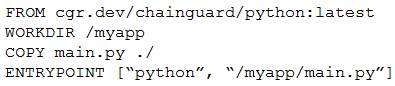
- Add the instruction USER nonroot.
- Change the version from latest to 3.11.
- Remove the ENTRYPOINT instruction.
- Ensure myapp/main/py is owned by root.
The short version
A — add USER nonroot to improve container security. Running as non root limits impact of breakout or bug.
Key concepts in this question
- Least privilege containers: processes should run with minimal OS rights needed for the app.
- USER instruction: Dockerfile directive setting the runtime user away from default root.
- Root risk: root in container eases host impact if isolation fails or files are writable.
- Version pinning: useful for stability, but not the primary security hardening in this stem.
- Entrypoint and ownership: execution setup details that do not replace non root execution.
Why A is correct
A is correct because adding the instruction USER nonroot ensures the Python web app does not run as root inside the container. That single change enforces least privilege, so file writes, process signals, and potential escapes operate with limited rights. Changing latest to a pinned tag helps reproducibility, removing entrypoint breaks startup, and root owned code preserves privilege. The settled hardening is non root execution.
Why the others are wrong
- B. Wrong because pinning to 3 dot 11 aids determinism, but does not remove root privilege risk.
- C. Wrong because removing ENTRYPOINT disrupts launch without improving privilege posture.
- D. Wrong because root owned app files keep elevated control rather than reducing runtime privilege.
CV0-004 exam tip
Container hardening first equals USER nonroot: pin versions next, never run as root.
- Drift detection
- Repeatability
- Documentation
- Versioning
The short version
D — versioning restores template change history for repeated deployments. Tracked revisions show who changed what and allow rollback.
Key concepts in this question
- Deployment templates: declarative definitions recreating dev environments consistently.
- History need: ability to review past changes when troubleshooting drift or failure.
- Versioning: storing each template revision with identity, diff, and restore point.
- Drift detection: finding divergence from desired state, useful after history exists.
- Repeatability and docs: desirable properties, but neither records revision history by itself.
Why D is correct
D is correct because versioning the deployment template gives administrators a reviewable history of changes made to the shared definition. Each edit becomes a restorable revision, enabling diff review, audit, and rollback when recreations behave differently. Drift detection spots differences, repeatability ensures same result, and documentation describes intent, yet only versioning preserves the temporal record the stem lacks.
Why the others are wrong
- A. Wrong because drift detection compares actual versus desired, but does not store template history.
- B. Wrong because repeatability ensures consistent builds, not a browsable change log.
- C. Wrong because documentation explains usage, but does not version each template revision.
CV0-004 exam tip
No history plus same template equals versioning: drift finds skew, versioning shows past.
- Compliance
- IaaS vs. SaaS
- Firewall capabilities
- Regulatory
- Implementation timeline
- Service availability
The short version
AD — compliance plus regulatory dominate public sector cloud migration. Government moves must satisfy law before architecture or timeline.
Key concepts in this question
- Compliance: meeting internal and external obligations for data handling, security, and auditability in cloud.
- Regulatory: statutes governing residency, sovereignty, retention, and citizen data that can veto locations or models.
- Service model choice: IaaS versus SaaS matters after legal feasibility is confirmed.
- Firewall and availability: important technical qualities, but subordinate to legal permission to migrate.
- Timeline pressure: schedule follows scope that law allows, not the reverse.
Why AD is correct
AD is correct because a government agency moving on premises to cloud must weigh compliance and regulatory considerations above all. Those determine what data may move, where it may reside, which controls are mandatory, and what evidence auditors demand. Model choice, firewall features, timelines, and availability shape implementation once legal path is clear. The settled pair reflects public sector reality that law decides feasibility first.
Why the others are wrong
- B. Wrong because IaaS versus SaaS is an architecture choice made after legal feasibility is settled.
- C. Wrong because firewall capabilities are technical controls within a compliant design, not top considerations.
- E. Wrong because timeline is planning detail that cannot override regulatory permission.
- F. Wrong because availability matters operationally, yet law still decides whether migration may proceed.
CV0-004 exam tip
Government cloud equals compliance plus regulatory first: tech and time follow law.
Want the full bank of 534 questions for CompTIA Cloud+ (CV0-004)? See all practice exams.