ServiceNow Certified Implementation Specialist - Discovery (CIS-Discovery) — Free Practice Questions
10 free sample questions from a bank of 104, with the correct answers and explanations. No signup required — start practising right now.
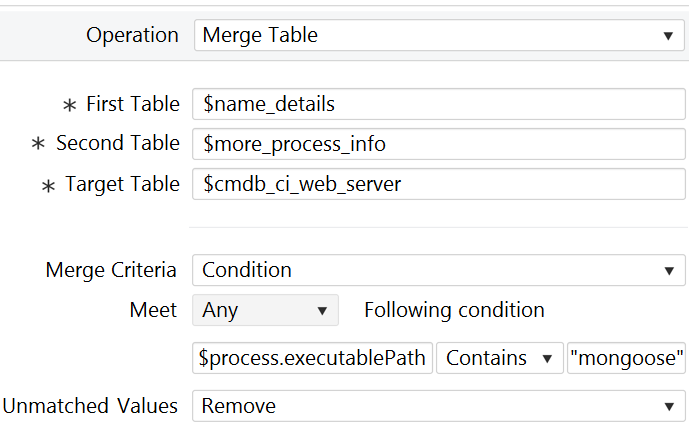
- Attributes from two tables populate a table with the same name as a ServiceNow CMDB table.
- This operation is more than likely a part of a step on a pattern set to Application Pattern Type.
- If a value is unmatched, it is still merged into the Target Table.
- For this operation to run, there must be some data in the process.executablePath variable.
- This is a horizontal pattern of type "infrastructure."
The short version
ABD — merge into a CMDB-named table inside an application pattern gated by executablePath. The screenshot shows a table-merge style operation that lands in a CMDB-named target, the surrounding pattern is application-type, and the step can only run when process dot executablePath already has data.
Key concepts in this question
- Merge or transform operation: takes attributes from two upstream tables and combines them into one target table for CMDB update.
- Same-name CMDB target: writing to a CMDB-named table stages CI attributes for identification, not a scratch table.
- Application Pattern Type: application patterns model running software top-down from a process, unlike infrastructure patterns that start from an IP.
- process dot executablePath: variable holding the process path, populated by a prior Get Process step and consumed as input here.
Why ABD is correct
A is correct because the operation pulls attributes from two sources into a table mirroring a CMDB table, which is how merge steps stage CI data. B is correct because an operation keyed on process dot executablePath belongs to an application pattern flow. D is correct because the step consumes executablePath as input, so an empty value leaves it with nothing to match or merge.
Why the others are wrong
- C. Unmatched values are excluded by merge logic, they are not forced into the target.
- E. The executablePath dependency marks this as application-type, not a horizontal infrastructure pattern.
CIS-Discovery exam tip
Think path means process means application pattern, and application merges need a populated executablePath to fire.
- write community strings
- usernames
- read community strings
- port 135 access
The short version
C — SNMP discovery needs read community strings. Discovery only polls devices for inventory, so a read-only community string is sufficient and expected, while write strings, interactive usernames, and Windows port 135 have no role in the SNMP credential.
Key concepts in this question
- SNMP community strings: shared secrets for SNMPv1 and SNMPv2c that authorize managers to query agents.
- Read versus write access: Discovery performs read-only polling of MIB values such as sysDescr and serial numbers, and never sets device configuration.
- SNMP ports: standard SNMP uses UDP port 161 for polls and 162 for traps, which the MID Server must reach.
- Least privilege: best practice grants only the access needed, so read-only is sufficient and safer.
Why C is correct
Discovery SNMP probes issue GET and walk requests against device MIBs to identify class, model, and serial data, and a read community string provides exactly that authority. PDI behavior confirms that the read string lets SNMP identification succeed, while no write operation is ever issued by Discovery. Granting only read access therefore satisfies function and least privilege for enterprise scanning.
Why the others are wrong
- A. Write strings grant SET authority Discovery never uses and violate least privilege.
- B. Usernames belong to SNMPv3 USM or SSH auth, not to community-string SNMP credentials.
- D. Port 135 is for Windows WMI DCOM, while SNMP polls use UDP 161 and traps use 162.
CIS-Discovery exam tip
Remember read to see, write to change, and Discovery only ever needs to see SNMP data.
- Shared libraries
- Connection sections
- Identification sections
- Network libraries
The short version
A — Shared libraries are contained in an extension section. Extension sections hold reusable customization logic, and shared libraries are the textbook example. If the question asks what lives in an extension, choose shared libraries.
Key concepts in this question
- Horizontal discovery pattern: A sequence of operations that finds CIs and their connections without relying on a top-down service entry point.
- Extension section: A customization container that lets you extend or override pattern behavior without editing the published base pattern directly.
- Shared libraries: Reusable script includes and helper logic that can be called from multiple patterns or operations.
- Connection and identification sections: Core pattern structure that defines how to connect to a target and how to identify the CI, distinct from extensions.
Why A is correct
ServiceNow pattern documentation for modifying patterns with extensions describes extension sections as the place for added logic such as shared libraries. Connection sections and identification sections belong to the main pattern flow, not inside an extension. Shared libraries fit the extension purpose exactly because they are reusable and kept separate from base logic so upgrades do not overwrite custom work. That alignment makes A the only choice consistent with the documented pattern model.
Why the others are wrong
- B. Connection sections define how the pattern reaches the target and are part of the core pattern, not contents of an extension.
- C. Identification sections determine CI identity and classification and sit in the main pattern flow, not inside an extension.
- D. There is no standard network libraries construct contained in an extension section in the Discovery pattern model.
CIS-Discovery exam tip
Think extension equals customization: shared libraries go in extensions so base patterns stay upgrade-safe.
- Ping IP Addresses
- Retry Discovery
- View instructions
- Make Ranges
The short version
BC — Retry Discovery and View instructions are the bulk remediation actions. On the Discovery Home Automated Error Messages list, ACTION ON ALL lets an operator re-run discovery for the filtered errors and open the per-error guidance, which matches PDI behavior and crowd confirmation.
Key concepts in this question
- Discovery Home: central operator workspace showing schedules, results, and automated error messages that need triage after each run.
- Automated Error Messages list: aggregates active discovery errors with help links so admins can diagnose credential, connectivity, and classification failures at scale.
- Recommended Actions pane: bulk-action menu applied to all filtered rows, including assignment, task creation, retry, and viewing fix instructions.
- Retry Discovery: re-queues the selected targets for a fresh discovery attempt after the root cause such as credentials or firewall rules is corrected.
- View instructions: opens documented remediation guidance for each error type so junior operators follow the same fix path as experts.
Why BC is correct
B is correct because re-running discovery is the core bulk remediation once errors are triaged, and the Recommended Actions menu exposes Retry Discovery for ACTION ON ALL in a PDI. C is correct because each automated error carries curated help text, and View instructions surfaces that guidance for every selected row at once. Community verification in a PDI plus the vendor explanation listing Mark as assigned, Create a task, Retry Discovery, and View instructions corroborates exactly this pair as the available bulk choices.
Why the others are wrong
- A. Pinging addresses is a network diagnostic, not a bulk error-list remediation action.
- D. Making ranges belongs to schedule scope design, not to error-list triage.
CIS-Discovery exam tip
For error-list bulk actions think retry the run and read the fix, never rebuild ranges there.
- Positions
- Use SNMP Browser
- Delimiters
- Merge Criteria
The short version
AC — Delimited Text parsing offers Delimiters and Positions. In a Parse Variable step using the Delimited Text strategy, the designer picks the separator characters and the positional extraction settings, confirmed in PDI as Variables, Line Separator, Delimiters, and Positions.
Key concepts in this question
- Parse Variable operation: extracts scalar or tabular variables from command output or file content captured by an earlier probe step.
- Delimited Text strategy: treats the source as separator-divided fields such as comma, semicolon, tab, or pipe separated values rather than fixed offsets or regex groups.
- Delimiters field: defines which characters split each line into fields so the pattern knows where one value ends and the next begins.
- Positions setting: selects which field positions map to which output variables, essential when only columns two and four matter from a longer line.
- Line Separator and Variables: companion settings that split multi-line output into rows and declare the target variables to populate.
Why AC is correct
A is correct because positional mapping is how the designer tells Discovery which delimited column feeds each variable, and PDI shows Positions on the step form for this strategy. C is correct because without declaring delimiter characters the engine cannot split the line, so Delimiters is a mandatory control for this parsing mode. Together with Variables and Line Separator they form the complete Delimited Text control set visible in Pattern Designer, which is why crowd discussion and PDI checks converge on A and C.
Why the others are wrong
- B. SNMP Browser belongs to SNMP OID test helpers, not to text parsing.
- D. Merge Criteria belongs to table-merge steps, not to variable parsing.
CIS-Discovery exam tip
Delimited means declare the divider plus the positions you want to keep.
- Relationships are created automatically for each successful connection section.
- By using the Create Connections operation.
- By using the Create Relation/Reference operation.
- Relationships cannot be created via patterns.
The short version
C — Create Relation slash Reference builds relationships in horizontal patterns. It links discovered CIs to related items during pattern execution per vendor documentation.
Key concepts in this question
- Horizontal pattern: declarative logic in Pattern Designer that discovers infrastructure layer by layer from an IP or host entry point.
- Connection section: connectivity step that establishes access to a target, distinct from modeling a CMDB relationship between two CIs.
- Create Relation slash Reference operation: pattern operation that writes a CMDB relation or reference field between a primary CI and a related CI.
- CI relationships: CMDB links such as runs on, hosted on, or contains that support impact analysis and service modeling.
- Infrastructure and application patterns: both horizontal families can use relation operations to connect discovered nodes into a graph.
Why C is correct
C is correct because ServiceNow documentation for creating a relationship and reference identifies this operation as the way to create relationships between CIs and related items inside a pattern. Pattern authors add this step after identification to persist graph edges.
Why the others are wrong
- A. Successful connections establish access, they do not automatically author CMDB relations without an explicit relation step.
- B. Create Connections manages connectivity sequencing, not relation authoring between already discovered CIs.
- D. Patterns routinely create relationships, so claiming impossibility contradicts documented designer capability.
CIS-Discovery exam tip
When the stem asks how patterns create relationships, choose Relation slash Reference every time.
- Discovery Dashboard
- CI Class Manager
- Process Handlers
- Processes and Classification
- CI record
The short version
B — CI identifiers are viewed under CI Class Manager. CI identification rules and their identifiers are managed per class in CI Class Manager. When asked where to see identifiers, pick CI Class Manager.
Key concepts in this question
- CI identification: The rule set that decides whether discovered data creates a new CI or updates an existing one.
- CI identifiers: The ordered attributes, such as serial number or MAC address, used to uniquely recognize a CI of a given class.
- CI Class Manager: The CMDB workspace where administrators view classes, identifiers, identification rules, and attributes.
- Reconciliation and IRE: The engine that applies those identifiers at runtime, separate from where you view and configure them.
Why B is correct
ServiceNow documentation for creating CI identification rules directs administrators to the CI Class Manager to view and manage identifiers. The Dashboard shows Discovery status and errors, not identifier definitions. Process handlers and classification lists deal with execution flow, not identifier viewing. CI records show instance values, not the identifier rule model. Only CI Class Manager presents the identifier entries per class, so B is decisively correct.
Why the others are wrong
- A. Discovery Dashboard reports schedules, status, and errors, not CI identifier definitions.
- C. Process Handlers control automation flow and are unrelated to viewing identifiers.
- D. Processes and Classification relate to Discovery phases, not identifier administration.
- E. A CI record shows one instance and its field values, not the class-level identifier rules.
CIS-Discovery exam tip
Link identifiers to classes: if you need to see or edit identifiers, open CI Class Manager, not Discovery home.
- updating the acl rules for the CMDB tables in ServiceNow
- increase the amount of disk space on the MID Server host
- increasing the memory allocated to the MID Server app.
- increase the MID Server max payload size
The short version
C — raising MID Server thread count also demands more MID memory. Each concurrent probe thread consumes heap and CPU on the MID host, so increasing max threads without raising the memory allocation risks slowdowns, queue backup, and out-of-memory restarts.
Key concepts in this question
- MID Server threads: workers that execute probes and shuttle ECC payloads between targets and the instance.
- Max threads setting: caps concurrent probes, trading faster completion against higher resource use.
- MID JVM memory: heap shared by all threads for payload parsing and result batching.
- Throughput versus stability: adding threads helps only while CPU and memory headroom remain.
Why C is correct
C is correct because concurrent probes each hold payloads and connection state in memory at once, so more threads raise peak heap demand. Thread increases without more memory produce sluggish MIDs, stuck ECC outputs, and restarts under load. Raising MID memory is therefore the documented companion change when max threads is raised.
Why the others are wrong
- A. CMDB ACLs govern instance-side write permission, not MID concurrency capacity.
- B. Disk space affects logging and upgrades, not concurrent thread execution headroom.
- D. Max payload size governs single ECC message limits, not thread parallelism.
CIS-Discovery exam tip
More threads means more simultaneous work in memory, so size heap with threads.
- Location field for a Discovery Schedule
- Location field for a parent CI Type
- Location field for a Port Probe
- Location report from the Discovery Dashboard
The short version
A — the Discovery Schedule Location field populates CI Location. When a schedule carries a location value, discovered CIs from that run inherit it for site attribution, which is the documented and KB-backed behavior for this exact question.
Key concepts in this question
- Discovery Schedule: defines scope such as IP ranges or CIs, timing, MID selection, and metadata applied to everything found by that run.
- Location field on schedule: administrative site value set once per schedule to tag all resulting CIs without per-CI manual edits.
- CI Location field: CMDB attribute used for grouping, assignment, reporting, and health dashboards by site or campus.
- Inheritance during processing: sensors and identification rules copy schedule-level location onto newly created or updated CI records.
- KB0864114 reference: support article confirming schedule location as the source that stamps CI location during discovery.
Why A is correct
A is correct because the schedule is the only listed object whose location is designed to propagate to result CIs at scale across an entire subnet or site scan. The cited KB and community consensus confirm that setting Location on the schedule causes discovered CIs to show that location after promotion to the CMDB. This centralized approach avoids editing thousands of CI records individually and keeps site reporting consistent across recurring runs.
Why the others are wrong
- B. Parent CI type location does not cascade to newly found child CIs.
- C. Port probes detect open services and liveness, they do not assign site metadata.
- D. Dashboard location reports display existing values, they do not populate them.
CIS-Discovery exam tip
Need CIs tagged by site, set Location once on the schedule and let Discovery stamp them.
- ACC Websocket Endpoint
- Credential-less Discovery
- Check
- Infrastructure Patterns
- Policies
The short version
The correct answer is C, Check, because the osquery command itself lives in the ACC check definition. ServiceNow docs describe creating a check definition to execute the osquery command on the agent, with command text, plugin, and query parameter. A policy only schedules that check and targets CIs, so E alone does not create the action.
Key concepts in this question
Agent Client Collector uses checks, check types, and policies as separate layers. A check type handles result processing, a check definition holds command plus plugin plus parameters such as the query string, and a check instance inside a policy supplies values. Policies link agents to check instances and control timing and scope. Execution therefore needs a check first, then a policy.
Why C is correct
C is correct because the check definition contains osqueryi with logger flags and a query parameter, for example select statements against processes or logged-in users. Docs show Name util.osquery, Check type osquery, Command osqueryi with json output, Plugin osquery, and a mandatory query parameter. Without this check there is no osquery payload for any policy to schedule.
Why the others are wrong
A is wrong because the ACC websocket endpoint is connectivity plumbing, not the place where an osquery string is authored. B is wrong because credential-less discovery is a Discovery capability, not an ACC osquery construct. D is wrong because infrastructure patterns belong to Pattern Designer, not ACC execution. E is wrong as the sole answer because a policy schedules checks but does not define command text; it depends on C.
CIS-Discovery exam tip
For CIS-Discovery, separate definition from scheduling when you see ACC. If the stem asks what must be configured to run an osquery command, pick Check. If it asks what controls when and on which CIs it runs, pick Policy. Remember osqueryi with json and params query, plus the osquery plugin, as the giveaway.
Want the full bank of 104 questions for ServiceNow Certified Implementation Specialist - Discovery (CIS-Discovery)? See all practice exams.