CompTIA SecurityX (CAS-005) — Free Practice Questions
10 free sample questions from a bank of 866, with the correct answers and explanations. No signup required — start practising right now.
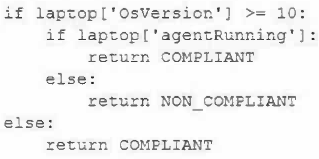
- The agent was not running on the laptop, which triggered a false positive.
- The OS was a valid version, but the MDM agent was not installed, triggering a true positive.
- The OS was running a Windows version below 10 and triggered a false negative.
- The OS version was higher than 11, and the MDM agent was running, triggering a true negative.
The short version
C — Logic flaw admitted an out-of-range OS as compliant. Policy requires Windows 10 or 11 plus a running MDM agent. A false negative means a non-compliant device was wrongly judged compliant, matching a below-10 OS slipping through.
Key concepts in this question
- Compliance conjunction: OS version check plus MDM-agent-running check must both pass for access.
- False negative meaning: a bad device is incorrectly allowed, the risky error for NAC enforcement.
- False positive contrast: a good device incorrectly denied, annoying but not a breach of policy.
- True positive and negative: correct allow and correct deny outcomes when logic works.
- Log review clue: event logs plus NAC logic diagram reveal which predicate misfired.
Why C is correct
The settled key C describes an OS below Windows 10 triggering a false negative, meaning the version predicate failed to reject a device that policy forbids. Because the overall compliant verdict was still granted, the personal laptop gained network access despite violating the OS floor. That outcome fits the observed breach exactly, where an unauthorized personal device was allowed on the corporate network.
Why the others are wrong
- A. Agent-not-running with false positive would deny a compliant device, not allow a personal one.
- B. Valid OS without agent plus true positive would correctly deny, contradicting the observed allow.
- D. Higher-than-11 OS with agent plus true negative would also correctly deny, not allow.
CAS-005 exam tip
Allow of a bad device equals false negative, deny of a good device equals false positive.
- Implement least privilege access to all systems.
- Roll out security awareness training for all users.
- Set up policies and systems with separation of duties.
- Enforce job rotations for all developers and administrators.
- Utilize mandatory vacations for all developers.
- Review all access to production systems on a quarterly basis.
The short version
C — Separation of duties blocks direct developer-to-production pushes. Least privilege alone does not remove the deployment path. Splitting build, approve, and release roles ensures no single developer can ship to production solo.
Key concepts in this question
- Separation of duties: divides critical actions so collusion is needed to abuse production.
- Deployment pipeline control: code promotion requires distinct submitter and approver identities.
- Least privilege limits: narrows permissions but can still leave a direct push right in one role.
- Awareness and rotation: training, vacations, and rotations deter fraud but do not technically block pushes.
- Access reviews: quarterly checks detect excess rights after the fact rather than preventing deployment.
Why C is correct
Preventing developers from deploying artifacts directly to production is a classic separation-of-duties problem requiring enforced workflow and system controls. By assigning build, review, and release duties to different principals and encoding that split in pipeline policies, the organization makes unilateral production pushes impossible. Settled key C therefore provides the strongest preventive control for the stated objective.
Why the others are wrong
- A. Least privilege trims rights but can still leave a combined deploy right in one developer role.
- B. Awareness training improves behavior but does not technically block a direct deployment.
- D. Job rotation changes who holds rights over time without removing the risky path itself.
- E. Mandatory vacations aid fraud detection, not prevention of pipeline pushes.
- F. Quarterly reviews find violations late instead of blocking them at deployment time.
CAS-005 exam tip
Stop solo prod pushes, split duties across build, approve, and release.
- Client-side processing
- Query parameterization
- Data normalization
- Escape character blocking
- URL encoding
The short version
B — Concatenated ItemID is injectable, parameterize the query. The snippet appends raw request input into SQL text. Parameterization separates code from data so input cannot alter query logic.
Key concepts in this question
- SQL injection vector: string-built WHERE clause lets attacker input add OR, UNION, or comment tokens.
- Query parameterization: placeholders plus bound values keep user data as literals, never executable code.
- Client-side insufficiency: browser checks are bypassable and never protect the database tier.
- Normalization irrelevance: schema design does not neutralize injected syntax in a built string.
- Encoding limits: URL or escape blocking is fragile compared to bound parameters.
Why B is correct
The line builds SELECT text by concatenating Request ItemID directly, so a crafted value can break out of the intended literal and change the query structure. Recommending query parameterization, as settled key B states, forces the database driver to send the ItemID as a bound parameter with a fixed type. That preserves the intended single-item lookup and eliminates the injection channel at its root.
Why the others are wrong
- A. Client-side processing is bypassable and leaves the server-side concatenation exploitable.
- C. Data normalization improves schema quality but does not stop injected SQL syntax.
- D. Escape blocking is error-prone and incomplete versus driver-enforced parameters.
- E. URL encoding does not prevent SQL parsing tricks once the value reaches the query.
CAS-005 exam tip
See request input glued into SQL, answer parameterization every time.
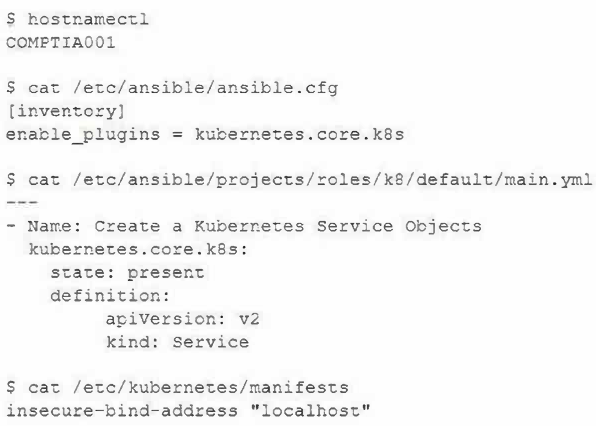
- Update the kubernetes.core.k8s module to kubernetes.core.k8s_service in the main.yml file.
- Update the COMPTIA001 hostname to localhost using the hostnamectl command.
- Update the state: present module to state: absent in the main.yml file.
- Update or remove the ansible.cfg file.
- Update the insecure-bind-address from localhost to the COMPTIA001 in the manifests file.
The short version
D — Insecure ansible dot cfg undermines orchestrator automation. Hardened modules and hostnames matter less when the config file enables dangerous defaults. Updating or removing that config removes the systemic weakness.
Key concepts in this question
- Ansible config precedence: ansible dot cfg controls privilege, transport, and secret handling for playbooks.
- Container orchestrator trust: DevSecOps and SOAR automation needs secure defaults across fleet runs.
- Module-name tweaks: k8s versus k8s_service changes are cosmetic if the runner itself is misconfigured.
- Hostname and state edits: localhost and present-versus-absent fixes do not repair a weak control plane.
- Bind-address risk: insecure bind settings compound exposure but stem from overall config posture.
Why D is correct
The YAML content shows automation running under an ansible dot cfg that permits insecure behavior for configuration management at scale. Correcting that file by hardening or removing unsafe entries, as settled key D directs, restores secure defaults for every playbook the orchestrator invokes. Single-module or hostname edits would leave the broader automation plane exposed, while the config fix addresses the root cause.
Why the others are wrong
- A. Renaming the k8s module does not fix insecure runner configuration.
- B. Changing hostname to localhost does not harden automation secrets or transport.
- C. Flipping state to absent breaks desired-state enforcement rather than securing it.
- E. Moving insecure bind address to a hostname still leaves an insecure listener posture.
CAS-005 exam tip
Broad Ansible weakness across files, fix ansible dot cfg first.
- The CRM company
- The CRM company's customer
- The CSP
- The regulatory body
The short version
A — SaaS vendor on PaaS owns app-layer compliance duties. The CSP secures the platform fabric, the customer defines its own needs, and regulators do not operate controls. The CRM builder must implement patching and lifecycle for its product.
Key concepts in this question
- Shared responsibility: CSP covers physical and platform layers, vendor covers app and data layers.
- PaaS boundary: middleware and OS patching may shift down, but app config and lifecycle stay up.
- Customer request: asking for proof does not transfer implementation duty to the requester.
- Regulator role: sets rules and audits, does not deploy patches on vendor systems.
- SaaS publisher accountability: the firm shipping the product proves compliance for its stack.
Why A is correct
On a CSP PaaS, the CRM company builds, configures, and publishes its SaaS, including libraries, images, and deployment pipelines that need configuration, patch, and lifecycle management. Those strict regulatory requirements therefore fall on the CRM company to implement and evidence, even though the CSP attests to the underlying platform. Settled key A places responsibility where operational control actually sits.
Why the others are wrong
- B. The end customer requests assurance but does not manage vendor infrastructure components.
- C. The CSP assures platform controls, not the vendor app-layer lifecycle above PaaS.
- D. The regulatory body defines and verifies requirements, it does not implement vendor patching.
CAS-005 exam tip
SaaS on PaaS, vendor owns app-layer patching and lifecycle proof.
- Determine whether the incident response plan has been tested at both companies, and use it to respond.
- Review the incident response plans, and engage the disaster recovery plan while relying on the IT leaders from both companies.
- Ensure hot, warm, and mobile disaster recovery sites are available, and give an update to the companies' leadership teams.
- Initiate Company A's IT systems processes and procedures, assess the damage, and perform a BIA.
The short version
B — Review both IR plans then engage DR with joint IT leaders. A live data-center fire needs immediate coordinated response, not a test audit or a one-sided takeover. Joint plan review plus DR activation preserves continuity.
Key concepts in this question
- Incident vs disaster: fire response starts as incident handling and escalates to disaster recovery.
- Plan currency across mergers: duplicated systems mean neither legacy plan alone fits the combined estate.
- Leadership leverage: IT leaders from both firms hold tacit knowledge of dependencies and sites.
- BIA timing: impact analysis follows stabilization, it does not precede life-safety and containment.
- Site readiness: hot and warm sites matter after the response path is chosen, not as the first act.
Why B is correct
On day one with a fire at the main site, the CIO must quickly reconcile the two incident response plans and trigger the disaster recovery plan while relying on leaders from both companies. That approach honors tested procedures where they exist, bridges gaps from duplication, and mobilizes the people who know each environment. Settled key B sequences review plus engagement correctly for life-safety, continuity, and leadership alignment.
Why the others are wrong
- A. Checking whether plans were tested delays action without activating recovery for a live fire.
- C. Verifying recovery sites and briefing leadership skips plan-driven containment and coordination.
- D. Imposing Company A procedures plus a fresh BIA ignores Company B scale and stalls urgent response.
CAS-005 exam tip
Live fire on day one, reconcile IR plans and engage DR with both IT teams.
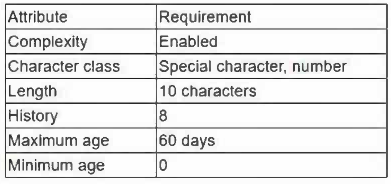
- Increase the minimum age to two days.
- Increase the history to 20.
- Increase the character length to 12.
- Add case-sensitive requirements to character class.
- Decrease the maximum age to 30 days.
- Remove the complexity requirements.
The short version
AB — Raise history to 20 and enforce minimum age to stop quick cycling. Compromised-password reuse happens when users rotate back to familiar secrets. Longer memory plus a two-day floor blocks immediate reuse.
Key concepts in this question
- Password history: number of prior hashes the system remembers and forbids for new choices.
- Minimum age: shortest time before a user may change again, preventing rapid cycle-through.
- Reuse root cause: short history lets old compromised values become valid again quickly.
- Length and complexity limits: longer or stranger secrets do not stop reuse of known-bad values.
- Maximum-age tradeoff: shorter expiry can increase write-downs and reuse pressure.
Why AB is correct
Audit findings show users returning to published compromised passwords, which means the history window is too small and changes can be cycled too fast. Increasing history to 20, as settled key B states, forces genuinely new choices by remembering more prior values. Adding a two-day minimum age, as settled key A states, stops users from burning through changes in minutes to loop back to a favorite. Together they directly address reuse mechanics.
Why the others are wrong
- C. Longer length strengthens guessing resistance but still permits reuse of a long compromised value.
- D. Case rules add complexity without blocking return to a previously used compromised secret.
- E. Shorter maximum age forces more frequent changes, often worsening reuse and write-downs.
- F. Removing complexity weakens secrets and does nothing to prevent reuse of known-bad passwords.
CAS-005 exam tip
Reuse of leaked passwords, expand history plus enforce minimum age.

- Service set identifier authentication
- Wireless network auto joining
- 802.1X with mutual authentication
- Association MAC address randomization
The short version
D — DHCP log pattern proves randomized MAC association. Managed-device Wi-Fi policy can require private MACs per SSID. The log showing changing client identifiers for the same device confirms that control.
Key concepts in this question
- MAC randomization: device presents a per-network private address instead of the hardware address.
- DHCP fingerprint: lease logs reveal client identity behavior across joins and renewals.
- SSID auth contrast: service-set authentication settings appear as EAP or PSK events, not MAC churn.
- Auto-join contrast: auto-join policy appears as profile payload, not address variation in logs.
- 802 dot 1X contrast: mutual auth shows certificate exchanges rather than randomized association IDs.
Why D is correct
The administrator checks DHCP logs to confirm that managed devices apply the expected wireless privacy setting. Randomized association addresses cause the same physical device to appear with varying MACs across joins while policy still manages it, which is exactly what the log pattern demonstrates. Settled key D therefore names the verified control, since authentication, auto-join, and 802 dot 1X settings would leave different evidence.
Why the others are wrong
- A. SSID authentication would show auth-method events, not per-join MAC variation.
- B. Auto-join enforcement appears in profile state, not in DHCP client-identity churn.
- C. 802 dot 1X mutual auth leaves EAP and cert traces rather than randomization evidence.
CAS-005 exam tip
Varying MAC for same device in DHCP, answer association randomization.
- Classify the incident as a false positive.
- Classify the incident as a false negative.
- Classify the incident as a true positive.
- Classify the incident as a true negative.
The short version
B — Real exfiltration with no alert is a false negative. An unauthorized USB outside the allow list moved data from a shared account yet no rule fired. The control missed a true attack, defining a false negative.
Key concepts in this question
- False negative meaning: attack present but detector silent, the most dangerous detection failure.
- Allow-list signal: hardware ID absent from allow list should have triggered a block or alert.
- Shared-account complication: attribution is harder, but detection should still fire on device policy.
- False positive contrast: benign event flagged as malicious, which did not happen here.
- Next-step classification: correct labeling drives tuning before hunting ownership.
Why B is correct
The analyst confirmed unauthorized hardware, data movement, and absence of an alert, which together prove the control failed to detect a real malicious action. Classifying it as a false negative, as settled key B states, records that the sensor missed a true incident rather than misfiring on benign activity. That label is the required next step before tuning rules and tracing the USB owner.
Why the others are wrong
- A. False positive requires an alert on benign activity, opposite of this silent real attack.
- C. True positive requires both attack and alert, but no alert was generated here.
- D. True negative requires no attack and no alert, yet exfiltration did occur.
CAS-005 exam tip
Real attack plus silent sensor equals false negative, tune then hunt.
- Non-repudiation
- Body encryption
- Code signing
- Sender authentication
- Chain of custody
The short version
A — Email signatures deliver non-repudiation of origin. A private-key signature binds sender identity to message content. Recipients can prove who sent what, which encryption or custody labels alone do not give.
Key concepts in this question
- Non-repudiation: cryptographic proof that the claimed sender cannot plausibly deny sending.
- Digital signature mechanics: hash plus private-key operation verified with the sender public key.
- Body encryption contrast: confidentiality hides content but does not prove authorship by itself.
- Code-signing scope: signs software artifacts, not routine email authorship.
- Custody and auth limits: chain-of-custody and login checks lack message-level sender proof.
Why A is correct
An email signature applies the sender private key to the message hash, letting any recipient verify with the public key that content came from that identity unaltered. That verifiable binding is the definition of non-repudiation for messaging. Settled key A therefore names the primary security feature, while encryption, code signing, and custody describe adjacent but different guarantees.
Why the others are wrong
- B. Body encryption provides confidentiality, not proof of who authored the message.
- C. Code signing attests software origin, not everyday email sender binding.
- D. Sender authentication alone is weaker and more spoofable than signature-based proof.
- E. Chain of custody tracks handling, it does not cryptographically bind author to content.
CAS-005 exam tip
Signed email proves who sent it, answer non-repudiation.
Want the full bank of 866 questions for CompTIA SecurityX (CAS-005)? See all practice exams.