Designing and Implementing Microsoft Azure Networking Solutions (AZ-700) — Free Practice Questions
10 free sample questions from a bank of 397, with the correct answers and explanations. No signup required — start practising right now.
- ExpressRoute Local
- ExpressRoute Direct
- ExpressRoute Premium
- ExpressRoute Standard
The short version
A — same-region peering-location demand fits ExpressRoute Local. The settled key minimizes cost for 1 Gbps Unlimited within one metro.
Key concepts in this question
- ExpressRoute Local: low-cost SKU for ingress from the peering location metro into the adjacent Azure region.
- Unlimited data plans: flat-rate billing suited to predictable high transfer without metered egress surprises.
- Peering-location proximity: Washington DC peering serving East US keeps traffic local and eligible for Local.
- Bandwidth fit: 1 Gbps falls within Local circuit options without requiring Direct pipes.
- Premium and Standard contrast: add global reach or scale features that raise price without benefit here.
Why A is correct
A is correct because ExpressRoute Local with Unlimited is explicitly designed for customers whose on-premises site sits in the same peering metro as the target region, which Washington DC to East US satisfies. It delivers the required 1 Gbps at the lowest Unlimited price point. Choosing Standard or Premium would pay for unneeded global or scale capabilities.
Why the others are wrong
- B. ExpressRoute Direct needs dedicated 10 or 100 Gbps ports and costs far more.
- C. Premium adds global routing and scale, unnecessary for single-region East US use.
- D. Standard lacks the Local cost advantage for metro-adjacent Unlimited scenarios.
AZ-700 exam tip
If peering city equals region metro and goal is minimize cost, pick ExpressRoute Local.
- an Azure key vault
- a RADIUS server
- a certification authority
- Azure Active Directory (Azure AD) Application Proxy
The short version
B — OpenVPN with on-premises AD needs a RADIUS bridge. The settled key adds the authentication proxy between Azure VPN and domain controllers.
Key concepts in this question
- Point-to-Site OpenVPN: per-user TLS VPN from devices into Azure virtual network address space.
- On-premises AD dependency: user credentials live in domain controllers, not natively in Azure VPN gateway.
- RADIUS role: forwards EAP and credential checks to NPS tied to AD, returning accept or reject.
- Certificate contrast: a CA issues device certs but does not validate AD passwords for OpenVPN here.
- Key Vault contrast: stores secrets and certs but does not perform live AD authentication.
Why B is correct
B is correct because Azure P2S OpenVPN with AD authentication is documented to integrate through a RADIUS server such as NPS that proxies requests to on-premises AD. The gateway forwards the user authentication to RADIUS, which checks domain credentials. Without that bridge, the gateway has no path to validate domain users.
Why the others are wrong
- A. Key Vault stores material but cannot broker AD password validation.
- C. certification authority alone handles certificates, not AD password checks for this design.
- D. Application Proxy publishes web apps and does not front P2S VPN authentication.
AZ-700 exam tip
Hear P2S plus on-premises AD and immediately add RADIUS with NPS.
- a virtual network gateway
- Azure Application Gateway
- Azure Firewall
- a local network gateway
- Azure Front Door
The short version
AD — BGP for Site-to-Site needs both gateway ends configured. The settled key pairs the Azure VPN endpoint with its on-premises peer definition.
Key concepts in this question
- Border Gateway Protocol: dynamic routing that exchanges prefixes between datacenter and Azure over IPsec.
- Virtual network gateway: the Azure VPN endpoint that terminates IPsec and speaks BGP with an ASN and APIPA peering.
- Local network gateway: the Azure object representing on-premises VPN device address plus on-premises prefixes and BGP peer.
- Application Gateway contrast: a Layer 7 load balancer with no IPsec or BGP role.
- Firewall and Front Door contrast: traffic inspection and global routing, not tunnel BGP endpoints.
Why AD is correct
A is correct because the virtual network gateway is where BGP is enabled, ASN assigned, and peering addresses configured on the Azure side. D is correct because the local network gateway records the on-premises BGP peer IP and ASN so Azure knows whom to peer with. Both objects must exist and carry BGP settings for the Site-to-Site session to establish.
Why the others are wrong
- B. Application Gateway never terminates Site-to-Site IPsec or BGP.
- C. Azure Firewall filters traffic but is not a BGP tunnel endpoint.
- E. Front Door provides global HTTP routing, unrelated to VPN BGP.
AZ-700 exam tip
For VPN BGP always select the two gateways: virtual plus local, Azure plus on-premises.
- IKEDiagnosticLog
- RouteDiagnosticLog
- GatewayDiagnosticLog
- TunnelDiagnosticLog
The short version
A — failed IPsec negotiation is diagnosed in IKEDiagnosticLog. The settled key directs tunnel-bring-up faults to IKE logging.
Key concepts in this question
- IKE handshake: Internet Key Exchange phases negotiate proposals, keys, and identities for IPsec.
- IKEDiagnosticLog: Azure diagnostic stream capturing IKE errors, proposal mismatches, and peer unreachable events.
- GatewayDiagnosticLog contrast: broader gateway health rather than per-tunnel IKE negotiation detail.
- Route and Tunnel log contrast: focus on propagated routes or data-plane flow, not handshake failures.
- Troubleshooting order: establish whether Phase 1 or Phase 2 fails before checking policies and pre-shared keys.
Why A is correct
A is correct because inability to establish the IPsec tunnel almost always stems from IKE proposal, pre-shared key, or peer identity mismatch, all recorded in IKEDiagnosticLog. Microsoft documentation maps tunnel-establishment troubleshooting to that log first. Reviewing it reveals which side rejected the negotiation and why.
Why the others are wrong
- B. RouteDiagnosticLog tracks route learning, not IKE handshake success.
- C. GatewayDiagnosticLog covers gateway operations, less specific than IKE for tunnel bring-up.
- D. TunnelDiagnosticLog is not the credited IKE negotiation source in this syllabus.
AZ-700 exam tip
If the tunnel never comes up, open IKE logs first and compare proposals and keys.
- a user-defined route
- a virtual network gateway
- Azure Firewall
- Azure Web Application Firewall (WAF)
- an on-premises data gateway
- an Azure application gateway
The short version
B — every Site-to-Site plan needs a virtual network gateway. The settled key identifies the mandatory Azure VPN endpoint.
Key concepts in this question
- Virtual network gateway: the Azure-managed VPN device deployed into a GatewaySubnet with public IPs.
- Site-to-Site requirement: IPsec termination plus routing between on-premises and virtual network CIDRs.
- User-defined route contrast: optional custom routing, not a prerequisite for tunnel creation.
- Firewall contrast: Azure Firewall and WAF inspect or protect traffic but do not terminate VPN.
- Gateway naming traps: on-premises data gateway serves Power Platform refresh, and application gateway serves HTTP load balancing.
Why B is correct
B is correct because Microsoft requires a route-based virtual network gateway in the Azure virtual network to terminate the IPsec tunnel and exchange routes with the on-premises VPN device. No Site-to-Site design can proceed without provisioning its SKU, GatewaySubnet, and public IP. The question tests that single non-optional Azure resource.
Why the others are wrong
- A. user-defined routes optimize paths but are not mandatory tunnel components.
- C. Azure Firewall adds filtering and is never a VPN terminator.
- D. Web Application Firewall protects HTTP apps, unrelated to IPsec.
- E. on-premises data gateway supports analytics refresh, not Azure VPN.
- F. application gateway load-balances web traffic, not Site-to-Site tunnels.
AZ-700 exam tip
Any Site-to-Site plan starts with GatewaySubnet plus virtual network gateway.
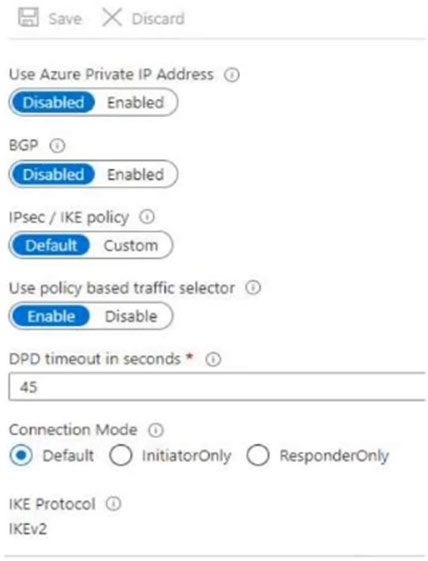
- Set Connection Mode to ResponderOnly.
- Set BGP to Enabled.
- Set Use Azure Private IP Address to Enabled.
- Set IPsec / IKE policy to Custom.
The short version
D — Custom IPsec IKE policy enables connection to the policy-based site. Azure route-based gateways use broad modern IKEv2 proposals by default, while legacy policy-based devices offer narrow traffic selectors and algorithms. A custom IPsec IKE policy lets the administrator match encryption, integrity, Diffie-Hellman group, and selectors to the peer. Defaults are documented as incompatible, so custom policy is the prerequisite before creating the connection.
Key concepts in this question
- Route-based gateway: Uses routes and any-to-any selectors with dynamic routing support on SKUs such as VpnGw1.
- Policy peer: Negotiates one association per address-pair policy, failing against broad Azure defaults unless narrowed.
- Custom policy: Sets phase 1 and phase 2 algorithms, lifetimes, and selectors per connection for proposal parity.
- Order: Must exist before creation because negotiation happens at bring-up and mismatch prevents establishment.
Why D is correct
Leaving defaults means the policy-based device rejects the handshake on selector or algorithm mismatch, so no traffic reaches Vnet1. Setting Custom and aligning it with on-premises capabilities lets both phases complete. Other toggles do not fix cryptographic incompatibility, making the settled choice the only enabling step.
Why the others are wrong
- A. ResponderOnly controls initiation direction, not proposal or selector compatibility.
- B. BGP adds route exchange but cannot succeed until IKE and IPsec establish.
- C. private IP changes tunnel endpoint addressing, not proposal compatibility.
AZ-700 exam tip
Pair route-based to policy-based with Custom IPsec IKE every time.
- 1
- 2
- 3
- 4
- 5
The short version
A — one circuit can span peered subscriptions in two nearby regions. The settled key leverages ExpressRoute sharing across the organization.
Key concepts in this question
- Circuit sharing: a single ExpressRoute circuit can connect to multiple subscriptions and virtual networks through authorizations.
- West US geography: West US and West US 2 are served efficiently by one circuit with appropriate premium or local reach.
- Subscription boundary: subscriptions are billing and policy scopes, not connectivity islands requiring separate circuits.
- Cost minimization: reusing one circuit avoids duplicate port fees and provider charges.
- Multi-region nuance: nearby regions in the same geo keep latency and cost low on one circuit.
Why A is correct
A is correct because ExpressRoute circuits support connections from many virtual networks across subscriptions, so Subscription1 through Subscription3 in West US and West US 2 can all attach to one circuit linked to on-premises. That satisfies departmental separation while meeting the minimum-number goal. Additional circuits would only add cost without functional gain.
Why the others are wrong
- B. two circuits would split an already shareable topology and waste spend.
- C. three circuits map one per subscription, ignoring circuit sharing.
- D. four circuits exceed any technical need in two adjacent regions.
- E. five circuits have no basis in the stated subscription and region layout.
AZ-700 exam tip
Count circuits by geos and peering metros, not by subscription count.
- ExpressRoute FastPath
- ExpressRoute Global Reach
- ExpressRoute Direct
- ExpressRoute Local
The short version
B — on-premises to on-premises via Azure needs Global Reach. The settled key enables Amsterdam to New York transit over ExpressRoute circuits.
Key concepts in this question
- ExpressRoute Global Reach: links two ExpressRoute circuits so on-premises sites exchange routes through Microsoft edge.
- Dual-circuit topology: New York to East US plus Amsterdam to North Europe creates two independent private paths.
- Site-to-Site contrast: existing VPNs provide interim connectivity but the goal is ExpressRoute transit.
- FastPath contrast: optimizes virtual-network data path, not inter-site routing between cities.
- Direct and Local contrast: describe port models and metro scope, not circuit-to-circuit bridging.
Why B is correct
B is correct because only Global Reach advertises each office prefixes to the other circuit, letting Amsterdam computers reach New York servers privately without traversing the public internet. Enabling it on both circuits creates the required transit. That matches Microsoft guidance for branch-to-branch communication across regions via ExpressRoute.
Why the others are wrong
- A. FastPath improves gateway bypass, not Amsterdam to New York routing.
- C. Direct describes port capacity, not inter-circuit transit.
- D. Local restricts metro scope and cannot bridge continents.
AZ-700 exam tip
Whenever two ExpressRoute sites must talk to each other, choose Global Reach.

- VNet-to-VNet VPN connections
- peering
- service endpoints
- route tables
The short version
B — Peering Vnet2 and Vnet3 to Vnet1 shares the Site-to-Site VPN. All three networks share one region while only Vnet1 holds the on-premises VPN. Peering with gateway transit lets spokes use the hub gateway without extra gateways or tunnels. That hub pattern gives every VM a path to on premises for peering charges only, cheaper than mesh VPN connections.
Key concepts in this question
- Peering: Connects same-region networks over Azure backbone at peering rates rather than gateway hours.
- Transit: Hub advertises gateway transit while spokes use remote gateway, extending the tunnel to peer prefixes.
- VNet-to-VNet cost: Extra gateways and connection hours multiply spend with no benefit in one region.
- Other options: Service endpoints reach PaaS and route tables steer traffic, neither creates the transitive path.
Why B is correct
VMs on Vnet2 and Vnet3 need the Vnet1 gateway as next hop to on-premises prefixes. Peering with transit programs exactly that hop across the peering, so flows traverse the single tunnel. No extra public IPs or gateways are needed, minimizing cost while meeting connectivity. That is the documented hub-and-spoke optimum.
Why the others are wrong
- A. VNet-to-VNet VPN builds redundant tunnels and gateways, raising cost needlessly.
- C. service endpoints expose platform services, not spoke to on-premises routing.
- D. route tables adjust next hops where a path exists but cannot create the path.
AZ-700 exam tip
Same region plus one VPN equals peering with transit, not extra tunnels.
- one ExpressRoute Premium circuit
- two ExpressRoute Premium circuits
- four ExpressRoute Standard circuits
- one ExpressRoute Standard circuit
The short version
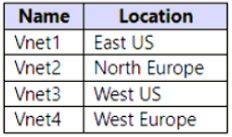
A — One Premium circuit links all VNETs within 1 Gbps most cheaply. The office needs up to 1 Gbps to every VNET while minimizing circuits and SKU cost. One circuit can attach many VNETs, and only Premium permits VNETs outside the peering region. A single Premium circuit therefore covers all listed networks at the required bandwidth without duplicate ports. Vendor notes cite Premium global reach as decisive.
Key concepts in this question
- Circuits: Private MPLS path to Microsoft edge, with VNETs linked by authorization rather than each needing a circuit.
- Premium reach: Extends attachment beyond the local region, unlike Standard which stays local.
- Bandwidth: Up to 1 Gbps fits one circuit tier, so splitting adds no throughput benefit.
- Cost: One Premium port beats two Premium or four Standard ports that still lack cross-region reach.
Why A is correct
One Premium circuit near New York authorizes every VNET regardless of region, meeting the all-networks rule in one billable object. Its tier supports 1 Gbps, and using one avoids duplicate metered ports. Standard-only designs fail cross-region attachment, so the settled combination alone meets throughput, reach, and cost together.
Why the others are wrong
- B. two Premium circuits double port cost with no added bandwidth or reach.
- C. four Standard circuits multiply cost yet still cannot attach cross-region VNETs.
- D. one Standard circuit is cheapest nominally but fails the cross-region access demand.
AZ-700 exam tip
Global VNET access plus one circuit equals Premium, never Standard.
Want the full bank of 397 questions for Designing and Implementing Microsoft Azure Networking Solutions (AZ-700)? See all practice exams.