AZ-220 — Free Practice Questions
10 free sample questions from a bank of 221, with the correct answers and explanations. No signup required — start practising right now.
1Note: This question is part of a series of questions that present the same scenario. Each question in the series contains a unique solution that might meet the stated goals. Some question sets might have more than one correct solution, while others might not have a correct solution.
After you answer a question in this section, you will NOT be able to return to it. As a result, these questions will not appear in the review screen.
You have an Azure IoT solution that includes an Azure IoT hub, a Device Provisioning Service instance, and 1,000 connected IoT devices.
All the IoT devices are provisioned automatically by using one enrollment group.
You need to temporarily disable the IoT devices from the connecting to the IoT hub.
Solution: From the Device Provisioning Service, you disable the enrollment group, and you disable device entries in the identity registry of the IoT hub to which the
IoT devices are provisioned.
Does the solution meet the goal?
- Yes
- No
Answer: A
2You create an Azure IoT hub by running the following command. az iot hub create --resource-group MyResourceGroup --name MyIotHub --sku B1 --location westus --partition-count 4
What does MylotHub support?
- Device Provisioning Service
- cloud-to-device messaging
- Azure IoT Edge
- device twins
Answer: A
3You have an existing Azure IoT hub.
You need to connect physical IoT devices to the IoT hub.
You are connecting the devices through a firewall that allows only port 443 and port 80.
Which three communication protocols can you use? Each correct answer presents a complete solution.
NOTE: Each correct selection is worth one point.
- MQTT over WebSocket
- AMQP
- AMQP over WebSocket
- MQTT
- HTTPS
Answer:
4You have an Azure IoT solution that includes an Azure IoT hub and 100 Azure IoT Edge devices.
You plan to deploy the IoT Edge devices to external networks. The firewalls of the external networks only allow traffic on port 80 and port 443.
You need to ensure that the devices can connect to the IoT hub. The solution must minimize costs.
What should you do?
- Configure the upstream protocol of the devices to use MQTT over TCP.
- Configure the upstream protocol of the devices to use MQTT over WebSocket.
- Connect the external networks to the IoT solution by using ExpressRoute.
- Integrate cellular communication hardware onto the devices and avoid the use of the external networks.
Answer: B
5You have 100 devices that connect to an Azure IoT hub named Hub1. The devices connect by using a symmetric key.
You deploy an IoT hub named Hub2.
You need to migrate 10 devices from Hub1 to Hub2. The solution must ensure that the devices retain the existing symmetric key.
What should you do?
- Add a desired property to the device twin of Hub2. Update the endpoint of the 10 devices to use Hub2.
- Add a desired property to the device twin of Hub1. Recreate the device identity on Hub2.
- Recreate the device identity on Hub2. Update the endpoint of the 10 devices to use Hub2.
- Disable the 10 devices on Hub1. Update the endpoint of the 10 devices to use Hub2.
Answer: B
6DRAG DROP -
You have an Azure subscription that contains an Azure IoT hub and 100 IoT devices.
The devices connect to the IoT hub by using the Advanced Message Queuing Protocol (AMQP) protocol and authenticate to the IoT hub by using symmetric keys.
You need to configure the SASL PLAIN username for the AMQP connection.
How should you configure the username? To answer, drag the appropriate options to the correct targets. Each option may be used once, more than once, or not at all. You may need to drag the split bar between panes or scroll to view content.
NOTE: Each correct selection is worth one point.
Select and Place:
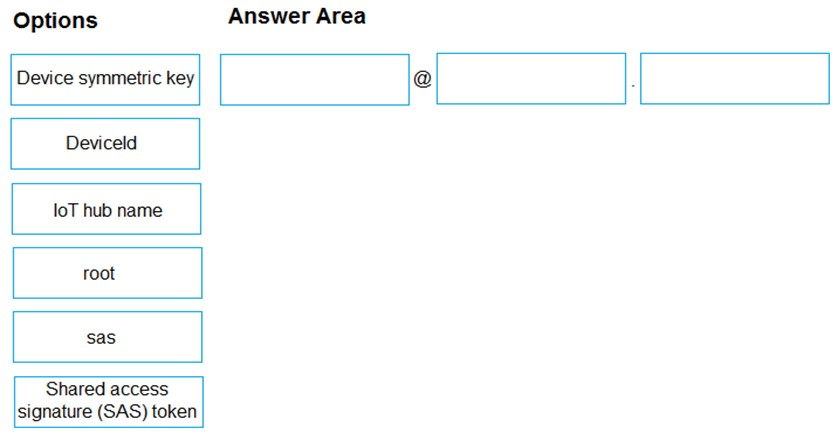
Answer:
7You are configuring a production environment for an Azure IoT solution.
You plan to deploy 1,000 IoT devices. Each device will send one device-to-cloud message every hour. Each message will be 4 KB.
You need to deploy an Azure IoT hub that will support the IoT device deployment. The solution must meet the following requirements:
✑ Perform bulk device operations such as creating multiple device identities.
✑ Minimize costs
What should you deploy?
- one unit of the B1 tier
- one unit of the free tier
- one unit of the S1 tier
- one unit of the S2 tier
Answer: A
8You have an Azure IoT hub that receives messages from an IoT device. The messages are serialized as Protobuf.
You need the IoT hub to route the messages.
What should you do first?
- From the Azure portal, add desired properties to the device twin.
- Configure the IoT device to add application properties to the messages.
- From the Azure portal, configure the IoT hub to add message enrichments.
- Configure the IoT device to add ASCII-encoded properties to the body of the messages.
Answer: A
9DRAG DROP
-
You have an Azure subscription that contains an Azure IoT hub and 100 IoT devices.
The devices connect to the IoT hub by using the Message Queuing Telemetry Transport (MQTT) protocol and authenticate to the IoT hub by using symmetric keys.
You need to configure the username and password for the MQTT connection.
What should you use? To answer, drag the appropriate components to the correct targets. Each component may be used once, more than once, or not at all. You may need to drag the split bar between panes or scroll to view content.
NOTE: Each correct selection is worth one point.
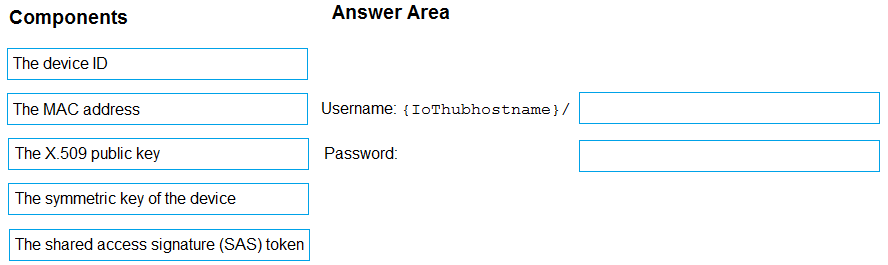
Answer:
10Note: This question is part of a series of questions that present the same scenario. Each question in the series contains a unique solution that might meet the stated goals. Some question sets might have more than one correct solution, while others might not have a correct solution.
After you answer a question in this section, you will NOT be able to return to it. As a result, these questions will not appear in the review screen.
You have an Azure IoT solution that includes an Azure IoT hub, a Device Provisioning Service instance, and 1,000 connected IoT devices.
All the IoT devices are provisioned automatically by using one enrollment group.
You need to temporarily disable the IoT devices from the connecting to the IoT hub.
Solution: You delete the enrollment group from the Device Provisioning Service.
Does the solution meet the goal?
- Yes
- No
Answer: B
Want the full bank of 221 questions for AZ-220? See all practice exams.