5V0-22.21 — Free Practice Questions
10 free sample questions from a bank of 76, with the correct answers and explanations. No signup required — start practising right now.
1A vSAN administrator, who has a cluster that has both compute-only and vSAN ReadyNodes, recently received a request to deploy a new application with higher storage performance requirements than what are currently available.
What are two ways the administrator can reconfigure the vSAN cluster to obtain this additional performance? (Choose two.)
- Add additional hosts, with capacity devices only, and then stream the cache from the other hosts.
- Add cache and capacity devices to the compute-only hosts.
- Add additional cache and capacity devices to the existing data nodes.
- Add additional compute-only hosts from the vSAN cluster.
- Add to the existing disk groups two cache devices and the eight capacity devices.
Answer: B, C
2Which two conditions should be verified before removing an ESXi host from a vSAN cluster? (Choose two.)
- Resyncs are running
- Data evacuation is complete
- Performance Service is disabled
- Encryption is disabled
- ESXi host is in maintenance mode
Answer: B, E
3In a 2-node vSAN cluster, one node has recovered from failure with FTT=1 and RAID-1 storage policy.
Refer to the exhibit: What is the total VMDK storage consumed?
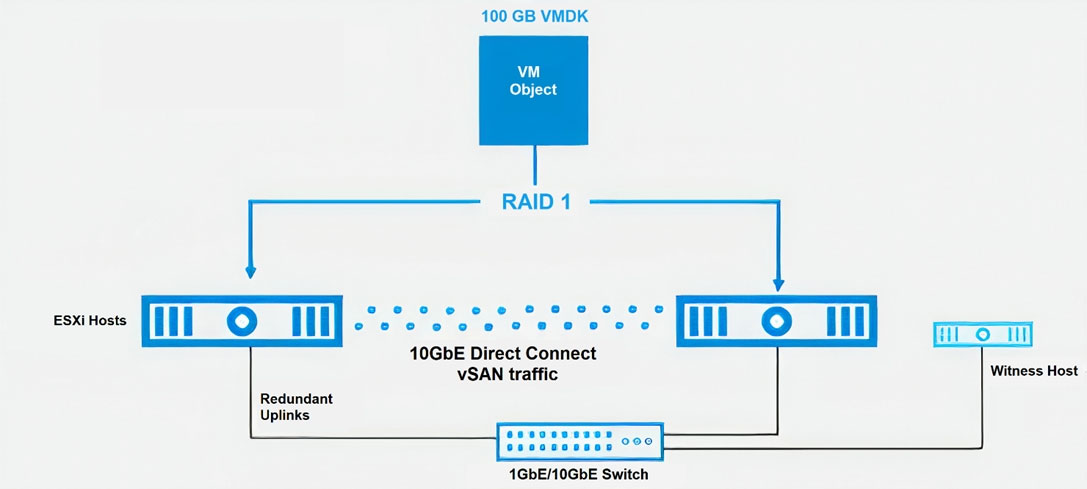
- 150 GB
- 100GB
- 133GB
- 200GB
Answer: D
4A vSAN administrator is implementing deduplication and compression on a vSAN all-flash cluster but wants the VMs to remain operational. The details are as follows:
✑ There are 4 nodes in the vSAN cluster.
✑ Existing VMs use a RAID-5 storage policy.
Which action should the vSAN administrator take to meet this goal?
- Use explicit fault domains.
- Enable TRIM/UNMAP.
- Change the existing VM storage policy to RAID-6.
- Use the Allow Reduced Redundancy option.
Answer: D
5A vSAN administrator was presented with 30 additional vSAN ReadyNodes to add to an existing vSAN cluster. There is only one administrator to complete this task.
What is the fastest approach?
- Use a Host Profile that was extracted from an existing host.
- Clone the ESXi boot partition to all new hosts, since the hardware is identical.
- Run vim-cmd to capture, and apply the configuration from an existing host.
- Launch Quickstart to Add Hosts to a vSAN Cluster
Answer: D
6A vSAN administrator has a vSAN cluster that is using vSphere Lifecycle Manager (vLCM) to manage hypervisor, server drivers, and firmware. All hosts in the cluster are compliant according to the vLCM image.
A 10GB NIC on the servers is experiencing issues, the vSAN administrator determines a new network driver will resolve the problem. Unfortunately, the required
NIC driver is a newer version compared to the driver provided by the most recent Vendor Addon.
Which action should the vSAN administrator take to ensure the latest network driver is installed on the NIC before remediation?
- Add an individual component to the vLCM image that has the updated NIC driver.
- Since server vendors release periodic server Vendor Addon updates, make sure the vLCM image is configured to use the most recent version of the vendor addon.
- Modify the vLCM image to omit the NIC Driver, and then manually update the servers with the required NIC driver.
- Remove the Vendor Addon from the vLCM image, and then manually install the network driver on the servers.
Answer: A
7Which tool should be used to identify vSAN unassociated objects?
- vSphere Host Client
- vSphere CLI
- vsantop
- PowerCLI
Answer: D
8What are two purposes of a vSAN storage policy (Choose two.)
- To determine vSAN encryption level
- To enable TRIM/UNMAP
- To define how the VM storage objects are provisioned
- To guarantee the required level of service
- To enable deduplication and compression
Answer: C, D
9A business unit requires proprietary data to be protected against a site failure while using the least amount of storage and the least amount of nodes. AN administrator plans to implement a vSAN Stretched Cluster with a RAID-5 policy.
What is the minimum number of data nodes across all sites in this vSAN Stretched Cluster configuration?
- 4
- 8
- 12
- 6
Answer: B
10Which two requirements should the vSAN administrator consider in order to accomplish this goal? (Choose two.)
- A leaf spine topology is required for core redundancy and reduced latency.
- NIC teaming must be implemented for the vSAN network vmkernel port.
- The configuration must meet the same latency and bandwidth requirement as local vSAN.
- Encryption must be disabled prior to configuring HCI mesh.
- Either Layer 2 and Layer 3 communications can be used.
Answer: B, E
Want the full bank of 76 questions for 5V0-22.21? See all practice exams.