400-151 — Free Practice Questions
10 free sample questions from a bank of 104, with the correct answers and explanations. No signup required — start practising right now.
1Which three options are valid sources for Cisco UCS monitor sessions? (Choose three.)
- VSAN
- pin group
- vHBA
- vNIC
- VLAN
- uplink FC interface
Answer: C, D, E
2When deploying a sensor network that uses CoAP, which of the following must be done on the firewall to allow sensor traffic into the data center?
- Permit UDP traffic from the sensor IP address range.
- Configure stateful inspection for ROLL.
- Enable NAT64.
- Permit IP Option 135 traffic from the sensor IP address range(s).
Answer: D
3Which two actions must occur for an APIC to be discovered successfully into a new ACI fabric? (Choose two.)
- The fabric controller target size must be equal to or greater than the number of APICs.
- A BIOS password must be set.
- LLDP must be enabled on the virtual interface card of the APIC.
- The controller must be discovered automatically.
- LLDP must be disabled on the virtual interface card of the APIC.
Answer: A, C
4Which option is the best practice recommendation for Spanning Tree configuration in a vPC environment?
- Disable PortFast (edge port type) on host-facing interfaces to avoid slow STP convergence.
- Disable the BPDU Filter on the edge devices to avoid BPDU propagation.
- Disable Rapid PVST or MST on all switches in the Layer 2 domain to avoid slow STP convergence.
- Disable the Bridge Assurance feature on vPC links. D
Answer:
5Which option is a commonly used network layer protocol in an IoT environment?
- XMPP
- AQMP
- CoAP
- RPL
- MQTT
Answer: C
6An administrator is replacing a fabric interconnect. The failed fabric interconnect was FI-A and was master at the time of failure. Which process brings the replacement fabric interconnect into the cluster?
- Connect the new FI-A to the management network and the Layer 1/Layer 2 links to the existing FI-B. Use the Full State Backup file to restore the configuration when prompted at the console.
- Connect the new FI-A to the management network and the Layer 1/Layer 2 links to the existing FI-B. Let the system sync with FI-B when prompted at the console.
- Connect the FI-A to the management network and the Layer 1/Layer 2 links to the existing FI-B. Use the All Configuration backup file to restore the configuration through Cisco UCS Manager GUI.
- Connect the new FI-A to the management network only. Use the Full State Backup file to restore the configuration through Cisco UCS Manager GUI. Connect the Layer 1/Layer 2 cables.
- Connect the new FI-A to FI-B using the Layer1/Layer 2 cables only. Sync the configuration when prompted. Connect the management interface when the configuration is synced.
Answer: D
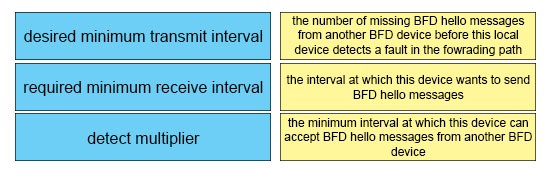
7DRAG DROP -
Drag and drop the term about BFD session parameters from the left onto the correct definition on the right.
Select and Place:
Answer:
8Which three options can be used to add a device as a member to a zone? (Choose three.)
- fully qualified domain name
- Fibre Channel ID
- VLAN ID
- IP address
- device alias
- LUN ID
Answer: B, D, E
9Which two statements about multicast routing are true? (Choose two.)
- Multicast routes are used to directly forward traffic without making RPF checks.
- IPv6 static multicast routes are supported.
- You can define RPF routes for multicast when you want multicast data to diverge from the unicast traffic path.
- You can define RPF routes for multicast on border routers to enable reverse path forwarding to an external network.
- RPF routes for multicast can be redistributed.
Answer: C, D
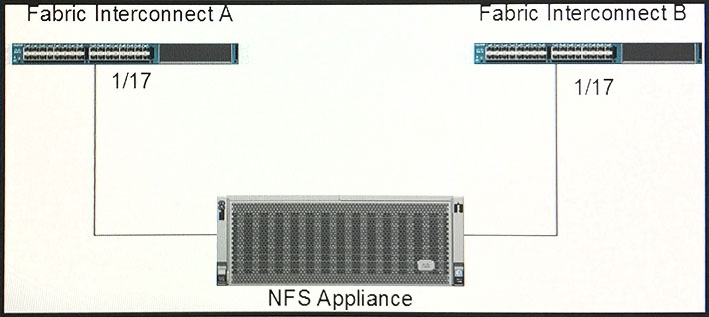
10Refer to the exhibit. Which three steps must be taken to add NFS storage to the Cisco UCS domain? (Choose three.)
- Configure fabric interconnect A and B to Ethernet switching mode.
- Create a LAN cloud VLAN on fabric A and fabric B.
- Configure Eth1/17 as an appliance port.
- Configure a QoS policy for NFS storage.
- Create an appliance VLAN on fabric A and fabric B.
- Configure Eth1/17 as a unified storage port. ABC
Answer:
Want the full bank of 104 questions for 400-151? See all practice exams.