400-007 — Free Practice Questions
10 free sample questions from a bank of 260, with the correct answers and explanations. No signup required — start practising right now.
1Company XYZ is planning to deploy primary and secondary (disaster recovery) data center sites. Each of these sites will have redundant SAN fabrics and data protection is expected between the data center sites. The sites are 100 miles (160 km) apart and target RPO/RTO are 3 hrs and 24 hrs, respectively. Which two considerations must Company XYZ bear in mind when deploying replication in their scenario? (Choose two.)
- Target RPO/RTO requirements cannot be met due to the one-way delay introduced by the distance between sites.
- VSANs must be extended from the primary to the secondary site to improve performance and availability.
- VSANs must be routed between sites to isolate fault domains and increase overall availability.
- Synchronous data replication must be used to meet the business requirements.
- Asynchronous data replication should be used in this scenario to avoid performance impact in the primary site.
Answer: C, E
2Refer to the table. A customer investigates connectivity options for a DCI between two production data centers to aid a large-scale migration project. The migration is estimated to take 20 months to complete but might extend an additional 10 months if issues arise. All connectivity options meet the requirements to migrate workloads. Which transport technology provides the best ROI based on cost and flexibility?
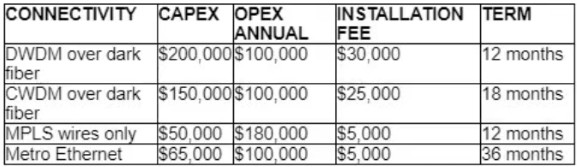
- DWDM over dark fiber
- MPLS
- CWDM over dark fiber
- Metro Ethernet
Answer: D
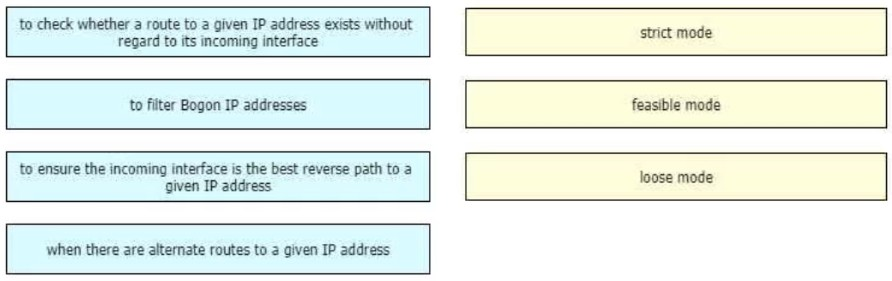
3DRAG DROP -
Drag and drop the design use cases from the left onto the correct uRPF techniques used to prevent spoofing attacks. Not all options are used.
Select and Place:
Answer:
4What is a disadvantage of the traditional three-tier architecture model when east west traffic between different pods must go through the distribution and core layers?
- low bandwidth
- security
- scalability
- high latency
Answer: D
5Which two actions must merchants do to be compliant with the Payment Card Industry Data Security Standard? (Choose two.)
- conduct risk analyses
- install firewalls
- use antivirus software
- establish monitoring policies
- establish risk management policies
Answer: B, C
6What are two descriptions of network optimization? (Choose two.)
- identify network requirements
- network redesign
- proactive network management
- network health maintenance
- maintain high availability
Answer: B, C
7An engineer is designing the QoS strategy for Company XYZ. Based on initial analysis, a lot of scavenger type of traffic is traversing the network’s 20Mb Internet link toward the service provider. The new design must use a QoS technique that limits scavenger traffic to 2 Mbps, which helps avoid oversubscription of the link during times of congestion. Which QoS technique can be used to facilitate this requirement?
- class-based traffic policing
- class-based traffic shaping
- CBWFQ
- LLQ
Answer: A
8A legacy enterprise is using a Service Provider MPLS network to connect its head office and branches. Recently, they added a new branch to their network. Due to physical security concerns, they want to extend their existing IP CCTV network of the head office to the new branch, without any routing changes in the network. They are also under some time constraints. What is the best approach to extend the existing IP CCTV network to the new branch, without incurring any IP address changes?
- GRE
- L2TPv3
- VXLAN
- EoMPLS
Answer: B
9Identity and access management between multiple users and multiple applications has become a mandatory requirement for Company XYZ to fight against ever increasing cybersecurity threats. To achieve this, federated identity services have been deployed in the Company XYZ network to provide single sign-on and Multi-Factor Authentication for the applications and services. Which protocol can be used by Company XYZ to provide authentication and authorization services?
- OAuth2
- OpenID Connect
- OpenID
- SAML 2.0
Answer: D
10A network security team uses a purpose-built tool to actively monitor the campus network, applications, and user activity. The team also analyzes enterprise telemetry data from IPFIX data records that are received from devices in the campus network. Which action can be taken based on the augmented data?
- reduction in time to detect and respond to threats
- integration with an incident response plan
- adoption and improvement of threat-detection response
- asset identification and grouping decisions
Answer: A
Want the full bank of 260 questions for 400-007? See all practice exams.