Developing Applications Using Cisco Core Platforms and APIs (DEVCOR 350-901) — Free Practice Questions
10 free sample questions from a bank of 516, with the correct answers and explanations. No signup required — start practising right now.
- Active/passive results in lower RTO and RPO. For RPO, data synchronization between the two data centers must be timely to allow seamless request flow.
- Active/passive results in lower RTO and RPO. For RPO, data synchronization between the two data centers does not need to be timely to allow seamless request flow.
- Active/active results in lower RTO and RPO. For RPO, data synchronization between the two data centers does not need to be timely to allow seamless request flow.
- Active/active results in lower RTO and RPO. For RPO, data synchronization between the two data centers must be timely to allow seamless request flow.
The short version
D — active-active with timely sync gives minimum downtime. Both sites serve traffic together, cutting recovery time and data loss when replication stays current.
Key concepts in this question
- Active-active design: two data centers both handle live requests behind load distribution, so no failover wait is needed during an outage.
- Recovery Time Objective: maximum tolerable downtime before service restoration, minimized when standby capacity is already warm and serving.
- Recovery Point Objective: maximum tolerable data loss measured in time, minimized when writes replicate promptly between sites.
- Timely data synchronization: synchronous or near-synchronous replication keeping both sites consistent enough for seamless request flow.
Why D is correct
D is correct because active-active keeps both sites in service, which yields lower RTO than active-passive where traffic must fail over and scale up. It also yields lower RPO when data synchronization is timely, since each site already holds recent writes from the other. For a minimum-downtime requirement this combination of dual-live serving plus current replication is the decisive design.
Why the others are wrong
- A. Active-passive cannot beat active-active on RTO and RPO because one site stays idle until failover.
- B. Active-passive still has higher RTO and RPO, and claiming sync need not be timely worsens data loss.
- C. Active-active is right on architecture but wrong on sync, since stale replication breaks seamless flow and inflates RPO.
350-901 exam tip
Link minimum downtime to dual-live plus fresh data: active-active lowers RTO, timely sync lowers RPO.
- GET /messages?personId=me&roomId=NETWORK_STATUS Authorization: Bearer THE_BOTS_ACCESS_TOKEN
- GET /messages?mentionedPeople=me&roomId=NETWORK_STATUS Authorization: Bearer THE_BOTS_ACCESS_TOKEN
- GET /messages?mentionedBot=me&roomId=NETWORK_STATUS Authorization: Bearer THE_BOTS_ACCESS_TOKEN
- GET /messages?botId=me&roomId=NETWORK_STATUS Authorization: Bearer THE_BOTS_ACCESS_TOKEN
The short version
B — mentionedPeople equals me retrieves bot-addressed Webex messages. The bot token plus room scope plus mention filter returns only messages that mention the bot for reply.
Key concepts in this question
- Webex bot identity: bots act with their own bearer token, distinct from user tokens, and must query as themselves.
- mentionedPeople filter: list-messages parameter that narrows results to messages mentioning a person ID, with me meaning the token owner.
- roomId scoping: limits the query to one space such as NETWORK_STATUS to avoid scanning all rooms.
- personId and invented params: personId filters by author rather than mention, while mentionedBot and botId are not valid list-messages fields.
- Webhook flow: notification arrives, then bot fetches triggering message content before posting a response.
Why B is correct
Webex list-messages supports mentionedPeople to find messages where the authenticated identity was mentioned, which is exactly how a bot discovers it was addressed. Using mentionedPeople equals me with the bot bearer token returns those triggering messages in the target room. The vendor reference to bot guides and unanimous consensus confirm this parameter shape. Other spellings do not exist in the messages API, so only B forms a working call.
Why the others are wrong
- A. personId equals me filters by message author, so it misses messages authored by users that mention the bot.
- C. mentionedBot equals me is not a documented list-messages query parameter for Webex.
- D. botId equals me is not a supported filter on the messages resource.
350-901 exam tip
Bot needs its mentions equals mentionedPeople equals me with bot token plus roomId, never personId or invented bot fields.
- latitude = response.text['lat'] longitude = response.text['lng']
- latitude = response.json()['lat'] longitude = response.json()['lng']
- latitude = response.json()[0] longitude = response.json()[1]
- latitude = response.text[0] longitude = response.text[1]
The short version
B — parse the Meraki payload as JSON to read lat and lng. Response text is a string, while response dot json returns a dict supporting key lookup.
Key concepts in this question
- requests dot get: Python HTTP call returning a Response object with text, content, status code, and parsed JSON helpers.
- response dot text: raw body as a string, useful for logging but not subscriptable by field names.
- response dot json: method parsing the body into Python dicts and lists, enabling direct key access like lat and lng.
- Meraki device record: JSON object carrying lat, lng, mac, lanIp, model, and firmware for inventory and mapping use.
Why B is correct
B is correct because the exhibit shows a JSON object string, so calling response dot json converts it to a dict where lat and lng keys exist. Indexing that dict with lat yields latitude 37 dot 41 and indexing with lng yields longitude minus 122 dot 09, exactly the geographical coordinates requested. The settled key reflects standard requests practice for JSON APIs such as Meraki Dashboard.
Why the others are wrong
- A. Subscripting response dot text fails because text is a string, not a dict keyed by lat.
- C. Indexing json output by 0 and 1 fails because the payload is an object, not a positional list.
- D. Indexing text by 0 and 1 returns single characters, not coordinate values.
350-901 exam tip
See JSON braces then use dot json: text is a string for display, json is a dict for lat and lng lookup.
- A publicly available HTTP server to receive Meraki Webhooks from the Meraki Scanning API.
- A publicly available HTTP server to receive Meraki Webhooks from the Meraki Dashboard API.
- A daemon to consume the Wireless Health endpoint of the Meraki Dashboard API.
- A daemon to consume the Wireless Health endpoint of the Meraki Scanning API.
The short version
B — build a public webhook receiver for Dashboard API alerts. Wireless health counts arrive as pushed webhook events, not polled scan data.
Key concepts in this question
- Meraki Dashboard API: REST interface for organization, network, device, and health inventory, complemented by event webhooks.
- Meraki Scanning API: separate location-analytics feed based on Wi-Fi probe observations, unrelated to wireless health alerts.
- Webhooks: HTTP POST callbacks from Meraki to a customer URL when alerting events occur, enabling near real-time dashboards.
- Public HTTP server: internet-reachable endpoint that can receive and acknowledge Meraki webhook POSTs securely.
Why B is correct
B is correct because Meraki delivers wireless health alerts as webhook notifications sourced from Dashboard alerting, so a receiver must exist before counts can be presented. A publicly available HTTP server provides the reachable URL Meraki can POST to whenever health events fire. Building that receiver first satisfies the prerequisite for the timeframe dashboard to collect and display alert counts.
Why the others are wrong
- A. The Scanning API covers location presence, not wireless health alert delivery.
- C. A polling daemon for a Wireless Health endpoint misstates the push webhook model for alerts.
- D. Combining Scanning API with Wireless Health polling mixes two unrelated data sources and mechanisms.
350-901 exam tip
Pair health alerts with webhooks: Dashboard API plus a public HTTP receiver is the prerequisite for real-time alert counts.
- POST request to Cisco DNA Center to obtain the network health information, and then a GET request to the dashboard to publish the new metric
- GET request to Cisco DNA Center to obtain the network health information, and then a PUT request to the dashboard to publish the new metric
- GET request to Cisco DNA Center to obtain the network health information, and then a POST request to the dashboard to publish the new metric
- PUT request to Cisco DNA Center to obtain the network health information, and then a POST request to the dashboard to publish the new metric
The short version
C — GET health from DNA Center, then POST the metric to the dashboard. Retrieval uses safe read semantics, while publishing creates a new dashboard resource.
Key concepts in this question
- Cisco DNA Center health APIs: REST endpoints exposing network, client, and device health scores for automation and reporting.
- HTTP GET: idempotent read method appropriate for fetching current health without changing controller state.
- HTTP POST: creation method appropriate for submitting a new metric sample to a custom dashboard receiver.
- Custom dashboard ingestion: RESTful collector that accepts new measurements as they arrive and renders them over time.
Why C is correct
C is correct because the script must first obtain authoritative health from DNA Center, which is a read operation naturally expressed as GET. It must then deliver that value to the dashboard as a new metric event, which is a create operation naturally expressed as POST. This GET-then-POST pair respects REST semantics and matches the described flow from controller to dashboard receiver.
Why the others are wrong
- A. POST to DNA Center is wrong for retrieval, and GET to the dashboard is wrong for publishing a new metric.
- B. GET from DNA Center is right, but PUT implies updating a known resource rather than creating a fresh metric.
- D. PUT to DNA Center is wrong for a simple health read, even though POST to the dashboard is correct.
350-901 exam tip
Remember read then create: GET from DNA Center for health, POST to the dashboard for each new metric.
- Create a Dockerfile for the code base.
- Rewrite the code in Python.
- Build a wrapper for the code to ג€containerizeג€ it.
- Rebase the code from the upstream git repo.
The short version
A — Create a Dockerfile to containerize the JavaScript module for GKE. Kubernetes schedules containers, not raw source, so image build definition is the mandatory deploy step.
Key concepts in this question
- Google Kubernetes Engine runtime: runs OCI container images pulled from a registry, with Docker as the historical build format.
- Dockerfile role: declares base image, copy steps, install, expose, and start command that produce a deployable image.
- Language independence: GKE runs any language once packaged, so rewriting JavaScript to Python is unnecessary.
- Wrapper notion: containerize is achieved through image build, not an ad-hoc code wrapper around the module.
- Git rebase: integrates upstream history into a branch, unrelated to packaging code for cluster deploy.
Why A is correct
A new JavaScript module cannot run on GKE until it is built into a container image that the cluster can pull and start. The Dockerfile provides those build instructions and yields an image tag that deployment manifests reference. Vendor prose confirms GKE expects a Docker image and that only option A creates it. Language rewrite, generic wrapper, and rebase add no deployable artifact, so they cannot satisfy the mandatory packaging need.
Why the others are wrong
- B. Rewriting in Python discards working code while still leaving no container image for scheduling.
- C. Building a wrapper describes containerization vaguely but does not produce the required image definition.
- D. Rebasing from upstream git manages source history, not image build or cluster rollout.
350-901 exam tip
New code to GKE equals Dockerfile first, then build plus push plus deploy, language stays as written.
- Define the ma property by using the pagination functionality.
- Set the beforeMessage property to retrieve the messages sent before a specific message ID.
- Avoid unnecessary calls by using a prior request to /v1/rooms to retrieve the last activity property.
- Filter the response results by specifying the created property in the request.
The short version
A — Use pagination with max to page through room messages efficiently. Bounded pages cut latency versus fetching the full history in one call.
Key concepts in this question
- Webex messages scale: busy rooms accumulate large histories that slow single bulk retrievals from the v1 messages endpoint.
- Pagination controls: max page size plus Link headers and next links let clients walk history in small chunks.
- beforeMessage use: retrieves messages before a known ID, useful for recursion but not the primary speed optimization for initial listing.
- Rooms pre-check: reading last activity avoids useless calls but does not accelerate the messages call itself.
- Created filter: narrows by timestamp, which reduces set size only when a time window is known.
Why A is correct
Slow presentation comes from oversized responses that block rendering while the whole collection transfers. Defining max page size through pagination returns small predictable batches with navigation links for continuation. That reduces per-call payload, time to first paint, and retry cost. Vendor discussion points to pagination as the optimization answer, matching Webex guidance for large room histories.
Why the others are wrong
- B. beforeMessage pages by anchor ID but alone does not bound page size for the slow initial fetch.
- C. Checking rooms last activity can skip calls, but does not make the messages retrieval itself faster.
- D. Filtering by created helps only for date-scoped reports, not general fast listing of room messages.
350-901 exam tip
Slow Webex message listing equals set max pagination first, then iterate next links, before adding date or anchor filters.
- Set up a webhook that has messages as the resource type and store the results locally.
- Utilize the pagination functionality by defining the max property.
- Recursively call the /v1/messages endpoint by using the beforeMessage property.
- Filter the response results by specifying the created property in the request.
The short version
C — Recursively call v1 messages with beforeMessage for monthly room history. Paging backward by anchor ID walks the full archive directly without local caching.
Key concepts in this question
- Monthly reporting need: requires every message sent to a room over a long window, beyond one response page.
- beforeMessage cursor: list-messages parameter that returns messages sent before a given message ID for backward traversal.
- Direct endpoint use: the requirement calls v1 messages directly, not via stored webhook copies.
- Webhook archiving: storing messages locally works for future capture but does not backfill a month already past.
- Max pagination alone: bounds page size but still needs a cursor to advance through older pages.
Why C is correct
To collect a month of room messages through the API itself, the app must iterate: fetch latest page, take oldest ID, then request before that ID, repeating until the window is covered. That recursive beforeMessage pattern is the documented way to exhaust history from v1 messages. Vendor notes support before-based listing for full retrieval, and consensus favors C over date filtering for completeness.
Why the others are wrong
- A. Webhook with local store captures new arrivals only and cannot retrieve the past month directly.
- B. Setting max pagination limits size but provides no traversal mechanism across many pages.
- D. Created date filter can narrow results but risks gaps from clock and format issues versus ID-anchored paging.
350-901 exam tip
Full history via v1 messages equals loop on beforeMessage from newest to oldest until the month is covered.
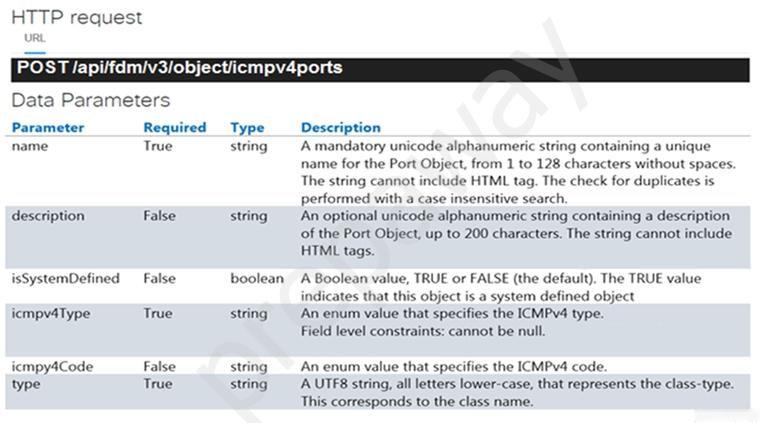
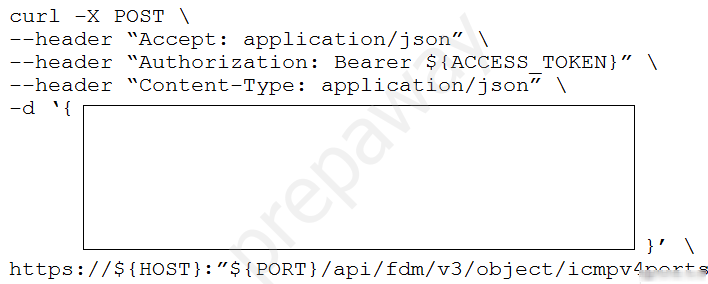
- "icmpv4Type": "ANY", "name": "string", "type": "icmpv4portobject"
- "description": "This is an ICMP Echo", "icmpv4Code": "8", "icmpv4Type": "Echo", "isSystemDefined": true, "name": "ICMP Echo", "version": "2.2"
- "description": "string", "icmpv4Code": "ANY_IPV4", "icmpv4Type": "ANY", "id": "string", "isSystemDefined": "string", "name": "string", "type": "icmpv4portobject", "version": "string"
- "description": "string", "icmpv4Code": "ANY_IPV4", "icmpv4Type": null, "isSystemDefined": true, "name": "string", "type": "icmpv4portobject"
The short version
A — Minimal ICMPv4 port object payload completes the FTD create call. Only name, type, and ANY type value satisfy required creation fields.
Key concepts in this question
- FTD port objects: reusable protocol definitions referenced by access rules, with distinct types for ICMPv4 versus TCP UDP.
- Required versus read-only fields: creation accepts writable identifiers, while id, version, and isSystemDefined are server-managed.
- ANY semantics: ANY type and matching code express an echo-independent generic ICMP object without hardcoding values.
- Over-specified payloads: including descriptions, versions, or IDs can fail validation when formats or booleans mismatch.
- cURL JSON body: must match the documented schema exactly or the API returns a 400 error.
Why A is correct
The create port object API requires a small writable set centered on name and icmpv4 object type, with ANY expressing the intended generic match. Option A supplies exactly that minimal valid shape without read-only or mismatched fields. Vendor discussion notes minimal requirements pass while richer variants break on isSystemDefined boolean handling. Matching the documented creation schema is therefore the deciding behavior.
Why the others are wrong
- B. Full echo description with version and system flag mixes read-only metadata into a create body.
- C. Verbose string placeholders for every field include server-assigned id and version that creation must omit.
- D. Null type plus string isSystemDefined violates the expected type enumeration and boolean contract.
350-901 exam tip
FTD create calls favor minimal writable JSON, leave id plus version plus system flags to the server.
- It has direct access to Cisco IOS XE CLI commands.
- It is a Python interpreter installed inside the guest shell.
- It enables execution of XML scripts on a Cisco IOS XE router or switch.
- It supports Qt for graphical interfaces and dashboards.
- It has access to Cisco IOS XE web UI through a controller.
The short version
AB — On-Box Python lives in the guest shell with CLI access. It provides an on-device interpreter plus direct IOS XE command interaction for automation.
Key concepts in this question
- Guest shell: Linux container environment on IOS XE devices hosting Python, package management, and custom applications.
- On-Box Python: interpreter running inside that container, able to execute scripts locally without an external server.
- IOS XE CLI access: ability to invoke show and configuration commands from Python for device-local remediation.
- Off-box versus on-box: off-box runs centrally through controllers, while on-box runs directly on the switch or router.
Why AB is correct
A is correct because On-Box Python exposes IOS XE CLI commands to scripts, enabling local show collection and configuration. B is correct because the capability is implemented as a Python interpreter installed inside the guest shell container on the device. Together these two traits define the hosting model: local execution with native device access.
Why the others are wrong
- C. Executing XML scripts is not the defining feature, since Python scripts plus CLI are the documented path.
- D. Qt graphical interfaces are unsupported on headless network devices and irrelevant to on-box hosting.
- E. Web UI access through a controller describes off-box management, not on-device Python execution.
350-901 exam tip
Anchor On-Box to the box: guest-shell interpreter plus direct CLI access distinguishes it from controller-based automation.
Want the full bank of 516 questions for Developing Applications Using Cisco Core Platforms and APIs (DEVCOR 350-901)? See all practice exams.