312-49v11: Computer Hacking Forensic Investigator — Free Practice Questions
10 free sample questions from a bank of 537, with the correct answers and explanations. No signup required — start practising right now.
1A suspect is accused of violating the acceptable use of computing resources, as he has visited adult websites and downloaded images. The investigator wants to demonstrate that the suspect did indeed visit these sites. However, the suspect has cleared the search history and emptied the cookie cache. Moreover, he has removed any images he might have downloaded. What can the investigator do to prove the violation?
- Image the disk and try to recover deleted files
- Seek the help of co-workers who are eye-witnesses
- Check the Windows registry for connection data (you may or may not recover)
- Approach the website's administrator for evidence
Answer: A
2You have been asked to investigate the possibility of computer fraud in the finance department of a company. It is suspected that a staff member has been committing finance fraud by printing cheques that have not been authorized. You have exhaustively searched all data files on a bitmap image of the target computer, but have found no evidence. You suspect the files may not have been saved. What should you examine next in this case?
- The registry
- The swap file
- The recycle bin
- The metadata
Answer: B
3Which of the following are small pieces of data sent from a website and stored on the user’s computer by the user’s web browser to track, validate, and maintain specific user information?
- Temporary Files
- Open files
- Cookies
- Web Browser Cache
Answer: C
4Depending upon the jurisdictional areas, different laws apply to different incidents. Which of the following law is related to fraud and related activity in connection with computers?
- 18 USC §1029
- 18 USC §1030
- 18 USC §1361
- 18 USC §1371
Answer: B
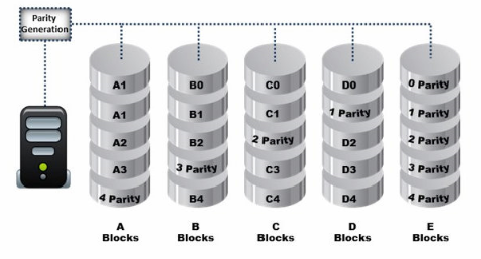
5Data is striped at a byte level across multiple drives, and parity information is distributed among all member drives.
What RAID level is represented here?
- RAID Level 0
- RAID Level 5
- RAID Level 3
- RAID Level 1
Answer: B
6Charles has accidentally deleted an important file while working on his Mac computer. He wants to recover the deleted file as it contains some of his crucial business secrets. Which of the following tool will help Charles?
- Xplico
- Colasoft’s Capsa
- FileSalvage
- DriveSpy
Answer: C
7Jason discovered a file named $RIYG6VR.doc in the C:\$Recycle.Bin\<USER SID>\ while analyzing a hard disk image for the deleted data. What inferences can he make from the file name?
- It is a doc file deleted in seventh sequential order
- RIYG6VR.doc is the name of the doc file deleted from the system
- It is file deleted from R drive
- It is a deleted doc file
Answer: D
8Which of the following attacks allows an attacker to access restricted directories, including application source code, configuration and critical system files, and to execute commands outside of the web server’s root directory?
- Parameter/form tampering
- Unvalidated input
- Directory traversal
- Security misconfiguration
Answer: C
9Annie is searching for certain deleted files on a system running Windows XP OS. Where will she find the files if they were not completely deleted from the system?
- C: $Recycled.Bin
- C: \$Recycle.Bin
- C:\RECYCLER
- C:\$RECYCLER
Answer: B
10Which of the following files stores information about a local Google Drive installation such as User email ID, Local Sync Root Path, and Client version installed?
- filecache.db
- config.db
- sigstore.db
- Sync_config.db
Answer: D
Want the full bank of 537 questions for 312-49v11: Computer Hacking Forensic Investigator? See all practice exams.