Certified Network Defender (CND) — Free Practice Questions
10 free sample questions from a bank of 490, with the correct answers and explanations. No signup required — start practising right now.
- SQL injection
- Denial-of-Service
- Buffer overflow
- Cross site scripting
The short version
C — Buffer overflow is the classic C memory-safety flaw. A C programmer working with fixed-size buffers and unsafe string handling exposes the program to overwriting adjacent memory, which is the textbook definition tested here.
Key concepts in this question
- Buffer overflow: occurs when input exceeds the allocated buffer and overwrites nearby stack or heap memory, enabling crashes or code execution.
- Unsafe C functions: strcpy, strcat, gets and sprintf perform no bounds checking, so oversized input flows straight past the buffer end.
- SQL injection versus memory corruption: injection targets database query logic through crafted input, while overflow targets process memory layout itself.
- Cross-site scripting: a web output-encoding flaw affecting browsers, unrelated to native C memory handling.
- Denial-of-Service as impact: an availability outcome that can result from many flaws, not a specific vulnerability mechanism.
Why C is correct
C is correct because the scenario describes a C programmer writing native code with vulnerable buffer handling. In EC-Council Network Security taxonomy, C programs without bounds validation are the canonical buffer overflow example. The unsafe copy lets attacker-controlled bytes overwrite return addresses and control execution flow, which matches the settled key exactly.
Why the others are wrong
- A. SQL injection needs a database query built from user input, which this C program stem does not describe.
- B. Denial-of-Service describes an impact on availability, not the underlying coding flaw being asked for.
- D. Cross-site scripting needs a web application reflecting input to a browser, absent from a standalone C program.
312-38 exam tip
Remember C equals memory: when you see C code plus fixed buffers on 312-38, choose buffer overflow over web or database flaws.
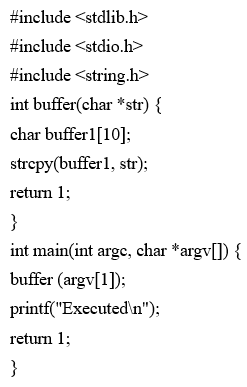
- SQL injection
- Denial-of-Service
- Buffer overflow
- Cross site scripting
The short version
C — unbounded copy into a small stack buffer means overflow. The program copies user supplied input into a ten byte array without length checking, so excess bytes overwrite adjacent memory and the settled key identifies a buffer overflow.
Key concepts in this question
- Stack buffer: fixed size local array that holds input during execution, with neighboring return addresses and variables stored nearby.
- Unsafe copy: functions that copy until terminator without a size limit will write past the destination when source is longer than allocated space.
- Attacker control: when length comes from external input, an attacker can craft a long string to overwrite control data and redirect execution.
- SQL injection contrast: injection targets database query parsing, not memory bounds, so it needs query concatenation rather than a raw byte copy.
- XSS and DoS contrast: scripting targets browser rendering and denial targets availability, neither explains linear memory overwrite from a copy.
Why C is correct
C is correct because a ten byte destination cannot safely hold arbitrary user input without explicit bounds enforcement. The described copy continues past the allocation when input exceeds ten bytes, corrupting stack memory in the classic overflow pattern. That behavior matches the settled answer exactly and distinguishes memory corruption from injection or availability attacks.
Why the others are wrong
- A. no database query is built from the input, so query logic injection does not apply.
- B. no flooding, resource exhaustion loop, or service crash mechanism is described beyond memory overwrite.
- D. no browser context or script reflection occurs, so cross site scripting is unrelated.
312-38 exam tip
See user input into tiny fixed buffer with no length check and choose overflow immediately.
- Flow label
- Next header
- Traffic class
- Hop limit
The short version
D — Hop Limit is the IPv6 lifetime counter. Each forwarding router decrements it by one and discards the packet at zero, preventing endless loops in the settled key.
Key concepts in this question
- Hop Limit: eight bit IPv6 header field that caps how many router hops a packet may traverse before discard.
- Per hop decrement: forwarding logic subtracts one on ingress or egress, so the value reflects remaining path budget rather than total distance.
- Flow Label contrast: twenty bit field that marks related packets for special handling, never altered for lifetime control.
- Next Header contrast: identifies the following encapsulated protocol or extension header, set by the source and preserved across hops.
- Traffic Class contrast: carries priority and congestion markings similar to IPv4 TOS, not a loop prevention counter.
Why D is correct
D is correct because RFC behavior defines Hop Limit as the IPv6 successor to IPv4 TTL, decremented by every router on the path. When the counter reaches zero the packet is dropped and an ICMPv6 time exceeded message may return, which bounds routing loops. No other listed header field performs hop by hop lifetime accounting, so the settled key is decisive.
Why the others are wrong
- A. Flow Label groups flows for QoS handling and stays constant along the path.
- B. Next Header describes payload type and is not decremented by forwarders.
- C. Traffic Class signals priority and is not used as a hop counter.
312-38 exam tip
Map Hop Limit to TTL: the only IPv6 field that ticks down each router hop.
- Using WPA encryption
- Not broadcasting SSID
- Using WEP encryption
- MAC filtering the router
The short version
AC — encrypt the coffee shop air with a shared key. WPA and WEP both provide over the air confidentiality using a password given to customers, so the settled pair reflects historic exam emphasis on encryption first.
Key concepts in this question
- WPA encryption: stronger wireless privacy than legacy WEP, with per packet key mixing and integrity checks suited to public hotspots.
- WEP encryption: older shared key privacy that still scrambles traffic, historically taught as a baseline though now considered weak.
- Customer usability: a pre shared passphrase can be posted, rotated daily, and entered without per user accounts, fitting cafe workflow.
- SSID hiding contrast: suppressing beacons does not encrypt frames and is trivially bypassed with passive sniffing.
- MAC filtering contrast: allow lists are spoofable and painful to maintain for transient guests, adding friction without real secrecy.
Why AC is correct
A is correct because WPA protects customer frames from casual eavesdropping while remaining easy to distribute as a shared passphrase. C is correct in the context of the settled bank key, which treats any over the air encryption, including legacy WEP, as a valid protective step for an open hospitality network. Together they prioritize confidentiality mechanisms that work without per customer provisioning.
Why the others are wrong
- B. hidden SSID is discoverable in probe and association frames and provides no encryption.
- D. MAC addresses are easily spoofed and filtering transient devices creates constant help desk load.
312-38 exam tip
For legacy hospitality questions, pick encryption options first and ignore hiding and filtering as weak obscurity.
- Wireless sniffer
- Spectrum analyzer
- Protocol analyzer
- Performance Monitor
The short version
AC — Wireless sniffer plus protocol analyzer both capture and decode network traffic. Each tool intercepts packets passing over a medium and reconstructs transactions, which is exactly the dual capability the stem asks for.
Key concepts in this question
- Wireless sniffer: a receiver placed in promiscuous or monitor mode that captures 802.11 frames to trace sessions and diagnose transactions.
- Protocol analyzer: software such as Wireshark that decodes layers two through seven, reassembles streams and exposes transaction sequences.
- Spectrum analyzer: a radio-frequency measurement device showing signal strength and interference, not packet contents.
- Performance Monitor: an operating-system utility tracking CPU, memory and counters, with no packet interception role.
- Choose all that apply logic: two answers are complete solutions independently, so both A and C must be selected together.
Why AC is correct
AC is correct because both a wireless sniffer and a protocol analyzer analyze traffic to trace specific transactions and can intercept plus log traffic on a digital network. Sniffers provide the capture mechanism on wireless media while protocol analyzers provide decode and transaction tracing. Together they satisfy every clause of the question, matching the settled key.
Why the others are wrong
- B. Spectrum analyzer measures RF energy and channel use but cannot decode transactions or log packet flows.
- D. Performance Monitor observes host counters and process activity, never intercepting network transactions.
312-38 exam tip
On 312-38, link sniffer to capture and analyzer to decode: if the stem says trace transactions plus intercept and log, pick both together.
- The router does not have a configuration file.
- There is a need to set operating parameters.
- The user interrupts the boot sequence.
- The router does not find a valid operating system image.
The short version
CD — Interrupting boot or missing a valid IOS image drops a Cisco router to ROMMON. Both conditions prevent normal bootstrap, leaving the ROM monitor as the only available execution environment.
Key concepts in this question
- ROM monitor mode: a low-level bootstrap prompt used for recovery, password reset and image loading when IOS cannot start.
- Break sequence during boot: sending a break signal within the first seconds halts loading and forces entry to ROMMON for maintenance.
- Missing or corrupt IOS image: without a valid system image in flash, the bootstrap has nothing to load and falls back to ROM monitor.
- Missing configuration file: an absent startup-config sends the router to setup mode, not ROMMON, because IOS itself still loads.
- Operating parameters: routine settings are handled through configuration commands, not by entering ROM monitor.
Why CD is correct
CD is correct because Cisco bootstrap behavior defines exactly these two ROMMON entry paths. A user-initiated break aborts the boot sequence deliberately, while failure to locate a valid operating-system image makes booting impossible. In both cases control stays in ROM, which is precisely the settled key for this choose-all-that-apply item.
Why the others are wrong
- A. A missing configuration file triggers initial setup dialog, since IOS still boots successfully from flash.
- B. Setting operating parameters is normal configuration work performed from EXEC or global configuration mode.
312-38 exam tip
For 312-38 Cisco recovery, memorize break plus bad image equals ROMMON, while missing config equals setup mode instead.
- IGMP
- ICMP
- EGP
- OSPF
The short version
C — Exterior Gateway Protocol exchanges routes between autonomous systems. The stem asks for gateway-to-gateway routing across autonomous system boundaries, which is the defining role of EGP as a category.
Key concepts in this question
- Autonomous system: a network collection under one administrative routing policy, identified by an AS number for inter-domain exchange.
- Exterior gateway protocol: a class of protocols designed to share reachability between autonomous systems rather than inside one.
- IGMP: Internet Group Management Protocol managing host multicast group membership on a LAN segment.
- ICMP: Internet Control Message Protocol carrying error and diagnostic messages such as echo and unreachable.
- OSPF: an interior gateway protocol optimizing routing within a single autonomous system using link-state logic.
Why C is correct
C is correct because EGP is the protocol family created for exchanging routing information between gateways in different autonomous systems. The question wording mirrors standard definitions that contrast interior protocols like OSPF with exterior protocols for AS-to-AS exchange. That boundary-crossing function maps directly to EGP and to the settled key.
Why the others are wrong
- A. IGMP manages multicast subscriptions between hosts and routers, never inter-AS route exchange.
- B. ICMP reports errors and diagnostics, it does not advertise routing tables between gateways.
- D. OSPF is an interior protocol for use inside one autonomous system, the opposite scope from the stem.
312-38 exam tip
On 312-38, split interior versus exterior: inside one AS think OSPF, between autonomous systems think EGP family.
- Sequence Number
- Header Length
- Acknowledgment Number
- Source Port Address
The short version
D — Source Port Address is the 16-bit sender port in the transport header. Both TCP and UDP reserve the first 16 bits for the originating application port, matching the field described in the stem.
Key concepts in this question
- Source port: a 16-bit identifier letting the receiver reply to the correct sender socket and multiplex many concurrent sessions.
- TCP segment structure: source port, destination port, sequence number, acknowledgment number and header length appear as distinct fixed fields.
- Sequence number: a 32-bit value tracking byte order for reassembly and reliability, much larger than 16 bits.
- Header length and acknowledgment fields: control and accounting fields with different sizes and purposes from port identification.
- Port versus address wording: exam banks often phrase port number as Source Port Address while still meaning the transport port field.
Why D is correct
D is correct because standards define the source port as a 16-bit field identifying the sending application. TCP RFC layouts place it first in the segment header, and UDP mirrors the same 16-bit source and destination port pair. That size plus sender-side semantics uniquely identifies Source Port Address among the choices and confirms the settled key.
Why the others are wrong
- A. Sequence Number is 32 bits for ordering bytes, not a 16-bit sender port identifier.
- B. Header Length is a small 4-bit control field describing header size in words.
- C. Acknowledgment Number is 32 bits confirming received data, unrelated to identifying the source port.
312-38 exam tip
Memorize TCP sizes for 312-38: ports are 16 bits each, sequence and acknowledgment are 32 bits each.
- Data can be shared easily between wireless devices.
- It provides mobility to users to access a network.
- Data can be transmitted in different ways by using Cellular Networks, Mobitex, DataTAC, etc.
- It is easy to connect.
The short version
ABCD — all four statements describe wireless benefits. Sharing, mobility, diverse transport options, and easy joining are each defining traits, so the settled key selects every choice.
Key concepts in this question
- Easy sharing: wireless LANs let nearby devices exchange files, print, and stream without cabling or port moves.
- Mobility: users roam within coverage while sessions persist, supporting meeting rooms, warehouses, and campus use.
- Diverse bearers: cellular, Mobitex, DataTAC and similar packet radio systems extend data beyond local WiFi to wide area mobility.
- Simple onboarding: association plus pre shared key or open portal gets guests online faster than pulling drops.
- Choose all pattern: when each option states a well known advantage without exclusivity, the complete set is the intended response.
Why ABCD is correct
ABCD is correct because each statement independently holds true for wireless deployments. Devices do share data directly, users do gain untethered access, multiple radio bearers do carry data, and connection steps are intentionally lightweight. Since no option introduces a false limitation, the only consistent selection is the full set recognized by the settled key.
Why the others are wrong
- A. true alone is incomplete because it omits the other valid benefits in a choose all prompt.
- B. true alone is incomplete because mobility is only one of several correct traits.
- C. true alone is incomplete because bearer diversity is not the sole advantage.
- D. true alone is incomplete because ease of joining accompanies the other listed gains.
312-38 exam tip
If every choice is a textbook wireless advantage with no false claim, select all.
- Adding a second power supply unit
- Performing regular backup of the server
- Adding one more same sized disk as mirror on the server
- Implementing cluster servers' facility
- Encrypting confidential data stored on the server
The short version
BE — backup and encryption do not keep service running through failure. Fault tolerance needs redundant parts that take over instantly, while copies and secrecy protect recovery and confidentiality in the settled key.
Key concepts in this question
- Fault tolerance: continuity of operation during component failure through duplication of power, disks, CPUs, or whole nodes.
- Redundant power: second supply preserves uptime if one feed or unit fails, directly masking hardware faults.
- Mirroring and clustering: RAID mirror and cluster failover maintain access while a member is down, the core tolerance pattern.
- Backup contrast: periodic copies enable restoration after loss but require downtime and manual recovery, so they aid resilience not tolerance.
- Encryption contrast: scrambling stored data enforces confidentiality and compliance, with no effect on surviving hardware faults.
Why BE is correct
B is correct as a NOT tolerance step because regular backups shorten data loss windows yet still need restore time and do not mask a live failure. E is correct because encrypting confidential files strengthens secrecy but leaves single points of failure unchanged. The settled pair therefore isolates the two actions that never provide automatic failover, unlike extra supplies, mirrors, or clusters.
Why the others are wrong
- A. second supply is classic tolerance because load continues if one unit dies.
- C. mirrored disk keeps volume online when one spindle fails.
- D. cluster facility shifts workload to surviving nodes without interruption.
312-38 exam tip
Ask if it masks failure instantly: redundant hardware yes, backup and encryption no.
Want the full bank of 490 questions for Certified Network Defender (CND)? See all practice exams.