Implementing Cisco Advanced Call Control and Mobility Services — Free Practice Questions
10 free sample questions from a bank of 263, with the correct answers and explanations. No signup required — start practising right now.
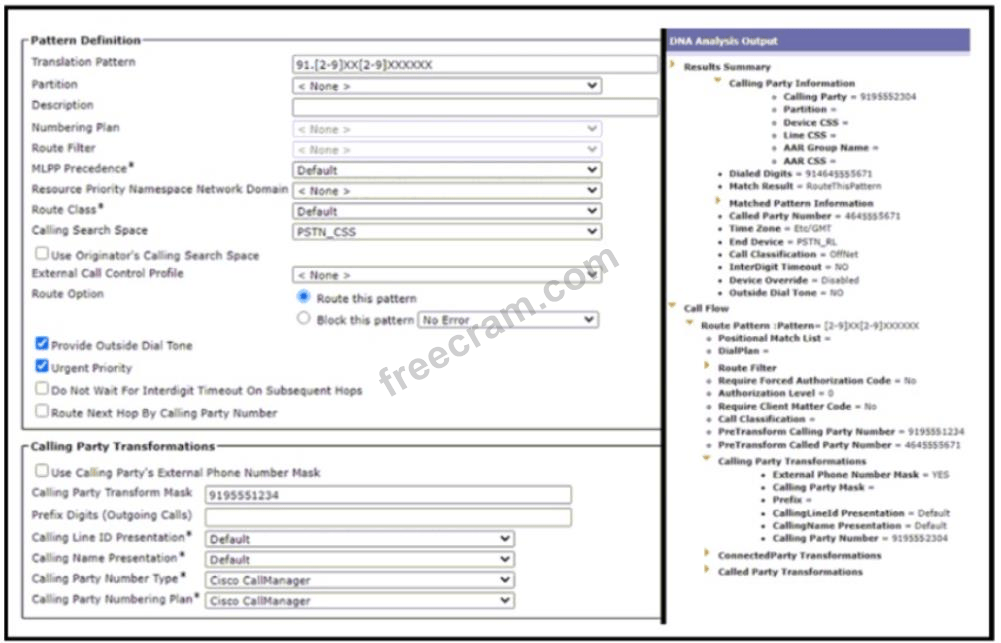
- Change the partition of the translation pattern from none to pstn_pt.
- Enable Force Authorization Code on the route pattern.
- Enable Use Calling Party's External Phone Number Mask on the translation pattern.
- Disable Use Calling Party's External Phone Number Mask on the route pattern.
The short version
D — Disable External Mask on the route pattern. DNA proves the downstream route pattern overwrote the caller ID.
Key concepts in this question
- Calling Party Transform Mask: sets 9195551234 on the translation pattern.
- External Phone Number Mask override: when YES, it replaces the transform with the line DN mask.
- DNA Analysis Output: shows which pattern actually set the outgoing Calling Party Number.
- Route pattern precedence: downstream match can overwrite translation-pattern normalization.
Why D is correct
Exhibit images/fc_0_0.jpg configures Calling Party Transform Mask 9195551234 with Use Calling Party's External Phone Number Mask unchecked, but DNA shows PreTransform Calling Party 9195551234 then Calling Party Transformations External Phone Number Mask = YES with final Calling Party Number = 9195552304 under Matched Pattern Route Pattern [2-9]XX[2-9]XXXXXX. The route pattern re-applied the external mask and sent the wrong caller ID, so disabling it on the route pattern preserves 9195551234.
Why the others are wrong
- A. Partition none to pstn_pt changes reachability, not the Calling Party Number overwrite shown in DNA.
- B. Forced Authorization Code controls call authorization, not caller-ID masking.
- C. Enabling the external mask on the translation pattern would force 9195552304 and worsen the fault.
300-815 exam tip
DNA Calling Party Transformations tells you which pattern overwrote the caller ID — fix the mask there, not where it was first set.
- Configure class of control.
- Configure service parameters
- Configure device pools.
- Configure enterprise softkeys.
The short version
B — Service parameters control park reversion timing. The Call Park Reversion Timer sends an unretrieved parked call back to the parker.
Key concepts in this question
- Call Park: places a call on hold in a park slot for retrieval from another phone.
- Reversion: returns the call to the original parker after the timer expires.
- Service parameters: cluster-wide timers and defaults in Cisco UCM administration.
Why B is correct
Forwarding an unretrieved parked call back to the parker is governed by the Call Park Reversion Timer, which lives under Cisco UCM service parameters. Setting that timer and its reversion behavior accomplishes the task without touching device-level or dial-plan objects, since reversion is a service-level policy.
Why the others are wrong
- A. Class of control governs calling permissions and partitions, not park timers.
- C. Device pools group devices for region, date, and CM-group settings, not call-park reversion.
- D. Softkey templates change available keys, but the return-after-timeout behavior is a timer, not a key.
300-815 exam tip — memory hook
Parked call must come back equals service parameter timer; think reversion timer, not partitions or pools.
- three-way conference
- secure SIP lines
- T.38 fax relay
- SIP trunk
- transcoding
The short version
A and C — Three-way conference and T.38 fax are the supported IPv6 fallback features. They remain available to SIP phones when the IOS XE gateway falls back to SRST over IPv6.
Key concepts in this question
- Unified SRST: branch gateway keeps basic call handling during WAN or UCM loss.
- IPv6 fallback: supplementary features are a restricted subset versus IPv4.
- SIP phone support: media and signaling features must explicitly support IPv6 on the gateway.
Why A and C are correct
For an IOS XE unified SRST gateway with IPv6 toward SIP phones, the supported supplementary set includes ad-hoc three-way conferencing and T.38 fax relay. Those two preserve core branch collaboration and fax continuity in fallback, while the remaining options fall outside the documented IPv6 fallback scope for this scenario.
Why the others are wrong
- B. Secure SIP lines are excluded from the IPv6 fallback supplementary set in this scenario.
- D. A SIP trunk is a call-routing construct, not one of the two supported supplementary endpoint features asked for.
- E. Transcoding is excluded from the IPv6 fallback supplementary set in this scenario.
300-815 exam tip — memory hook
IPv6 SRST fallback equals conference plus T.38; secure voice and transcoding are the classic unsupported traps.
- Add the mobility key to the softkey template that the desk phone is using.
- Check to make sure that the Resume softkey option appears on the desk phone.
- Use Dialed Number Analyzer to determine if the user extension can dial the mobile phone.
- Confirm that the desk phone is subscribed to Cisco Extension Mobility.
The short version
A — Add the Mobility key for desk-to-mobile handoff. Session handoff between the desk phone and the Single Number Reach destination needs the Mobility softkey.
Key concepts in this question
- Single Number Reach: rings the desk phone and a configured remote destination together.
- Session handoff: moves an active call between the desk phone and the mobile phone.
- Softkey template: controls which keys appear on the desk phone in each call state.
Why A is correct
Single Number Reach alone only extends ringing; moving an active call back and forth requires the Mobility feature on the desk phone. Adding the Mobility key to the softkey template in use gives the user the handoff action during the call, fulfilling the move-between-phones request.
Why the others are wrong
- B. A Resume key restores a held call but does not hand the session to the mobile device.
- C. Dialed Number Analyzer tests dial-plan reachability; it does not enable the handoff feature.
- D. Extension Mobility moves user profiles between desk phones, not active calls to mobile phones.
300-815 exam tip — memory hook
Move active call mobile to desk equals Mobility softkey; ringing both phones is only Single Number Reach.
- configuration for a single SIP phone
- configuration for SIP registrar service
- configuration for a pool of SIP phones (similar to device pool on Cisco Unified Communications Manager)
- configuration items common for all SIP phones
The short version
A — Voice register pool configures a single SIP phone. Each pool defines one phone's number, credentials, and features in CME.
Key concepts in this question
- Voice register global: settings common to all SIP phones in CME.
- Voice register pool: per-phone profile, analogous to an ephone for SCCP.
- Voice register dn: directory numbers referenced by pools.
Why A is correct
In Cisco Unified CME, voice register pool 1 enters the configuration block for one specific SIP phone instance. It holds that phone's ID, number, username, and feature bindings, so work done in this section applies to a single SIP phone rather than the whole SIP population.
Why the others are wrong
- B. The SIP registrar service itself is enabled globally, not inside an individual pool block.
- C. A pool of phones is not the meaning here; one pool equals one phone, unlike a UCM device pool template.
- D. Items common to all SIP phones live under voice register global, not under a numbered pool.
300-815 exam tip — memory hook
Pool with a number equals one SIP phone; global equals all phones; dn equals the line itself.
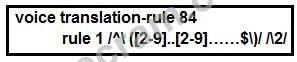
- rule 1 /^\([2-9]..[2-9]......$\)/ /\1/
- rule 1/^\+1\([2-9]..[2-9]......$\)/ /\1/
- rule 1 /^\+1\([2-9]..[2-9]......$\)/ /\0/
- rule 1 /^/+\([^1].*\)/ /011\1/
The short version
B — Strip +1 with /^\+1\([2-9]..[2-9]......$\)/ /\1/. CUCM sends +E.164 but the provider needs 10 digits.
Key concepts in this question
- Globalized E.164: CUCM sends +1NPA-NXXXXXX to CUBE.
- Voice translation-rule regex: must match the literal +1 then capture 10 digits.
- Replacement strings: /\1/ returns group 1, /\0/ returns whole match, /\2/ is empty here.
- Provider requirement: North America 10-digit DNIS NPA-NXX-XXXX.
Why B is correct
Exhibit images/fc_5_0.jpg shows voice translation-rule 84 rule 1 matching [2-9]..[2-9]...... with replacement \2 and no \+1, so a +1-prefixed DNIS never matches correctly. Rule 1 /^\+1\([2-9]..[2-9]......$\)/ /\1/ matches +1 plus 10 digits and returns only the 10-digit group, exactly the format the provider expects.
Why the others are wrong
- A. /^\([2-9]..[2-9]......$\)/ /\1/ matches only 10 digits, so +E.164 input misses.
- C. Replacement /\0/ returns the whole match including +1, leaving E.164 un-stripped.
- D. /^/+\([^1].*\)/ /011\1/ builds an international 011 string, the opposite of 10-digit.
300-815 exam tip
+E.164 to 10-digit is always /^\+1\(...\)/ /\1/ — watch for \0 versus \1 in the answers.
- gateway.corporate.local
- .
- *@example.com
- [email protected]
- example.com
The short version
B and C — wildcard plus exact-domain patterns both route the form. . catches everything including [email protected]; *@example.com targets it precisely.
Key concepts in this question
- SIP route patterns: * matches any string including dots.
- Exact-domain pattern: *@example.com matches the required user@domain form.
- Reversed/bare forms: domain-first or domain-only strings never match user-first URIs.
Why B and C are correct
. routes every SIP URI including the target form, and *@example.com routes exactly the required form to the corporate gateway.
Why the others are wrong
- A. A bare gateway name matches no user@domain URI.
- D. Domain-first ordering never matches user-first request URIs.
- E. A bare domain lacks the user portion the required form carries.
300-815 exam tip
User-at-domain routing always answers star-at-domain. Reversed orders never match.
- Enable transmit security status on the SIP security profile
- Enable ANAT on the SIP profile.
- Monitor the link using network management toots, and if it fails, manually change the routing to another working device.
- Enable SIP Option Ping on the SIP profile.
The short version
D — SIP OPTIONS ping tracks ITSP reachability. Failed peers are detected and calls route to the surviving device.
Key concepts in this question
- SIP OPTIONS: out-of-dialog keepalive probing the far-end device.
- ITSP failover: CUCM or CUBE marks a trunk destination down and uses the next available peer.
- SIP profile: enables OPTIONS ping and its intervals on the trunk.
Why D is correct
The customer has redundant ITSP devices and needs automatic rerouting when one fails. Enabling SIP OPTIONS ping on the SIP profile makes CUCM actively monitor each peer; an unresponsive device is marked out of service so outbound calls go to the working device without manual intervention.
Why the others are wrong
- A. Transmit security status relates to signaling security indication, not peer liveness detection.
- B. ANAT handles SDP grouping for dual-stack media and does not monitor trunk availability.
- C. Manual rerouting after NMS alarms is slow and operational, not the automatic mechanism requested.
300-815 exam tip — memory hook
Automatic SIP peer failover equals OPTIONS ping; manual reroute and security flags are distractors.
- in the queuing configuration
- in Cisco Unified CM Service Parameters
- in the telephony service configuration
- in Cisco Unified CM Enterprise Parameters
The short version
A — Maximum queue depth is set in the queuing configuration. The hunt-pilot queuing page holds callers-in-queue limits and announcements.
Key concepts in this question
- Call Queuing: holds callers against a hunt pilot instead of giving busy or overflow immediately.
- Hunt pilot queuing section: maximum callers, wait time, and announcements.
- Service versus enterprise parameters: global defaults, not the per-pilot queue size.
Why A is correct
Configuring Call Queuing in CUCM centers on the hunt pilot's queuing configuration, where the administrator enables queuing and sets the maximum number of callers allowed to wait. That per-pilot value directly controls queue depth, so it is the setting the question asks for.
Why the others are wrong
- B. Service parameters hold cluster-wide timers and defaults, not the hunt pilot's queue depth.
- C. Telephony service configuration belongs to CME or SRST gateways, not CUCM hunt-pilot queuing.
- D. Enterprise parameters set organization-wide defaults such as URLs and codecs, not per-queue capacity.
300-815 exam tip — memory hook
How many can wait equals hunt-pilot queuing page; cluster-wide timers live in service parameters.
- Enter ".*" in the route pattern section tied to a route group and list.
- Enter "!#" in the SIP route pattern.
- Enter "!#" in the route pattern section tied to a route group and list.
- Enter "*" in the SIP route pattern.
The short version
A — open internet URI dialing needs a catch-all route pattern. .* tied to a route group and list sends every URI to Expressway.
Key concepts in this question
- Catch-all pattern: .* matches any dialed URI.
- Route group/list: the Expressway-bound egress path.
- Bang patterns: ! rejects rather than routes.
Why A is correct
.* in a route pattern with a route group and list routes all internet URIs, satisfying the any-URI requirement.
Why the others are wrong
- B. !# in a SIP route pattern blocks rather than routes.
- C. !# in a route pattern blocks rather than routes.
- D. A bare * SIP pattern does not provide URI catch-all routing to a group/list.
300-815 exam tip
Any-URI dialing always answers dot-star on a route pattern. Bangs always block.
Want the full bank of 263 questions for Implementing Cisco Advanced Call Control and Mobility Services? See all practice exams.