300-630 — Free Practice Questions
10 free sample questions from a bank of 107, with the correct answers and explanations. No signup required — start practising right now.
1Refer to the exhibit. How is the ARP request from VM1 forwarded when VM2 is not learned in the Cisco ACI fabric?
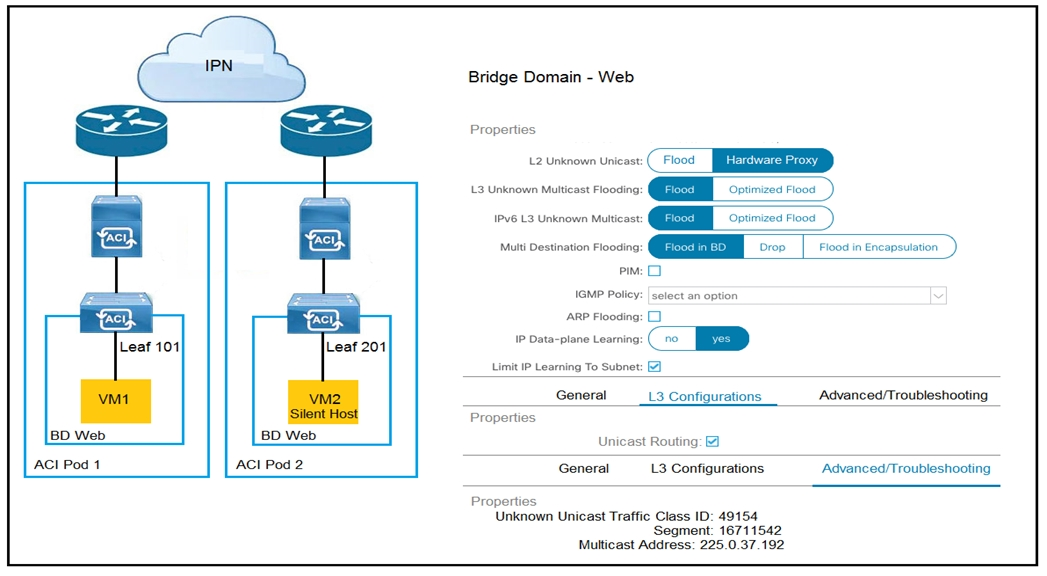
- Leaf 101 forwards the ARP request to one of the proxy VTEP spines.
- POD1 spine responds to the ARP request after the POD1 COOP is updated with the VM2 location.
- Leaf 101 encapsulates the ARP request into a multicast packet that is destined to 225.0.37.192.
- Leaf 101 switch consumes the ARP reply of VM2 to update the local endpoint table.
Answer: A
2An engineer deployed a Cisco ACI fabric and noticed that the fabric learns endpoints from subnets that are not configured on a bridge domain. To meet strict security requirements, the engineer must prevent this behavior. Which action must be taken to prevent this behavior?
- Activate Enable Data Plane Endpoint Learning
- Implement Pervasive Gateway
- Configure Static Binding
- Enable Enforce Subnet Check
Answer: D
3Refer to the exhibit. The requirement is to prefer the local PBR node and redirect the traffic to the remote pod PBR node in the case of catastrophic node failure. Which configuration meets these requirements?
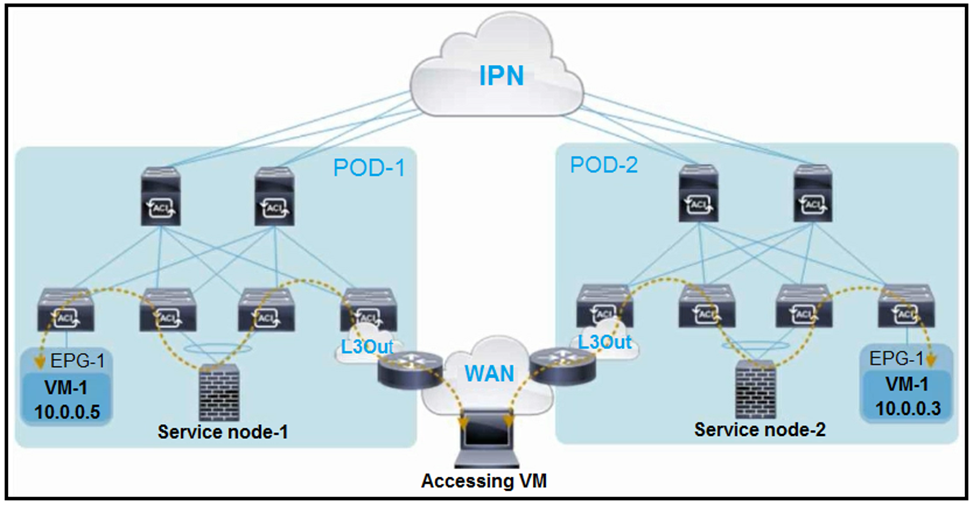
- location-based PBR host route advertisement resilient hashing
- symmetric PBR location-based PBR resilient hashing
- symmetric PBR unidirectional PBR resilient hashing
- location-based PBR host route advertisement node tracking
Answer: D
4Which protocol is used to exchange the MAC/IP address information for endpoints between spine switches in different pods in a Cisco Multi-Pod solution?
- BGP VPNv4
- MP-BGP EVPN
- IS-IS
- GRE
Answer: B
5Which mechanism is used by ACI spine switches to maintain a consistent copy of the endpoint address and location information?
- COOP
- ISIS
- BD
- OSPF
Answer: A
6An engineer is configuring ACI Multi-Pod between two data centers and must plan the physical cabling in the primary data center. How must the Cisco ACI Multi-Pod topology be connected?
- Connect spine switch 201 and 202 in pod 1 directly to spine switch 201 and 202 in pod 2.
- Connect leaf switch 101 and 102 in pod 1 directly to leaf switch 101 and 102 in pod 2.
- Connect spine switch 201 and 202 in pod 1 to ports on a device that is providing IP connectivity between pods.
- Connect leaf switch 101 and 102 in pod 1 to ports on a device that is providing IP connectivity between pods.
Answer: C
7What is a characteristic of application-centric design in Cisco ACI?
- One-to-one mapping between EPGs and bridge domains is enforced.
- A bridge domain has only one subnet.
- EPGs represent different application tiers.
- It simplifies gradual migration from a traditional network.
Answer: C
8A Cisco ACI fabric is configured with these settings:
• A single VRF exists that contains 100 EPGs.
• EPGs 1 to 50 must be permitted to communicate.
• EPGs 51 to 100 must NOT be allowed to communicate with EPGs 1 to 50.
• EPG 51 must be allowed to communicate with EPG 10
Which two actions must be taken to accomplish these requirements? (Choose two.)
- Create a vzAny contract
- Create a standard contract between EPG 51 and EPG 10.
- Select the Intra-EPG Isolation checkbox.
- Set policy control enforcement to Unenforced
- Enable the Preferred Group option on EPGs 1 to 50.
Answer:
9An engineer configures Cisco ACI Multi-Site and must specify the control plane TEP IP for spines. Which statement describes control plane TEP IP in this situation?
- The unique IP address is defined on each spine node that belongs to a fabric and is used to establish MP-BGP EVPN and VPNv4 adjacencies with the spine nodes in remote sites.
- The unique IP address is defined on each spine node that belongs to a fabric and is used to establish VXLAN adjacencies with the spine nodes in remote sites.
- The common anycast address is shared by all the spine nodes in the same site and is used to perform headend replication for BUM traffic.
- The common anycast address is shared by all the spine nodes at the same site and is used to source and receive unicast VXLAN data plane traffic.
Answer: A
10Refer to the exhibit. Server S1 is connected to Cisco ACI using two NIC interfaces. NIC1 is an active interface and NIC2 is a standby interface. NIC2 uses its MAC address to send traffic to the Cisco ACI fabric when NIC1 is offline. The requirement is to update the IP address to use the MAC address of NIC2. Which action accomplishes this goal?
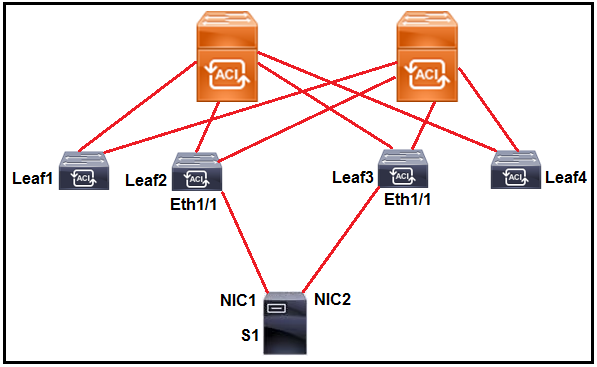
- Clear remote MAC entries.
- Set L2 Unknown Unicast to Proxy.
- Activate IP Data Plane Learning,
- Enable GARP EP Move Detection.
Answer: D
Want the full bank of 107 questions for 300-630? See all practice exams.