300-620 — Free Practice Questions
10 free sample questions from a bank of 487, with the correct answers and explanations. No signup required — start practising right now.
1An engineer is implementing a Cisco ACI data center network that includes Cisco Nexus 2000 Series 10G fabric extenders. Which physical topology is supported?
A. B. C. D.
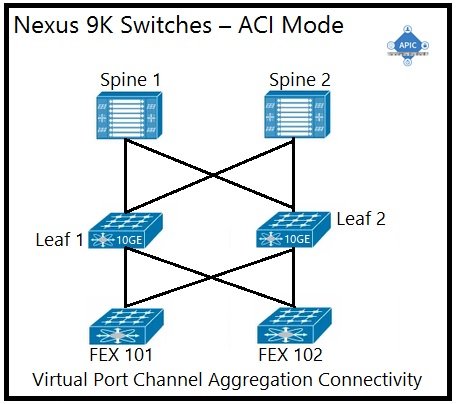
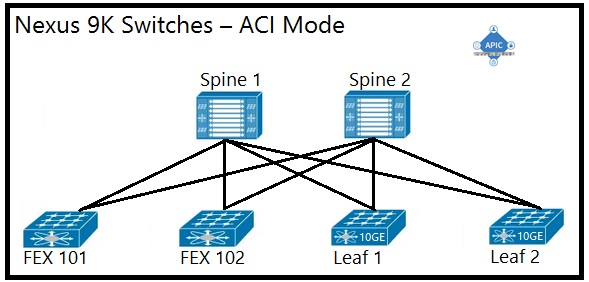
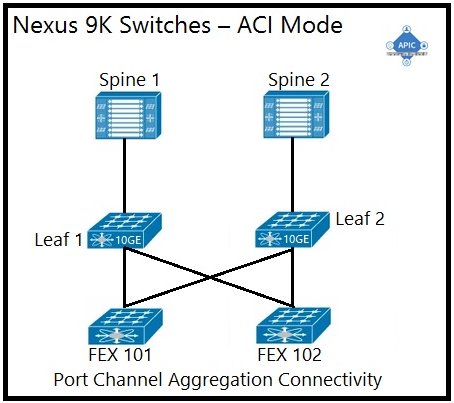
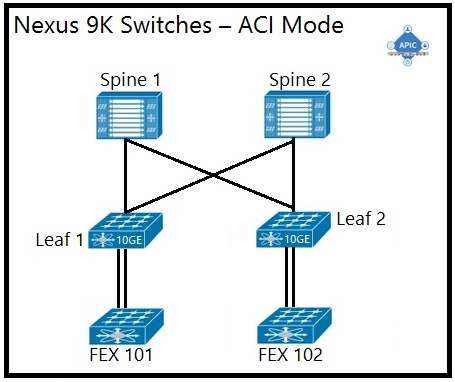
Answer:
2Which feature dynamically assigns or modifies the EPG association of virtual machines based on their attributes?
- vzAny contracts
- standard contracts
- application EPGs
- uSeg EPGs
Answer: D
3An engineer must allow multiple external networks to communicate with internal ACI subnets. Which action should the engineer take to assign the prefix to the class ID of the external Endpoint Group?
- Enable the Export Route Control Subnet for the External Endpoint Group flag.
- Enable an L3Out with Shared Route Control Subnet.
- Configure subnets with the External Subnets for External EPG flag enabled.
- Configure subnets with the Import Route Control Subnet flag enabled.
Answer: C
4An engineer must ensure that Cisco ACI flushes the appropriate endpoints when a topology change notification message is received in an MST domain. Which three steps are required to accomplish this goal? (Choose three.)
- Enable the BPDU interface controls under the spanning tree interface policy.
- Configure a new STP interface policy.
- Bind the spanning tree policy to the switch policy group.
- Associate the STP interface policy to the appropriate interface policy group.
- Create a new region policy under the spanning tree policy.
- Map VLAN range to MST instance number.
Answer: C, E, F
5A Cisco ACI bridge domain and VRF are configured with a default data-plane learning configuration. Which two endpoint attributes are programmed in the leaf switch when receiving traffic? (Choose two.)
- Remote MAC, IP
- Remote Subnet
- Local IP, not MAC
- Local MAC, IP
- Local Subnet
- Remote IP
Answer: D, F
6Refer to the exhibit. An engineer wants to initiate an ICMP ping from Server1 to Server2. The requirement is for the BD1 to enforce ICMP replies that follow the expected path. The packets must be prevented from taking the direct path from Leaf1 to Server1. Which action must be taken on BD1 to meet these requirements?
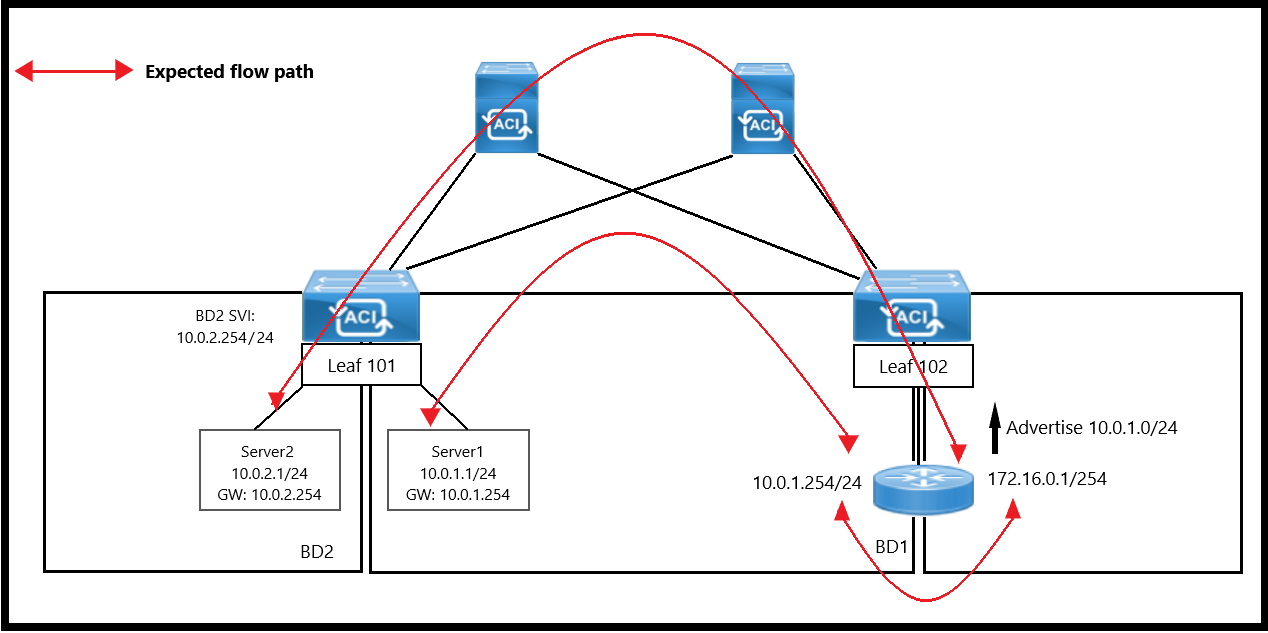
- Set L2 Unknown Unicast to Flood.
- Set L2 Unknown Unicast to Hardware Proxy.
- Disable Unicast Routing.
- Enable ARP Flooding.
Answer: C
7A network engineer must configure a Cisco ACI system to detect network loops for untagged and tagged traffic. The loop must be detected and stopped by disabling an interface within 4 seconds. Which configuration must be used?
Answer:
8An engineer must configure a group of servers with a contract that uses TCP port 80. The EPG that contains the web servers requires an external Layer 3 cloud to initiate communication. Which action must be taken to meet these requirements?
- Configure the EPG as a provider and L3 out as consumer of the contract.
- Configure OSPF to exchange routes between the L3 out and EPG.
- Configure a taboo contract and apply it to the EPG.
- Configure the EPG as a consumer and L3 out as a provider of the contract.
Answer: D
9The unicast routing feature is enabled on the bridge domain. Which two conditions enable the Cisco ACI leaf to learn a source IP as a local endpoint? (Choose two.)
- Through Ethernet traffic received in a bridge domain.
- IP traffic routed through an SVI.
- Through VXLAN traffic received on the uplink.
- IP traffic routed through a Layer 3 Out.
- Through ARP received on an SVI.
Answer: B, E
10When does the Cisco ACI leaf learn a source IP or MAC as a remote endpoint?
- When VXLAN traffic arrives on a leaf fabric port from the spine and outer source IP is in the Layer 3 Out EPG subnet range.
- When VXLAN traffic arrives on a leaf fabric port from the spine and outer source IP is in the bridge domain subnets range.
- When VXLAN traffic arrives on a leaf fabric port from the spine and inner source IP is in the Layer 3 Out EPG subnet range.
- When VXLAN traffic arrives on a leaf fabric port from the spine and inner source IP is in the bridge domain subnets range.
Answer: D
Want the full bank of 487 questions for 300-620? See all practice exams.