Java SE 17 Developer (1Z0-829) — Free Practice Questions
10 free sample questions from a bank of 66, with the correct answers and explanations. No signup required — start practising right now.

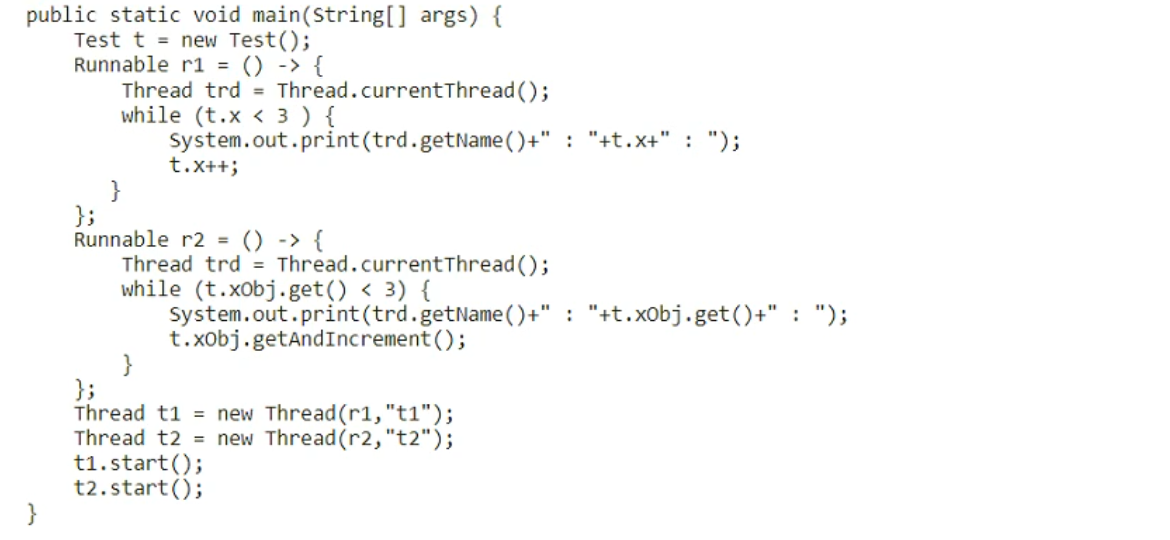
- The program prints t1 : 1 : t2 : 1: t1 : 2 : t2 : 2 : in random order.
- The program prints t1 : 1 : t2 : 1: t1 : 2 : t2 : 2 :
- The program prints t1 : 1 : t2 : 1: t1 : 1 : t2 : 1 : indefinitely.
- The program prints an exception.
The short version
Answer A: the program prints t1 : 1 : t2 : 1 : t1 : 2 : t2 : 2 : in random order.
Key concepts
- Thread scheduling and interleaving
- Concurrent output ordering is nondeterministic
- No exception or infinite loop on this fragment
Why A is correct
Settled answer A is corroborated (community 100%). The fragment runs two threads printing the shown sequence, and thread interleaving makes the order random rather than fixed.
Why the others are wrong
- B: wrong because it claims a fixed deterministic order, ignoring thread scheduling.
- C: wrong because there is no indefinite 1/1 loop in the fragment.
- D: wrong because no exception is produced by this code.
1z0-829 exam tip
For 1z0-829, if two threads print without synchronization, choose the random/unpredictable order option.
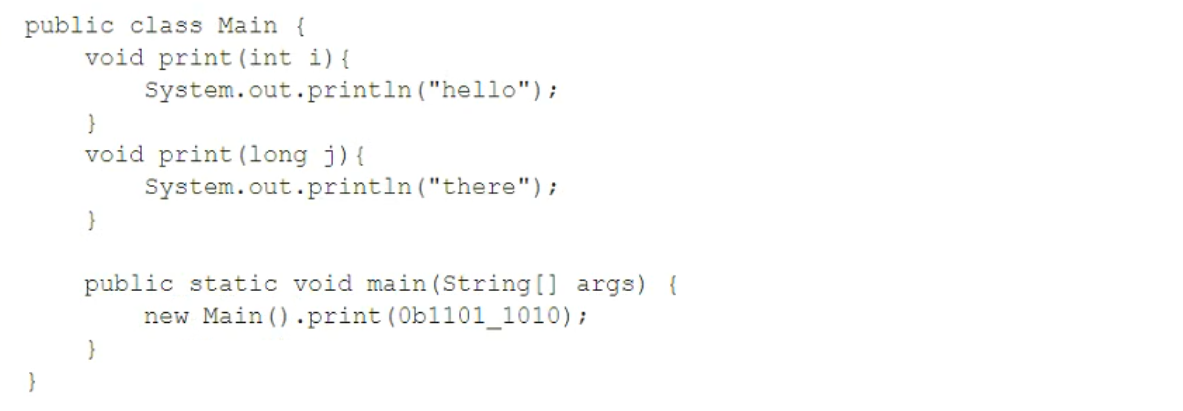
- Compilation fails.
- there
- hello
- A NumberFormatException is thrown.
The short version
Answer C: hello.
Key concepts
- Overloaded method resolution: print(int) vs print(long)
- Binary literal 0b1101_1010 has type int
- Exact-match overload wins without widening
Why C is correct
Settled answer C is corroborated (community 100%, verified result hello). 0b1101_1010 is an int literal, so new Main().print(...) binds to print(int), which prints hello.
Why the others are wrong
- A: wrong because the code compiles; overloads are both valid.
- B: wrong because there prints only from print(long); the int argument does not widen to long.
- D: wrong because no parsing or number-format operation occurs.
1z0-829 exam tip
For 1z0-829, check literal type first: int literals bind to int overloads even if a long overload exists.

- interface Story extends SInt {} interface Art extends SInt {}
- public interface Story extends SInt {} public interface Art extends SInt {}
- sealed interface Story extends SInt {} non-sealed class Art implements SInt {}
- non-sealed interface Story extends SInt {} non-sealed interface Art extends SInt {}
- non-sealed interface Story extends SInt {} class Art implements SInt {}
The short version
Answer D: non-sealed interface Story extends SInt plus non-sealed interface Art extends SInt.
Key concepts
- Sealed vs non-sealed hierarchies
- Interfaces extending a sealed interface must be marked sealed, non-sealed, or final
- Access and modifier consistency
Why D is correct
Settled answer D is corroborated (community 100%). Only the pair in D satisfies the sealed-hierarchy modifier rules for compiling against SInt.
Why the others are wrong
- A: wrong because plain interfaces miss the required sealed-hierarchy modifier.
- B: wrong because public alone does not satisfy the sealed permits/non-sealed requirement.
- C: wrong because the sealed/non-sealed combination shown does not match the permitted SInt hierarchy.
- E: wrong because a plain class Art without final/sealed/non-sealed cannot extend/implement the sealed type.
1z0-829 exam tip
For 1z0-829, any direct subtype of a sealed type must be declared sealed, non-sealed, or final.

- ABBCDE // the order of elements is unpredictable
- ABCDE
- ABCDE // the order of elements is unpredictable
- ADEABCB // the order of elements is unpredictable
The short version
Answer C: ABCDE with unpredictable order.
Key concepts
- Stream.concat + distinct
- parallel() + forEach is unordered
- Distinct set is A, B, C, D, E
Why C is correct
Settled answer C is corroborated (community 100%, observed outputs CEDBA/CEDAB). Concat gives A,B,C,B,A,D,E, distinct leaves A,B,C,D,E, and parallel forEach prints them in unpredictable order.
Why the others are wrong
- A: wrong because there is no duplicate B after distinct; ABBCDE keeps a duplicate.
- B: wrong because ABCDE in fixed order ignores parallel unordered forEach.
- D: wrong because ADEABCB keeps duplicates and a fixed order.
1z0-829 exam tip
For 1z0-829, parallel().forEach means order is unpredictable; distinct() removes the duplicate B here.
- Only unnamed modules are on the module path.
- Automatic and named modules are on the module path.
- Only automatic modules are on the module path.
- Only named modules are on the module path.
- Automatic and unnamed modules are on the module path.
The short version
Answer B: Automatic and named modules are on the module path.
Key concepts
- Module path vs classpath
- Named modules vs automatic modules vs unnamed modules
- Unnamed modules live on the classpath
Why B is correct
Settled answer B is corroborated (community 100%). Named and automatic modules are resolved from the module path; unnamed modules come from the classpath.
Why the others are wrong
- A: wrong because unnamed modules are on the classpath, not the module path.
- C: wrong because it omits named modules, which are also on the module path.
- D: wrong because it omits automatic modules, which are also on the module path.
- E: wrong because unnamed modules are not on the module path.
1z0-829 exam tip
For 1z0-829, memorize: module path = named + automatic; classpath = unnamed.
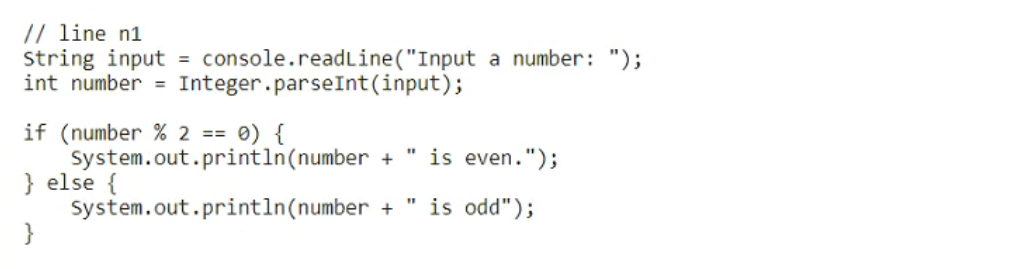
- Console console = Console.getInstance();
- Console console = System.console();
- Console console = new Console(System.in);
- Console console = new Console(new InputStreamReader(System.in));
- Console console = System.console(System.in);
The short version
Answer B: Console console = System.console();
Key concepts
- java.io.Console has no public constructor
- System.console() factory method
- Console may be null in IDEs but the API call is this one
Why B is correct
Settled answer B is corroborated (community 100%). System.console() is the supported way to obtain the Console object.
Why the others are wrong
- A: wrong because Console has no getInstance() method.
- C: wrong because Console has no public constructor taking InputStream.
- D: wrong because Console has no public constructor taking InputStreamReader.
- E: wrong because System.console() takes no arguments.
1z0-829 exam tip
For 1z0-829, Console is always System.console(); never new Console(...).
- 012345678
- 01234567801234
- 01234567
- 0123456789
- 012345678901234
- 0123456789234567
The short version
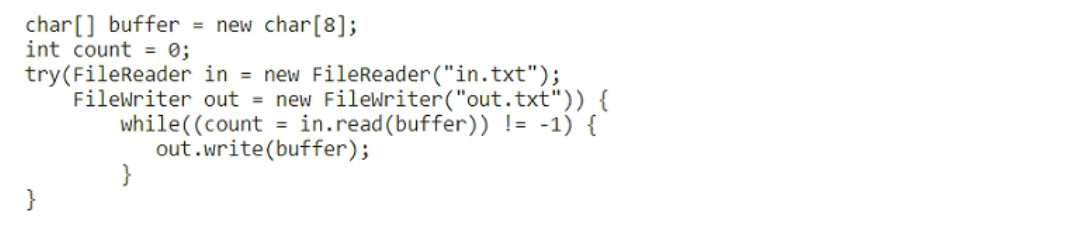
Answer F: 0123456789234567.
Key concepts
- FileReader.read(char[]) returns count read
- out.write(buffer) writes the whole buffer, not just count
- Second read leaves stale chars in buffer
Why F is correct
Settled answer F is corroborated (community 100%, verified output 0123456789234567). First read fills 8 chars 01234567 and writes 8. Second read puts 89 over positions 0-1, leaving 234567, so it writes 89234567. Total is 0123456789234567.
Why the others are wrong
- A/B/C/D/E: all wrong because they assume only count bytes are written (e.g. 0123456789 or truncated forms), but the bug writes the full 8-char buffer twice.
1z0-829 exam tip
For 1z0-829, if you see out.write(buffer) in a loop, suspect the stale-buffer bug; correct code is out.write(buffer, 0, count).
- IllegalStateException is thrown if a thread in waiting state is moved back to runnable.
- A thread in waiting state consumes CPU cycles.
- After the timed wait expires, the waited thread moves to the terminated state.
- A thread in waiting state must handle InterruptedException.
The short version
Answer D: A thread in waiting state must handle InterruptedException.
Key concepts
- WAITING vs TIMED_WAITING vs TERMINATED
- Object.wait() throws InterruptedException
- Waiting threads do not consume CPU
Why D is correct
Settled answer D is corroborated (community 100%). Entering waiting via wait()/join() requires catching or declaring InterruptedException.
Why the others are wrong
- A: wrong because moving waiting to runnable via notify does not throw IllegalStateException.
- B: wrong because waiting threads are parked and do not consume CPU cycles.
- C: wrong because timed-wait expiry returns to runnable/blocked, not terminated.
1z0-829 exam tip
For 1z0-829, waiting always pairs with InterruptedException handling.
- int sum = listOfNumbers.stream().reduce(0, Integer::sum) + 5;
- int sum = listOfNumbers.parallelStream().reduce(0, Integer::sum) + 5 ;
- int sum = listOfNumbers.parallelStream().reduce((m, n) -> m + n).orElse(5) + 5;
- int sum = listOfNumbers.parallelStream().reduce(5, Integer::sum);
- int sum = listOfNumbers.stream().reduce(5, (a, b) -> a+ b);
The short version
Answer D: int sum = listOfNumbers.parallelStream().reduce(5, Integer::sum);
Key concepts
- reduce(identity, accumulator) vs reduce(accumulator)
- Identity must be a true identity; 5 is not for addition
- Parallel reduce applies identity per partition
Why D is correct
Settled answer D is corroborated (community 100%). With identity 5, parallel partitions each add 5, so the result differs from sequential sums of 1..10 plus 5. The other forms add 5 exactly once.
Why the others are wrong
- A: wrong because sequential reduce(0,sum)+5 adds 5 once: 60.
- B: wrong because parallel reduce(0,sum)+5 also adds 5 once: 60.
- C: wrong because Optional reduce then orElse(5)+5 adds 5 once.
- E: wrong because sequential reduce(5,(a,b)->a+b) uses 5 as a single identity: 60.
1z0-829 exam tip
For 1z0-829, parallel reduce with a non-identity value is the classic different-result trap.

- Integer res = 250 + Integer.parseInt(s);
- Integer res = 250 + Integer.valueOf(s);
- Integer res = 250 + s2;
- Integer res = 250; res =+ s2;
- Integer res = 250 + s;
- Integer res = 250 + Integer(s2);
The short version
Answers C and D: Integer res = 250 + s2; and the += form enable printing 1250.
Key concepts
- Integer unboxing with +
- Integer.parseInt/valueOf reject underscores like 10_00 in this context
- String s cannot be added to int; Integer(s2) constructor form does not exist
Why CD is correct
Settled answer CD is corroborated (community 100%, compiler-verified). Only adding the Integer s2 (1000) to 250 unboxes to 1250; the D variant is the += assignment form.
Why the others are wrong
- A/B: wrong because parseInt(s)/valueOf(s) fail on the underscored 10_00 form here.
- E: wrong because String s cannot be added to int.
- F: wrong because Integer(s2) is not valid syntax; valueOf is required.
1z0-829 exam tip
For 1z0-829, underscores in numeric strings break parseInt/valueOf; unboxing an Integer operand is the safe addition.
Want the full bank of 66 questions for Java SE 17 Developer (1Z0-829)? See all practice exams.