Oracle Communications Session Border Controller 7 Basic Implementation Essentials (1Z0-404) — Free Practice Questions
10 free sample questions from a bank of 61, with the correct answers and explanations. No signup required — start practising right now.
- Navigate to the bootparams configuration branch and set the host inet field to the IP address of the external BOOTP Server from which the Session Border Controller can boot.
- Navigate to the system configuration branch and set the ip address field of the wancom1 management interface.
- Navigate to the bootparams configuration branch and set the ip address field of the destination SIP device with which the Session Border Controller needs to interact.
- Navigate to the system configuration branch and set the ip address field of the wancom0 management interface.
- Navigate to the bootparams configuration branch, set the host inet or Host IP, FTP username, and FTP password for the external FTP Server in
The short version
E — Boot from external FTP via bootparams host inet plus FTP credentials.
Key concepts
- bootparams branch: holds boot device, file name, host inet, FTP user/password.
- host inet (h): IP of external server where image resides.
- External boot: requires network reachability plus FTP login, not a SIP peer address.
Why E is correct
E sets host inet/Host IP plus FTP username and password for the external FTP server in bootparams, which is the documented external-boot procedure. C points at a destination SIP device IP, which cannot supply a boot image.
Why the others are wrong
- A. BOOTP Server address alone omits FTP credentials and file location needed for FTP boot.
- B. wancom1 management IP is local identity, not the external boot server.
- C. Destination SIP device IP is call-routing data, irrelevant to booting.
- D. wancom0 management IP is local identity, not the external boot server.
1z0-404 exam tip
External boot = bootparams host inet + user/ftp password; local wancom IPs never boot the box.
- Navigate to the sip-port configuration element and set the allow-anonymous parameter to all.
- Navigate to the session-agent configuration element and set the ip-address parameter to the IP subnet of your trusted User Agent (UA).
- Navigate to the realm-config configuration element and set the addr-prefix parameter to the IP subnet of your trusted User Agent (UA).
- Navigate to the sip-port configuration element and set the allow-anonymous parameter to agents-only.
- Navigate to the sip-port configuration element and set the allow-anonymous parameter to address-prefix.
The short version
B, D — Session-agent plus agents-only locks peering to known agents.
Key concepts
- session-agent ip-address: defines the trusted UA/peer.
- sip-port allow-anonymous: all / agents-only / realm-prefix / registered / register-prefix.
- address-prefix is not a value: E names a non-existent option.
Why B, D is correct
B registers the trusted UA subnet as a session agent; D sets allow-anonymous to agents-only so only those agents are accepted. This is the documented peering lockdown.
Why the others are wrong
- A. all opens access to any UA, opposite of agents-only.
- C. realm addr-prefix is a subnet filter, not the session-agent-only control asked here.
- E. address-prefix is not a valid allow-anonymous value; valid values are realm-prefix/agents-only/all/registered/register-prefix.
1z0-404 exam tip
Peering agents-only = session-agent ip-address + sip-port allow-anonymous agents-only; reject address-prefix.
- the Session Border Controller will never use the SIP-NAT mechanism for routing
- the Session Border Controller will not use the registration cache for routing
- all endpoints in the realm will be cached when registered
- only endpoints behind NAT in the realm will be cached when registered
- the Session Border Controller will never use the local-policy mechanism for routing
The short version
A — Registration caching bypasses SIP-NAT routing. When registration-caching is enabled the SBC uses its cache instead of the SIP-NAT mechanism for routing.
Key concepts in this question
- sip-interface: signaling entry point where registration-caching is enabled.
- registration cache: stored contacts used for subsequent routing decisions.
- SIP-NAT: bridging mechanism bypassed when cache routing applies.
Why A is correct
Enabling registration-caching tells the SBC to route using cached registration contacts rather than invoking SIP-NAT processing. That is the documented behavioral change for this knob, so A matches the settled key.
Why the others are wrong
- B. Opposite of the feature — the cache is used for routing, not ignored.
- C. Too broad — it is not all endpoints unconditionally, the point is routing behavior.
- D. Too narrow — not limited to only NAT endpoints in this statement.
- E. Local-policy is a separate routing stage and is not disabled by this flag.
1z0-404 exam tip
Link caching-enabled to cache-for-routing and SIP-NAT-bypassed.
- The running configuration version is reset to 1.
- The running configuration version does not increase and is equal to the saved configuration version.
- The saved configuration version increases by 1 and is higher than the running configuration version.
- The running configuration version increases by 1 and is higher than the saved configuration version.
- The editing configuration version increases by 1 and is higher than the saved configuration version.
The short version
C — save-config bumps the saved version above running. The saved configuration version increases by 1 and ends up higher than the running version.
Key concepts in this question
- editing configuration: candidate changes before activation.
- running configuration: currently active version.
- saved configuration: persistent version updated by save-config.
Why C is correct
In superuser mode save-config writes the running config to persistent storage and increments the saved version count. The result is saved version = old + 1, higher than running, exactly as C states.
Why the others are wrong
- A. Nothing resets to 1; versions are monotonic counters.
- B. Versions do change; they do not stay equal after a save.
- D. It is the saved version that increments on save, not the running version.
- E. Editing version increments on edits, not on save-config.
1z0-404 exam tip
Remember: activate bumps running, save bumps saved.
- Navigate to the network-interface configuration element and set the sub-port-id parameter to 12.
- Navigate to the network-interface configuration element and set the sub-port-id parameter to 0.
- Navigate to the phy-interface configuration element and configure the hip-id parameter.
- Navigate to the phy-interface configuration element and configure the pri-utility-address parameter.
- Navigate to the network-interface configuration element and configure the name parameter.
The short version
A,C — VLAN 12 needs sub-port-id 12 plus phy setup. Set network-interface sub-port-id to 12 and configure the phy-interface identity for the parent port.
Key concepts in this question
- network-interface: L3 signaling and media interface bound to a phy port.
- sub-port-id: VLAN tag ID; 12 carries VLAN 12 traffic.
- phy-interface: physical port hosting tagged sub-ports.
Why A,C is correct
VLAN operation on the SBC uses sub-interfaces: sub-port-id must equal the VLAN ID, here 12. The parent phy-interface must also be provisioned so the tagged sub-port has a carrier, which is the second required step.
Why the others are wrong
- B. Sub-port-id 0 means untagged native, not VLAN 12.
- D. pri-utility-address is HA utility addressing, not VLAN tagging.
- E. Name alone does not tag; without sub-port-id 12 no VLAN separation occurs.
1z0-404 exam tip
See VLAN ID think sub-port-id equals tag.
- The ACK method was defined only in RFC 2543 and it has been deprecated.
- The ACK method is part of the INVITE transaction.
- The ACK method is an exception in RFC 3261.
- The ACK method is an optional SIP method.
- The ACK method was replaced with the CANCEL method in RFC 3261.
The short version
B — ACK gets no response because it belongs to INVITE. ACK for a non-2xx final response is part of the INVITE transaction, not a standalone request.
Key concepts in this question
- INVITE transaction: three-way INVITE, final response, ACK sequence.
- ACK: confirmation of final response to INVITE.
- RFC 3261 transactions: ACK handling differs for 2xx versus non-2xx.
Why B is correct
For non-2xx INVITE handling the ACK is defined as part of the same INVITE server transaction. Because it completes that transaction rather than creating a new one, no final response is generated to the ACK itself.
Why the others are wrong
- A. ACK is not deprecated; it remains core in RFC 3261.
- C. Calling it a bare exception misses the exam point that it rides the INVITE transaction.
- D. ACK is mandatory for INVITE, not optional.
- E. CANCEL is a different method to terminate pending INVITEs, not a replacement for ACK.
1z0-404 exam tip
ACK no-answer equals part-of-INVITE.
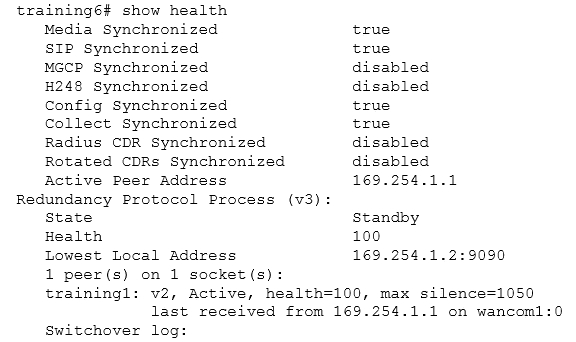
- The two nodes have different health scores.
- The training1 peer is the standby node.
- The switchover berpd force command was executed to do a manual failover.
- The training6 peer is the active node.
- The training6 peer will wait 1050 ms before considering the training1 peer out of service.
The short version
E — Max silence 1050 ms governs peer loss detection. The training6 peer waits 1050 ms before considering training1 out of service.
Key concepts in this question
- show health: HA health and heartbeat display.
- max silence: quiet interval before peer declared out of service.
- active versus standby: role display separate from timers.
Why E is correct
The output max-silence field reads 1050 ms for the training6 view of training1. That timer is exactly how long training6 waits without heartbeats before marking the peer out of service, so E is the accurate reading.
Why the others are wrong
- A. Scores match; no difference is shown.
- B. training1 is not shown as standby in this output.
- C. No forced-switchover evidence appears; this is steady-state timing.
- D. training6 is shown as standby, not active.
1z0-404 exam tip
For show health read max-silence as dead-timer.
- Navigate to the sip-port configuration element and set the allow-anonymous parameter to agents-only.
- Navigate to the session-agent configuration element and set the allow-anonymous parameter to prev-registered.
- Navigate to the sip-port configuration element and set the allow-anonymous parameter to realm-prefix.
- Navigate to the sip-port configuration element and set the allow-anonymous parameter to registered.
- Navigate to the session-agent configuration element and set the allow-anonymous parameter to 403-forbidden.
The short version
D — registered admits session agents plus prior registrants. Setting allow-anonymous to registered enforces exactly the requested policy.
Key concepts in this question
- sip-port: ingress SIP listener where admission is enforced.
- allow-anonymous: admission levels from all to agents-only to registered.
- session-agent: preconfigured trusted peer always admitted.
Why D is correct
The registered value means only requests from configured session agents and endpoints already registered through the SBC are processed, while new REGISTERs are still allowed. That matches allow only previously registered or session-agent callers.
Why the others are wrong
- A. agents-only would block previously registered non-agent UAs.
- B. allow-anonymous does not live on session-agent, and prev-registered is not the value.
- C. realm-prefix admits by subnet, not by registration or agent status.
- E. 403-forbidden and session-agent placement do not implement this rule.
1z0-404 exam tip
registered equals agents plus already-registered.
- Secondary only
- Active node that no longer has a heartbeat
- Standby only
- Active only
- Standby or Active
The short version
D — Trigger manual switchover from the active node. Issue notify berpd force on the active SBC to force HA failover.
Key concepts in this question
- HA pair: active and standby SBC nodes with heartbeats.
- berpd: redundancy protocol managing mastership.
- notify berpd force: manual switchover command.
Why D is correct
Per the settled key the supported procedure is to run notify berpd force on the active node that currently owns traffic. That forces it to relinquish mastership and the standby takes over in a controlled manual switchover.
Why the others are wrong
- A. Secondary-only is too restrictive for this forced command context.
- B. A node without heartbeat cannot reliably coordinate a clean switchover.
- C. Standby-only reverses the required origination point.
- E. Either-node is not the settled procedure; the key specifies active only.
1z0-404 exam tip
For manual failover think force-from-active.
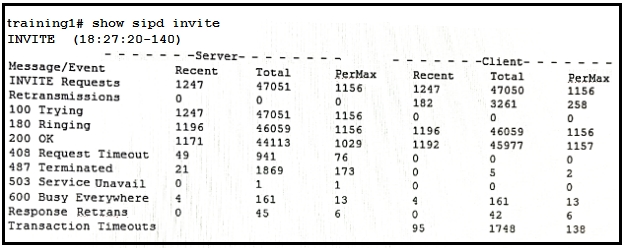
- 157
- 13
- 4
- 161
- 0
The short version
B — 13 locally generated 600 Busy Everywhere in window. The Recent count minus downstream-originated responses leaves 13 SBC-originated messages.
Key concepts in this question
- show sipd invite: SIP error and response counters.
- Recent column: count within seconds shown in timestamp line, here 140 seconds.
- Local versus downstream: SBC-generated versus proxied responses.
Why B is correct
Reading the 600 Busy Everywhere row for the last 140 seconds, the settled accounting subtracts responses that originated downstream and leaves 13 that the SBC itself generated. That arithmetic is the exam reading skill, yielding B.
Why the others are wrong
- A. 157 mixes total-since-reboot with recent-window counts.
- C. 4 reflects a different column such as PerMax, not recent locally generated.
- D. 161 adds downstream and local together instead of isolating local.
- E. 0 would mean none locally generated, contradicting the recent counter.
1z0-404 exam tip
Recent means last-N-seconds; subtract downstream to get local.
Want the full bank of 61 questions for Oracle Communications Session Border Controller 7 Basic Implementation Essentials (1Z0-404)? See all practice exams.