1z0-148 — Free Practice Questions
10 free sample questions from a bank of 107, with the correct answers and explanations. No signup required — start practising right now.
1The STUDENTS table exists in your schema.
Examine the DECLARE section of a PL/SQL block: Which two blocks are valid?
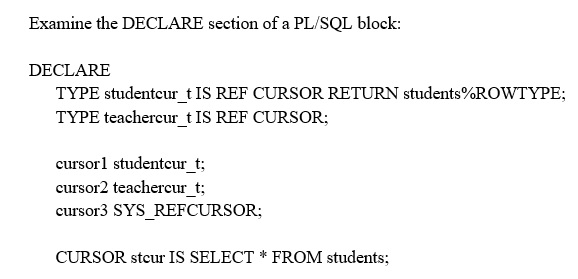
- BEGIN OPEN cursor3 FOR SELECT * FROM students; cursor1 :=cursor3; END;
- BEGIN OPEN stcur; cursor1 :=stcur; END;
- BEGIN OPEN cursor1 FOR SELECT * FROM students; stcur :=cursor1; END;
- BEGIN OPEN stcur; cursor3 :=stcur; END;
- BEGIN OPEN cursor1 FOR SELECT * FROM students; cursor2 :=cursor1;
Answer:
2Which codes executes successfully?
- CREATE PACKAGE pkg AS TYPE rec_typ IS RECORD (price NUMBER, inc_pct NUMBER); PROCEDURE calc_price (price_rec IN OUT rec_typ); END pkg; / CREATE PACAKGE BODY pkg AS PROCEDURE calc_price (price_rec IN OUT rec_typ) AS BEGIN price_rec.price := price_rec.price + (price_rec.price * price_rec.inc_pct)/100; END calc_price; END pkg; / DECLARE 1_rec pkg. rec_typ; BEGIN 1_rec_price :=100; 1_rec.inc_pct :=50; EXECUTE IMMEDIATE BEGIN pkg. calc_price (:rec); END; USING IN OUT 1_rec; END;
- CREATE PACKAGE pkg AS TYPE rec_typ IS RECORD (price NUMBER, inc_pct NUMBER); END pkg; / CREATE PROCEDURE calc_price (price_rec IN OUT pkg. rec_typ) AS BEGIN price_rec.price := price_rec.price + (price_rec.price * price_rec.inc_pct)/100; END / DECLARE 1_rec pkg.rec_typ; BEGIN EXECUTE IMMEDIATE BEGIN calc_price (:rec); END; USING IN OUT 1_rec (100, 50); END;
- CREATE PACKAGE pkg AS TYPE rec_typ IS RECORD (price NUMBER, inc_pct NUMBER); END pkg; / CREATE PROCEDURE calc_price (price_rec IN OUT pkg. rec_typ) AS BEGIN price_rec.price := price_rec.price + (price_rec.price * price_rec.inc_pct)/100; END ; / DECLARE 1_rec pkg. rec_typ; BEGIN 1_rec_price :=100; 1_rec.inc_pct :=50; EXECUTE IMMEDIATE BEGIN calc_price (1_rec); END;; END;
- DECLARE TYPE rec_typ IS RECORD (price NUMBER, inc_pct NUMBER); 1_rec rec-typ; PROCEDURE calc_price (price_rec IN OUT rec_typ) AS BEGIN price_rec.price := price-rec.price+ (price_rec.price * price_rec.inc_pct)/100; END; BEGIN 1_rec_price :=100; 1_rec.inc_pct :=50; EXECUTE IMMEDIATE BEGIN calc_price (:rec); END; USING IN OUT 1_rec;
Answer: A
3Examine this function header:
FUNCTION calc_new_sal (emp_id NUMBER) RETURN NUMBER;
You want to ensure that whenever this PL/SQL function is invoked with the same parameter value across active sessions, the result is not recomputed.
If a DML statement is modifying a table which this function depends upon, the function result must be recomputed at that point in time for all sessions calling this function.
Which two actions should you perform?
- Ensure RESULT_CACHE_MAX_SIZE is greater than 0.
- Enable the result cache by using DBMS_RESULT_CACHE.BYPASS (FALSE).
- Add the deterministic clause to the function definition.
- Add the RELIES_ON clause to the function definition.
- Add the RESULT_CACHE clause to the function definition.
Answer:
4Examine this block: Which two will be correct after line 5?
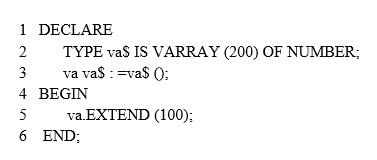
- va. LAST and va. LIMIT will return the same value.
- va. LAST and va. COUNT will return the same value.
- va. LIMIT and va. COUNT will return the same value.
- va. LIMIT and va. NEXT (199) will return the same value.
- va. LAST will return 200.
- va. NEXT (199) will return NULL.
Answer:
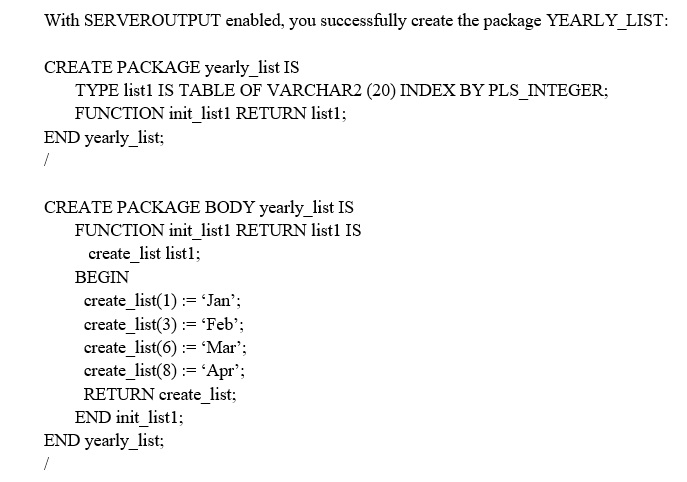
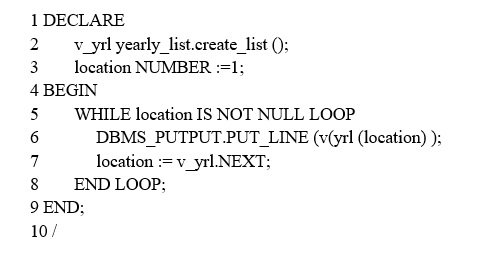
5Examine this code: You want to display the contents of CREATE_LIST.
Which two lines need to be corrected in the PL/SQL block?
- Line 2
- Line 3
- Line 5
- Line 6
- Line 7
Answer:
6Examine the following SQL statement:
ALTER SESSION SET PLSQL_OPTIMIZE_LEVEL=3;
What is the result of executing this statements?
- The PL/SQL optimize level for some existing PL/SQL units will be changed as an immediate result.
- The PL/SQL optimize level for subsequently complied PL/SQL units will be set to 3 and inlining will be enabled.
- The PL/SQL optimize level for subsequently compiled PL/SQL units will be set to 3 and inlining will be disabled.
- This statement will fail because PLSQL_OPTIMIZE_LEVEL can only be set at the system level,
Answer: C
7Which two statements describe actions developers can take to make their application less vulnerable to security attacks?
- Include the AUTHID DEFINER clause in stored program units.
- Do not concatenate unchecked user input into dynamically constructed SQL statements.
- Switch from using DBMS_SQL to EXECUTE IMMEDIATE.
- Include the AUTHID CURRENT_USER clause in stored program units.
- Increase the amount of code that is accessible to users by default.
Answer:
8Examine this code: What is the correct statement to get the value of attribute ACCOUNT_MGR after the procedure has been executed?
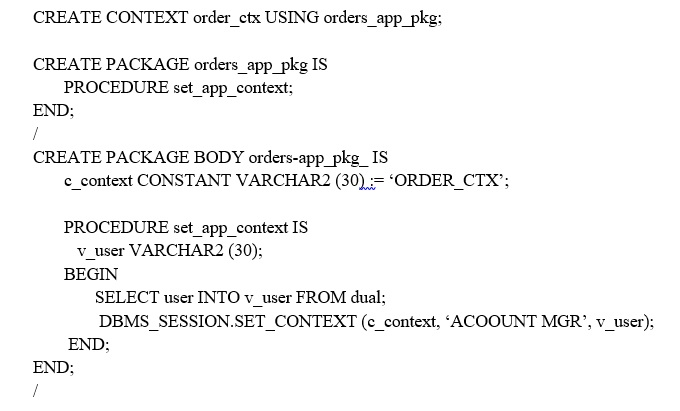
- SELECT USERENV (‘ACCOUNT_MGR’) FROM dual;
- SELECT SYS_CONTEXT (‘USERENV’, ‘ACCOUNT_MGR’) FROM dual;
- SELECT SYS_CONTEXT (‘ORDER_CTX’, ‘ACCOUNT_MGR’) FROM dual;
- SELECT SYS_CONTEXT (‘ACCOUNT_MGR’, ‘ORDER_CTX’) FROM dual;
- SELECT USERENV (‘ORDER_CTX’) FROM dual;
Answer: B
9Examine this code: Examine this DML statement executed in the SCOTT schema:
UPDATE emp SET comm = 1000 WHERE deptno= 20;
What is the outcome after executing this statement?
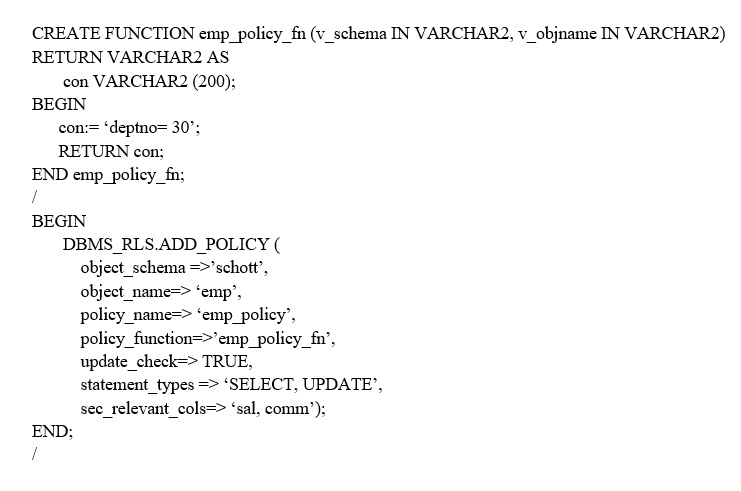
- COMM is set to 1000 for all records in the EMP table where DEPTNO = 30.
- The statement executes successfully but no rows are updated.
- COMM is set to 1000 for all records in the EMP table where DEPTNO=20.
- The statement fails with error ORA-28115: policy with check option violation.
Answer: D
10Identify the two correct scenarios where a function can be optimized using the function result cache feature.
- A function which inserts multiple records into a DEPARTMENTS table as part of one-time data setup for an HR application.
- A function which accesses multiple tables and calculates the commission to be given to a sales representative based on the number of products sold by that representative.
- A function which deletes all the records from an EMPLOYEES_AUDIT table based on their LOG_DATE.
- A function which updates the SALARY of all the employees in an EMPLOYEES table by a fixed percentage based on their DESIGNATION.
- A function which calculates the factorial of a given number without accessing any table.
Answer:
Want the full bank of 107 questions for 1z0-148? See all practice exams.