1z0-144 — Free Practice Questions
10 free sample questions from a bank of 74, with the correct answers and explanations. No signup required — start practising right now.
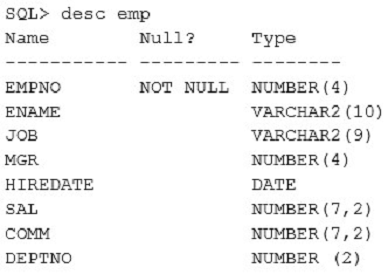
1View the Exhibit to examine the PL/SQL code: DECLARE -
x NUMBER := 5;
y NUMBER := NULL;
BEGIN -
IF x != y THEN yields NULL, not TRUE
DBMS_OUTPUT.PUT_LINE(x != y); not run
ELSIF x = y THEN also yields NULL
DBMS_OUTPUT.PUT_LINE(x = y);
ELSE -
DBMS_OUTPUT.PUT_LINE -
(Cant tell if x and y are equal or not.);
END IF;
END;
/
SREVROUPUT is on for the session. Which statement is true about the output of the PL/SQL block?
- The output is x = y.
- It produces an error.
- The output is x != y.
- The output is Can't tell if x and y are equal or not.
Answer: D
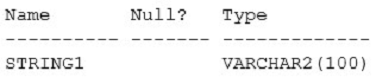
2The STRING_TAB table has the following structure: View the Exhibit and examine the code. What is the outcome on execution?
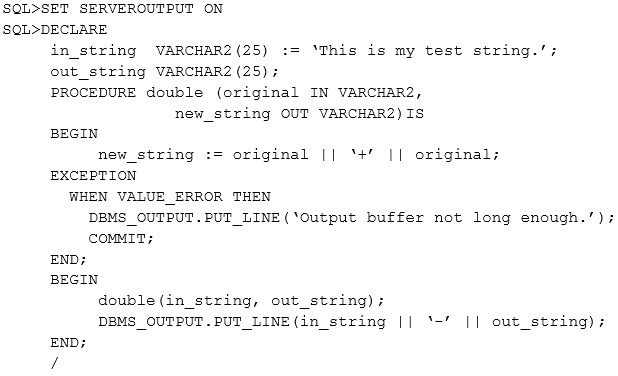
- It displays Output buffer not long enough. This is my test string.-.
- It displays only Output buffer not long enough, and exits the anonymous block.
- It displays only This is my test string. - Because EXCEPTION should have been defined in the anonymous block to get the error message.
- It does not display any of the MEMS_PUTPUT messages and gives an error because a transaction control statement cannot be used in the exception section
Answer: A
3View the Exhibit and examine the structure of the AUDIR_CUST table.
Exhibit Missing -
CUST_ID and CUST_LIMIT are existing columns in the CUSTOMER table.
Examine the following trigger code: Which statement is true about the above trigger?
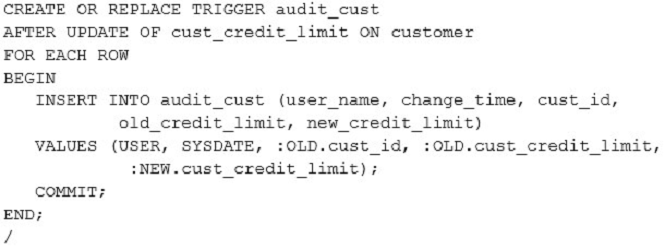
- It gives an error on compilation because it should be a statement-level trigger.
- It compiles and fires successfully when the credit limit is updated in the customer table.
- It gives an error on compilation because of the commit command in the trigger code.
- It compiles successfully, but gives an error when the credit limit is updated in the CUSTOMER table because the PRAGMA AUTONOMOUS_TRANSACTION
Answer: D
4Which three statements are true about anonymous blocks and subprograms? (Choose three.)
- Only subprograms can be parameterized.
- Only subprograms are persistent database objects.
- Both anonymous blocks and subprograms can be parameterized.
- Both anonymous blocks and subprograms are persistent database objects.
- Only subprograms can return values that persist after the execution of the subprogram.
- Both anonymous blocks and subprograms can return values that persist in SQL*Plus variables after their execution.
Answer: B, C, F
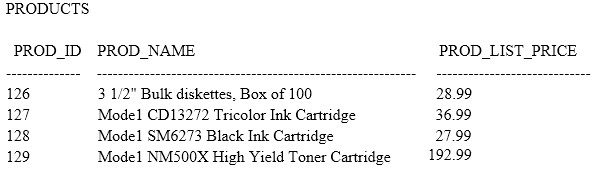
5View the Exhibit and examine the partial data in the PRODUCTS table.
PROD_ID is the primary key. Examine the following code: What is the outcome on execution of the above code?
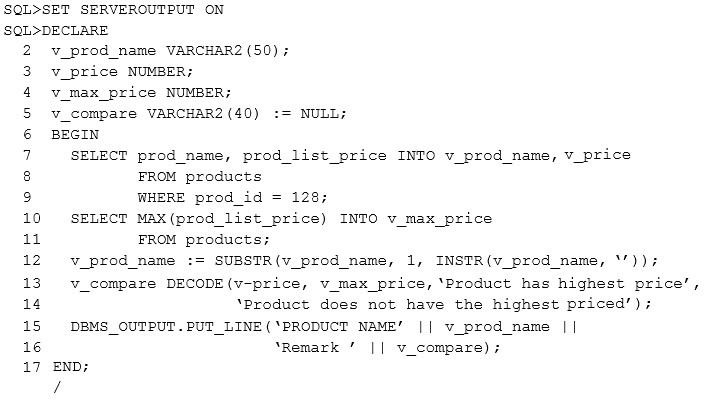
- It executes successfully.
- It gives an error because the DECODE function can be used only in a SQL statement.
- It gives an error because the SUBSTR and INSTR functions can be used only in a SQL statement.
- It gives an error because both the MAX and DECODE functions can be used only in a SQL statement.
Answer: A
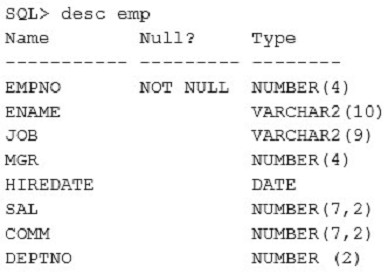
6View Exhibit 1 and examine the structure of the EMP table. View Exhibit 2 and examine the PL/SQL block of code. What is the outcome?
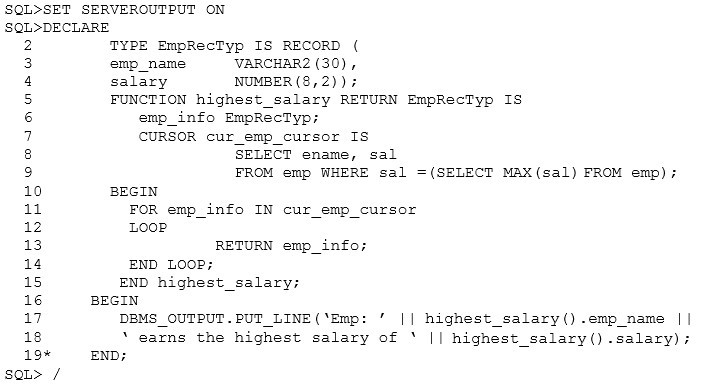
- It gives an error because the return type is not valid.
- It gives an error because the record type is not defined within the function.
- It gives an error because the function call in DBMS_OUTPUT. PUT__LINE is not valid
- It executes successfully and displays the names and salaries of all employees who earn the highest salary.
- It executes successfully but does not display the names and salaries of all employees who earn the highest salary.
Answer: E
7View the Exhibit and examine the blocks of code that you plan to execute. Which statement is true about the blocks of code?
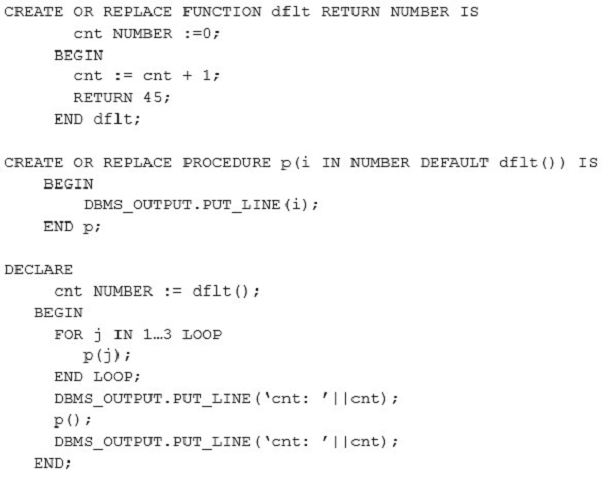
- All the blocks execute successfully and the anonymous block displays cnt: 45 cnt: 45
- All the blocks execute successfully and the anonymous block displays cnt: 0 cnt: 1
- The anonymous block gives an error because the function invocation in line 2 is not valid.
- The procedure creation gives an error because the function invocation in line 1 is not valid.
Answer: A
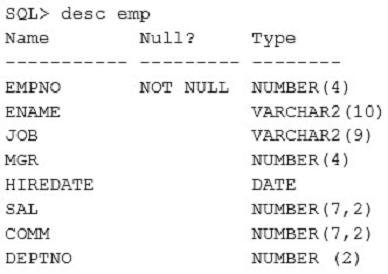
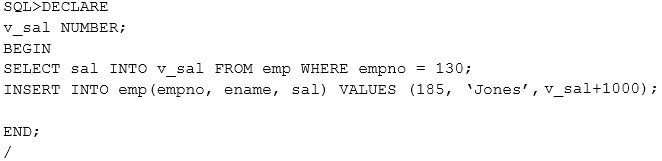
8View the Exhibit and examine the structure of the EMP table. Examine the following block of code: Which stages are performed when the above block is executed? (Choose all that apply.)
- Bind
- Parse
- Fetch
- Execute
Answer: C
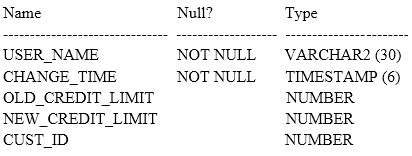
9View the Exhibit and examine the structure of the AUDIR_CUST table. CUST_ID and CUST_LIMIT are existing columns in the CUSTOMER table.
Examine the following trigger code: Which statement is true about the above trigger?
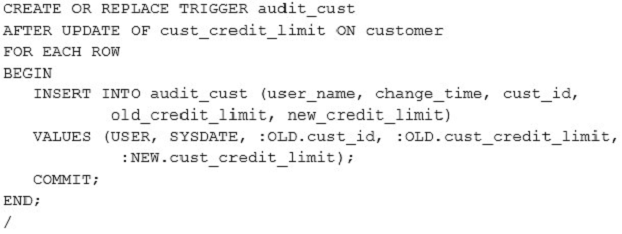
- It gives an error on compilation because it should be a statement-level trigger.
- It compiles and fires successfully when the credit limit is updated in the customer table.
- It gives an error on compilation because of the commit command in the trigger code.
- It compiles successfully, but gives an error when the credit limit is updated in the CUSTOMER table because the PRAGMA AUTONOMOUS_TRANSACTION
Answer: D
10Identify two situations where the DBMS_SQL package should be used. (Choose two.)
- The SELECT list is not known until run time.
- The dynamic SQL statement retrieves rows into records.
- You do not know how many columns a select statement will return, or what their data types will.
- You must use the % found SQL cursor attribute after issuing a dynamic SQL statement that is an insert or update statement.
Answer: A, C
Want the full bank of 74 questions for 1z0-144? See all practice exams.