1z0-1072-20 — Free Practice Questions
10 free sample questions from a bank of 85, with the correct answers and explanations. No signup required — start practising right now.
1You have an Oracle Cloud Infrastructure (OCI) load balancer distributing traffic via an evenly-weighted round robin policy to your back-end web servers. You notice that one of your web servers is receiving more traffic than other web servers.
How can you resolve this to make sure traffic is evenly distributed across all back-end webservers?
- Disable cookie-based session persistence on your backend set.
- Change keep-alive setting between the load balancer and backend server.
- Disable SSL configuration associated with your backend set.
- Create separate listeners for each backend web server.
Answer: A
2A financial firm is designing an application architecture for its online trading platform that must have high availability and fault tolerance.
Their solutions architect configured the application to use an Oracle Cloud Infrastructure Object Storage bucket located in the US West (us-phoenix-1) region to store large amounts of financial data. The stored financial data in the bucket must not be affected even if there is an outage in one of the Availability Domains or a complete region.
What should the architect do to avoid any costly service disruptions and ensure data durability?
- Create a new Object Storage bucket in another region and configure lifecycle policy to move data every 5 days.
- Create a lifecycle policy to regularly send data from Standard to Archive storage.
- Copy the Object Storage bucket to a block volume.
- Create a replication policy to send data to a different bucket in another OCI region.
Answer: D
3In Oracle Cloud Infrastructure Container Engine for Kubernetes (OKE), what does a Replica Set do?
- It provides declarative updates for Pods.
- It maintains a stable set of replica Pods running at any given time.
- It ensures that all Nodes run a copy of a Pod.
- It exposes an application running on a set of Pods.
Answer: B
4As a solution architect, you are showcasing the Oracle Cloud Infrastructure (OCI) Object Storage feature about Object Versioning to a customer.
Which statement is true in regards to OCI Object Storage Versioning?
- Object versioning does not provide data protection against accidental or malicious object update, overwrite, or deletion.
- By default, object versioning is disabled on a bucket.
- A bucket that is versioning-enabled can have only and always will have a latest version of the object in the bucket.
- Objects are physically deleted from a bucket when versioning is enabled.
Answer: B
5You created a public subnet and an internet gateway in your virtual cloud network (VCN) of Oracle Cloud Infrastructure. The public subnet has an associated route table and security list. However, after creating several compute instances in the public subnet, none can reach the Internet.
Which two are possible reasons for the connectivity issue? (Choose two.)
- The route table has no default route for routing traffic to the internet gateway.
- There is no stateful egress rule in the security list associated with the public subnet.
- There is no dynamic routing gateway (DRG) associated with the VCN.
- There is no stateful ingress rule in the security list associated with the public subnet.
- A NAT gateway is needed to enable the communication flow to internet.
Answer: A, D
6You are designing a lab exercise with an application that includes a large number of graphics with large file sizes. The application becomes unresponsive if the graphics are embedded in the application. You have uploaded the graphics to Oracle Cloud Infrastructure Object Storage bucket and added the URL paths for the individual objects in the application. You need to ensure these graphics are accessible without requiring any authentication for an extended period of time.
How can you achieve these requirements?
- Create pre-authenticated requests (PAR) and do not specify any expiration time.
- Make the Object Storage bucket private, make all objects public, and use the URL found in the object "Details".
- Make the Object Storage bucket public and use the URL path for the individual objects.
- Create pre-authenticated requests (PAR) and specify 00:00:0000 as the expiration time.
Answer: C
7You have setup your environment as shown below with the Mount Target "MT" successfully mounted on both compute instances CLIENT-X and CLIENT-Y.
For security reasons you want to control the access to the File System A in such a way that CLIENT-X has READ/WRITE and CLIENT-Y has READ only permission. What you should do?
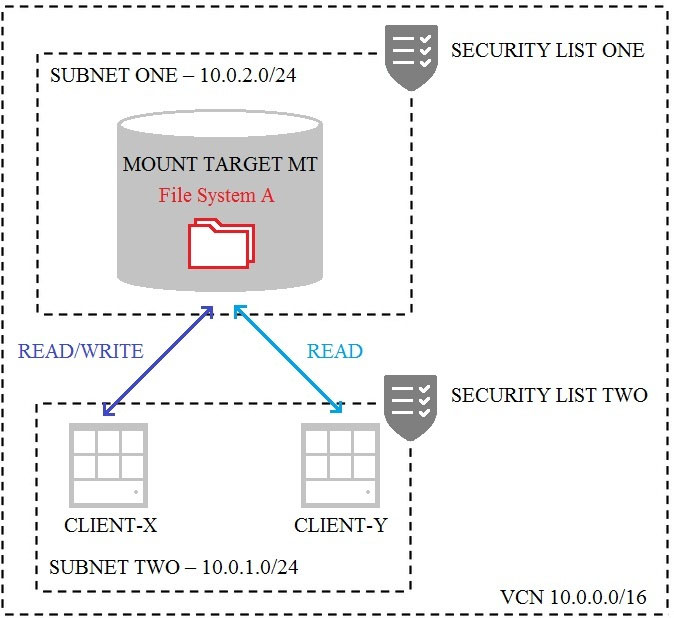
- Update the OS firewall in CLIENT-X to allow READ/WRITE access.
- Update the security list TWO to restrict CLIENT-Y access to read-only.
- Update the mount target export options to restrict CLIENT-Y access to read-only.
- Update the security list ONE to restrict CLIENT-Y access to read only.
Answer: C
8Which two methods are supported for migrating your on-premises Oracle database to an Oracle Autonomous Transaction Processing (ATP) database in Oracle
Cloud Infrastructure? (Choose two.)
- Load text files into ATP using SQL Developer.
- Use RMAN duplicate.
- Use Oracle Data Pump.
- Transfer the physical database files and re-create the database.
- Use database backup and restore.
Answer: A, C
9Which statement is NOT true about the Oracle Cloud Infrastructure Object Storage service?
- Object storage resources can be shared across tenancies.
- Immutable option for data stored in the Object Storage can be set via retention rules.
- Object versioning is enabled at namespace level.
- Object lifecycle rules can be used to either archive or delete objects.
Answer: B
10You are about to upload a large log file (5 TIB size) to Oracle Cloud Infrastructure object storage and have decided to use multipart upload capability for a more efficient and resilient upload.
Which two statements are true about multipart upload? (Choose two.)
- The maximum size for an uploaded object is 10 TiB.
- You do not have to commit the upload after you have uploaded all the object parts.
- Individual object parts can be as small as 10 MiB or as large as 50 GiB.
- While a multipart upload is still active, you cannot add parts even if the total number of parts is less than 10,000.
Answer: A, C
Want the full bank of 85 questions for 1z0-1072-20? See all practice exams.