1z0-082 — Free Practice Questions
10 free sample questions from a bank of 232, with the correct answers and explanations. No signup required — start practising right now.
1You execute this command: Sufficient storage is available in filesystem /u01.
Which two statements are true about the BIG_TBS tablespace? (Choose two.)

- AUTOEXTEND is possible for the datafile
- It must be bigger than the largest SMALLFILE tablespace
- Additional data files may not be added
- It will be a dictionary-managed tablespace by default
- It will always have a 32K blocksize
Answer:
2Which three functions are performed by dispatchers in a shared server configuration? (Choose three.)
- writing inbound request to the common request queue from all shared server connections
- checking for outbound shared server responses on the common outbound response queue
- receiving inbound requests from processes using shared server connections
- sending each connection input request to the appropriate shared server input queue
- broadcasting shared server session responses back to requesters on all connections
- sending shared server session responses back to requesters on the appropriate connection
Answer:
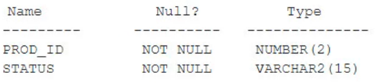
3Examine the description of the PRODUCT_STATUS table: The STATUS column contains the values 'IN STOCK' or 'OUT OF STOCK' for each row.
Which two queries will execute successfully? (Choose two.)
Answer:
4Which two statements are true about UNDO and UNDO tablespaces? (Choose two.)
- There can be only one UNDO tablespace created in a database.
- UNDO segments are owned by SYSTEM.
- UNDO segments are owned by SYSBACKUP.
- An UNDO tablespace may be owned by only one instance.
- An instance will crash if the active undo tablespace is lost.
Answer:
5You must create a tablespace of non-standard block size in a new file system and plan to use this command: The standard block size is 8k but other non-standard block sizes will also be used.
Which two are requirements for this command to succeed? (Choose two.)

- DB_32K_CACHE_SIZE must be less than DB_CACHE_SIZE.
- DB_32K_CACHE_SIZE must be set to a value that can be accommodated in the SGA.
- DB_32K_CACHE_SIZE should be set to a value greater than DB_CACHE_SIZE.
- The /u02 file system must have at least 100g space for the datafile.
- The operating system must use a 32k block size.
- DB_CACHE_SIZE must be set to a size that is smaller than DB_32K_CACHE_SIZE.
Answer:
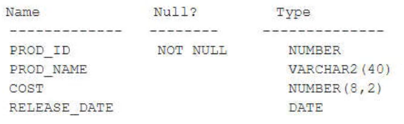
6Examine the description of the PRODUCTS table: Which query is valid?
- SELECT prod_id, release_date, SUM(cost) FROM products GROUP BY prod_id;
- SELECT prod_id, release_date, SUM(cost) FROM products GROUP BY prod_id, release_date;
- SELECT prod_id, AVG(MAX(cost)) FROM products GROUP BY prod_id;
- SELECT prod_id, MAX(AVG(cost)) FROM products GROUP BY prod_id;
Answer: B
7Which two statements are true about the Oracle Data Dictionary? (Choose two.)
- All data dictionary view join base tables to dynamic performance views.
- Data dictionary base tables can be queried directly.
- It is owned by the SYS user.
- It is owned by the SYSTEM user.
- Data dictionary views are always created with queries that join two or more base tables.
Answer:
8Which two Oracle database space management features require the use of locally managed tablespaces? (Choose two.)
- Automatic data file extension (AUTOEXTEND)
- Server-generated tablespace space alerts
- Online segment shrink
- Free space management with bitmaps
- Oracle Managed Files (OMF)
Answer:
9Which three statements are true about connection strings and service names used to connect to an Oracle database instance? (Choose three.)
- A connection string must include the SID of a database instance.
- A connection string including a service name must be defined in the tnsnames.ora file.
- A single database instance can support connections for multiple service names.
- A single connection string can refer to multiple database instances.
- A service name is created by a listener.
- Different connection strings in the same tnsnames.ora file can contain the same service name, host and port parameters.
Answer:
10Which three statements are true about using SQL*Plus? (Choose three.)
- It has both command-line and graphical user interfaces (GUI).
- It must be downloaded from the Oracle Technology Network (OTN).
- It can run Recovery Manager (RMAN) commands.
- It has its own commands that are separate from any SQL statements.
- It can run scripts entered at the SQL prompt.
- It can run scripts passed to it by a shell script.
Answer:
Want the full bank of 232 questions for 1z0-082? See all practice exams.