Oracle Database 19c: RAC Administration (1Z0-078) — Free Practice Questions
10 free sample questions from a bank of 73, with the correct answers and explanations. No signup required — start practising right now.
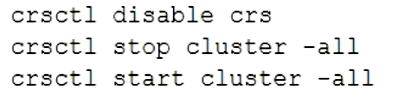
- The Oracle Clusterware stack is stopped on all nodes.
- The Oracle Clusterware stack is prevented from being automatically started on HOST01.
- The Oracle Clusterware stack is prevented from being automatically started on all nodes.
- The Oracle Clusterware stack is stopped on all nodes except HOST01.
- The Oracle Clusterware stack is started on all nodes except HOST01.
- The Oracle Clusterware stack is started on all nodes.
The short version
ABF — Correct. The sequence stops Clusterware everywhere, disables auto-start only on HOST01, then starts it everywhere. This matches the different scopes of stop, disable and start.
Key concepts in this question
- crsctl stop scope: stops the Oracle Clusterware stack across the cluster nodes.
- crsctl disable crs scope: only affects the local server where it is run.
- crsctl start scope: starts the stack on the nodes in the cluster.
Why ABF is correct
Option A is true because the stop operation halts the Clusterware stack on all four nodes. Option B is true because disable crs prevents automatic start only on the local server HOST01 per the Oracle documentation note. Option F is true because the final start brings the stack up again on all nodes, completing the cycle.
Why the others are wrong
- C. Incorrect because disable does not prevent automatic start on all nodes, it is strictly local to HOST01.
- D. Incorrect because the stack is stopped on all nodes including HOST01, not on all nodes except HOST01.
- E. Incorrect because the stack is started on all nodes, not on all nodes except HOST01.
1z0-078 exam tip
Remember the scope split for 1z0-078: stop and start act cluster-wide in this context, while disable crs is strictly local.
- The clusterware log files are stored inside the Grid Infrastructure Management Repository database used by the cluster health monitor (CHM).
- The diagcollection.pl script must be run from the Grid home directory as the grid infrastructure owner.
- There is one ologgerd service for the cluster health monitor (CHM) on each cluster node regardless of cluster size.
- The oclumon utility may be used to get and set parameters for the cluster health monitor (CHM ) repository.
- There is one osysmond service for the cluster health monitor (CHM) on each cluster node regardless of cluster size.
The short version
DE — Correct. oclumon manages CHM repository parameters and one osysmond runs per node. Logs are not in GMR and ologgerd is not per-node.
Key concepts in this question
- oclumon: utility to get and set CHM repository parameters.
- osysmond: one per cluster node regardless of size.
- ologgerd scaling: one logger per 32 nodes, not per node.
Why DE is correct
Option D is true because the oclumon utility may be used to get and set parameters for the Cluster Health Monitor repository. Option E is true because there is one osysmond service for CHM on each cluster node regardless of cluster size. Both describe diagnostic components correctly.
Why the others are wrong
- A. Incorrect because clusterware log files are not stored inside the Grid Management Repository database.
- B. Incorrect because diagcollection.pl need not be run from Grid home as grid owner in the stated mandatory sense.
- C. Incorrect because there is not one ologgerd per node, there is one per 32 nodes.
1z0-078 exam tip
For 1z0-078 memorize osysmond equals per-node and ologgerd equals per-32-nodes.
- Oracle RAC Resource Management only allows assignment of the SGA during instance startup.
- Oracle RAC Resource Management requires the same SGA value for all the instances of a RAC database which is configured during database startup only.
- Oracle RAC Resource Runtime Management allows for automatic and runtime adjustment of the SGA.
- Oracle RAC Resource Management only allows assignment of the SGA during database startup.
The short version
C — Correct. Oracle RAC Resource Runtime Management allows automatic runtime SGA adjustment. No restart-only rule and no identical SGA requirement apply.
Key concepts in this question
- SGA Management: sizing of System Global Area for RAC instances.
- Runtime Management: automatic and runtime adjustment capability in 19c.
- Per-instance values: instances do not need the same SGA setting.
Why C is correct
Option C is correct because Oracle RAC Resource Runtime Management supports automatic and runtime adjustment of the SGA without requiring instance restart. The Oracle documentation reference confirms there is no need to have the same settings on all nodes, which directly supports runtime flexibility.
Why the others are wrong
- A. Incorrect because assignment is not limited to instance startup, runtime adjustment is allowed.
- B. Incorrect because the same SGA value for all instances configured only at startup is not required.
- D. Incorrect because assignment is not limited to database startup only.
1z0-078 exam tip
If 1z0-078 says only at startup or same value on all nodes for SGA, eliminate it and look for runtime adjustment.
- Zero Downtime Patching requires out-of-place patching of Oracle Grid Infrastructure 19c with Oracle RAC or Oracle RAC One Node databases of 19c or later releases and only the binaries in the Oracle Grid Infrastructure user space are patched.
- When using Zero Downtime Patching, the root.sh script must be executed manually with -nodriverupdate option.
- When using Zero Downtime Patching, Oracle Grid Infrastructure OS system software, kernel modules and system commands including ACFS, AFD, OLFS, and OKA are not updated.
- Zero Downtime Patching requires in-place patching of Oracle Grid Infrastructure 19c with Oracle RAC or Oracle RAC One Node databases of 19c or later releases and only the binaries in the Oracle Grid Infrastructure user space are patched.
- Zero Downtime Patching can be fully automated by selecting the option to automatically run the root.sh script.
The short version
ABC — Correct. Zero Downtime patching is out-of-place, user-space only, with manual root.sh minus nodriverupdate. OS drivers and kernel modules are left untouched.
Key concepts in this question
- Zero Downtime Patching: Fleet Patching and Provisioning method without bringing down RAC instances.
- Out-of-place patching: requires 19c Grid Infrastructure with 19c or later RAC or RAC One Node.
- User-space only: OS software, kernel modules and drivers are not updated.
Why ABC is correct
Option A is true because Zero Downtime Patching requires out-of-place patching of 19c Grid Infrastructure with 19c or later databases and patches only user-space binaries. Option B is true because root.sh must be executed manually with the minus nodriverupdate option. Option C is true because ACFS, AFD, OLFS, OKA and other OS system software and kernel modules are not updated.
Why the others are wrong
- D. Incorrect because it says in-place patching, while Zero Downtime requires out-of-place patching.
- E. Incorrect because it claims fully automated root.sh, while manual execution with minus nodriverupdate is required.
1z0-078 exam tip
For 1z0-078 memorize Zero Downtime equals out-of-place plus manual root.sh plus no driver update.
- They can be applied in-place.
- When performing rolling patches, the VIPs for the node being patched are relocated to another node.
- Some Grid Infrastructure patchsets may not be intalled in a rolling fashion.
- When performing rolling patches, crsctl query crs softwareversion always displays the earliest version of the software running anywhere in the cluster.
The short version
B — Correct. During rolling patches the VIPs for the node being patched are relocated to another node. This keeps client connectivity while the local node is patched.
Key concepts in this question
- Rolling patches: patch nodes one at a time while the cluster stays available.
- VIP relocation: virtual IP for the patched node moves to a surviving node.
- Software version view: behavior of version queries during patching.
Why B is correct
Option B is correct per the decided key because rolling patch procedure relocates the VIPs of the node being patched to another node. This allows services and connections to continue while that node is taken for patching. It is the only statement counted as true for this question in the final key.
Why the others are wrong
- A. Incorrect because Grid Infrastructure patchsets are not applied in-place in this context.
- C. Incorrect because for this exam key it is not counted as true that some patchsets may not be installed rolling.
- D. Incorrect because crsctl query crs softwareversion does not always display the earliest version running anywhere in the cluster in the stated sense.
1z0-078 exam tip
On 1z0-078 focus on VIP relocation during rolling patches and do not confuse in-place versus out-of-place rules.
- All server pools in a cluster are controlled by the policy set, when user-defined policy management is used.
- Clusterware administrators cannot directly modify the policy set when Quality of Service (QoS) Management is used.
- A server pool can have different attributes defined for different policies in the policy set, when user-defined policy management is used.
- A server pool can have the same attributes defined for different policies in the policy set, when user-defined policy management is used.
- Servers in a server pool outside the control of the policy set are never affected by policy changes, when user-defined policy management is used.
The short version
Keep ACD: a pool may carry different or identical attributes across policies, and QoS disables the crsctl policy nouns.
Key concepts in this question
Policy set, user-defined policy management, server-pool attributes per policy, QoS Management control.
Why ACD is correct
A server pool can define different attributes under different policies (C) and may equally keep the same attributes (D); with QoS Management the crsctl policy/policyset commands are disabled, so administrators do not edit the policy set directly.
Why the others are wrong
B is backwards (QoS is exactly when direct policy-set edits are blocked, not allowed); E is false because unmanaged pools aside, managed pools are governed by the active policy.
1z0-078 exam tip
If QoS is mentioned, look for the answer that disables manual crsctl policy edits.
- New allocation units are mirrored in the FG2 failure group until FG1 is restored and the disk group resynchronized.
- The redundancy is lowered until the FG1 failgroup is restored and the disk group resynchronized.
- New allocation units are not mirrored but changes to allocation units are tracked in the FG2 failure group.
- Transactions on database objects stored in tablespaces in the DGRP1 disk group fail.
The short version
BC is correct: with FG1 offline, redundancy is lowered and changes are tracked for resync.
Key concepts in this question
- Normal redundancy needs two failure groups for mirroring
- Reduced redundancy during outage
- Fast resync change tracking
Why BC is correct
- B is correct: redundancy is lowered until FG1 is restored and resynchronized, because mirroring needs separate failure groups and only FG2 remains.
- C is correct: new allocation units are not mirrored but changes are tracked in FG2, per fast resync tracking of pending changes during outage.
Why the others are wrong
- A is wrong: new extents cannot be mirrored within FG2 alone to preserve normal redundancy; mirroring requires separate failure groups.
- D is wrong: transactions do not fail; the disk group stays mounted and available with reduced redundancy.
1z0-078 exam tip
If one failure group of a normal-redundancy group is offline, answer lowered redundancy plus tracked resync, not full mirroring or outage.
- A thread of redo must be created before starting a fourth instance if a thread is not already available.
- A thread of redo is automatically dropped when an instance is removed from a RAC database by using SRVCTL.
- All the instances must have the same number of redo log groups and each group must have the same number of redo log members.
- A redo log group added using ALTER DATABASE ADD LOGFILE without the INSTANCE clause is added to each instance.
- A thread of redo must contain at least two log groups before it can be enabled.
The short version
AE — Correct. A fourth instance needs an available redo thread, and any thread needs at least two groups before enabling. Both are always true.
Key concepts in this question
- Redo threads: one thread per RAC instance.
- Thread creation: must exist before starting a new instance.
- Minimum groups: at least two log groups per thread to enable.
Why AE is correct
Option A is true because a redo thread must be created before starting the fourth instance if no free thread exists. Option E is true because a thread must contain at least two log groups before it can be enabled. Both rules hold for this four-node three-instance configuration.
Why the others are wrong
- B. Incorrect because a thread is not automatically dropped when SRVCTL removes an instance.
- C. Incorrect because instances need not have identical group counts and member counts.
- D. Incorrect because ADD LOGFILE without INSTANCE clause is not added to each instance.
1z0-078 exam tip
On 1z0-078 remember thread per instance plus two groups minimum to enable.
- Run the crsctl unpin css - host04 command as root on host01, or on either host02 or host03.
- Run the crsctl delete node -n host04 command as root on host04.
- Run the crsctl delete node -n host04 command as root on host01, or on either host02 or host03.
- Run the crsct1 unpin css - host04 command as root on host04.
- Run the rootcrs.pl -deconfig -force command as root on host04.
- Run the rootcrs.pl -deconfig -force command as root on host01, or on either host02 or host03.
The short version
CE — Correct. Delete host04 from the cluster inventory from a surviving node, then deconfigure it locally. Both steps are always required without GNS.
Key concepts in this question
- crsctl delete node: removes the node from cluster membership.
- Where to run delete: must run on a surviving node, not the deleted node.
- rootcrs deconfig: cleans up Clusterware on the removed node itself.
Why CE is correct
Option C is true because crsctl delete node minus n host04 must be run as root on host01 or host02 or host03 to remove host04 from the cluster. Option E is true because rootcrs.pl minus deconfig minus force must be run as root on host04 to deconfigure that node. Together they satisfy the non-GNS delete procedure.
Why the others are wrong
- A. Incorrect because unpin css is not one of the two always-required steps in this key.
- B. Incorrect because delete node must not be run on host04 itself, it must run on a surviving node.
- D. Incorrect because the unpin command text with typo and run on host04 is not required.
- F. Incorrect because deconfig must run on host04 itself, not on host01 or host02 or host03.
1z0-078 exam tip
For 1z0-078 node delete without GNS remember: delete from a survivor, deconfig on the deleted node.
- Services support the balancing of client connections across RAC database instances.
- In server-side load balancing, node listener redirects the client to another node listener for connection to an instance.
- Load balancing can be done by the client or the listener, but not both, for any one connection request.
- Client-side connect-time load balancing can balance connection requests across SCAN listeners.
- Load balancing can be done by the client, the listener, or both, for any one connection request.
The short version
ADE — Correct. Services balance connections, SCAN listeners balance across listeners, and client plus listener balancing can combine. Server-side redirection is not via node listener alone.
Key concepts in this question
- Services: balance client connections across RAC instances.
- Client-side connect-time load balancing: balances across SCAN listeners.
- Client and listener balancing: can both participate for one request.
Why ADE is correct
Option A is true because services support balancing of client connections across RAC instances. Option D is true because client-side connect-time load balancing can balance requests across SCAN listeners. Option E is true because load balancing can be done by the client, the listener, or both for any one connection request.
Why the others are wrong
- B. Incorrect because redirection is via SCAN listener, not node listener redirecting to another node listener.
- C. Incorrect because it claims balancing can be done by client or listener but not both, while both can combine.
1z0-078 exam tip
On 1z0-078 remember SCAN for client-side balancing and that client plus server-side can work together.
Want the full bank of 73 questions for Oracle Database 19c: RAC Administration (1Z0-078)? See all practice exams.