Cisco Certified Support Technician (CCST) Networking — Free Practice Questions
10 free sample questions from a bank of 44, with the correct answers and explanations. No signup required — start practising right now.
- Network
- Transport
- Session
- Presentation
The short version
B — The Transport layer provides end-to-end delivery. It segments application data, numbers the segments, and performs error recovery (TCP) between hosts.
Key concepts in this question
- Transport layer (L4): end-to-end, port-to-port delivery via TCP or UDP.
- Segmentation: breaking large data streams into segments for transport and reassembly.
- Error recovery: TCP sequencing, acknowledgments, and retransmission of lost segments.
Why B is correct
End-to-end communication, segmentation, and error recovery are textbook Transport layer functions. TCP establishes a connection between application endpoints, segments the byte stream, tracks sequence numbers, and retransmits anything lost or corrupted, giving reliable delivery across any underlying network path.
Why the others are wrong
- A. Network layer handles logical addressing and routing (packets, IP), not end-to-end reliability or segmentation.
- C. Session layer manages dialogs and sessions (setup, maintenance, teardown), not segment-level recovery.
- D. Presentation layer handles data format, translation, compression, and encryption, not transport reliability.
100-150 exam tip
Memorize the L4 hook: segments, ports, TCP reliability versus UDP speed.
- SNMP
- RDP
- SMTP
- FTP
The short version
A — SNMP is the management and monitoring protocol. Of the choices given, it is the only one used to poll and view device configuration and status from a central station.
Key concepts in this question
- SNMP: polls agents via MIB objects to read device state and configuration.
- Centralized management: one NMS can monitor many switches without logging into each CLI.
- Protocol roles: management protocols versus application protocols.
Why A is correct
SNMP is designed for monitoring and managing network devices: an NMS queries each switch's SNMP agent to read values such as interface status, system information, and configuration objects. It is the only listed option in the device-management category, so it is the banked key for viewing switch state across many devices.
Why the others are wrong
- B. RDP is a Microsoft remote-desktop protocol for graphical access to Windows hosts, not switch management.
- C. SMTP is the email delivery protocol and has no device-management function.
- D. FTP transfers files between hosts; it does not poll or display device configuration.
100-150 exam tip
When every answer looks odd, pick the protocol family that matches the job: management means SNMP.
- To enable the switch to resolve URLs for the attached the devices
- To enable access to the CLI on the switch through Telnet or SSH
- To enable the switch to act as a default gateway for the attached devices
- To enable the switch to provide DHCP services to other switches in the network
The short version
B — The management SVI gives the switch an IP for remote access. With an address on the management VLAN, admins can reach the CLI via Telnet or SSH.
Key concepts in this question
- Management VLAN / SVI: a virtual interface that puts the switch itself on the IP network.
- Layer 2 switch: forwards by MAC and needs an SVI only to be managed, not to switch frames.
- Telnet/SSH: remote CLI sessions that require the switch to have its own IP.
Why B is correct
A Layer 2 switch switches frames without an IP address, but to manage it remotely it needs one. Assigning an IP to the management VLAN interface (SVI) places the switch on the network so Telnet/SSH sessions, ping, and SNMP can reach it. The address exists for management-plane access, not for forwarding user traffic.
Why the others are wrong
- A. A switch SVI does not resolve URLs or provide DNS for attached devices.
- C. A pure Layer 2 switch does not route, so its SVI does not make it a default gateway.
- D. The SVI does not provide DHCP services to other switches.
100-150 exam tip
No SVI, no remote management: on a Layer 2 switch the VLAN IP exists so you can SSH to it.
- IEEE 802.11
- GSM
- IEEE 802.3
- LTE
- EIA/TIA 568A
The short version
A — Wi-Fi is specified by IEEE 802.11. That standard family defines wireless LAN operation in unlicensed bands.
Key concepts in this question
- IEEE 802.11: the WLAN standard behind Wi-Fi, including amendments like a/b/g/n/ac/ax.
- IEEE 802.3: the wired Ethernet standard, a common distractor.
- Cellular standards: GSM and LTE belong to mobile carrier networks, not Wi-Fi.
Why A is correct
Wi-Fi equipment is built to the IEEE 802.11 family, which specifies the 2.4 GHz and 5/6 GHz physical layers, MAC coordination, authentication, and association procedures. Any question asking for the Wi-Fi specification points directly at 802.11.
Why the others are wrong
- B. GSM is a cellular mobile standard, unrelated to wireless LANs.
- C. IEEE 802.3 specifies wired Ethernet, not wireless.
- D. LTE is a cellular broadband standard, not Wi-Fi.
- E. EIA/TIA 568A specifies twisted-pair cabling pinouts, not wireless operation.
100-150 exam tip
Last digit hook: dot-11 is wireless, dot-3 is wired Ethernet.
The short version
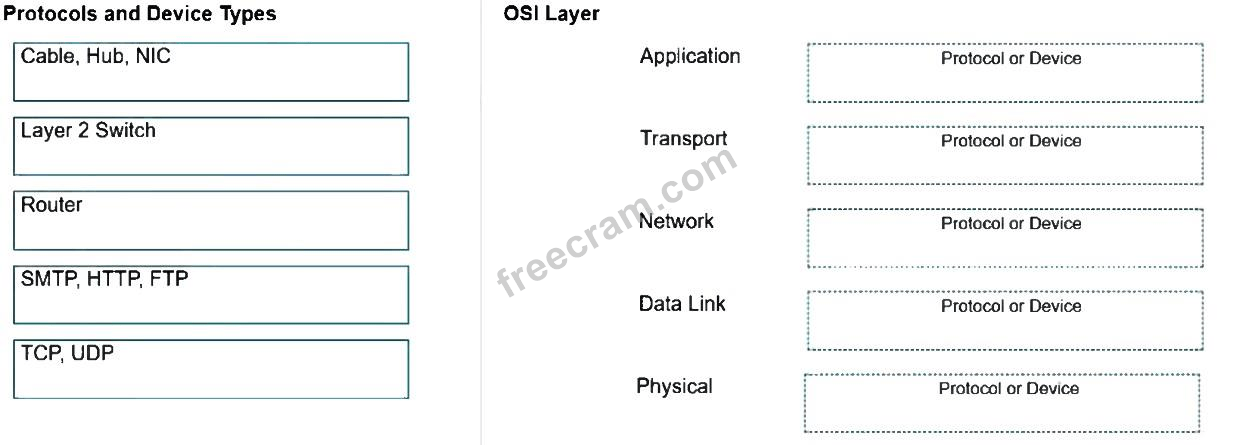
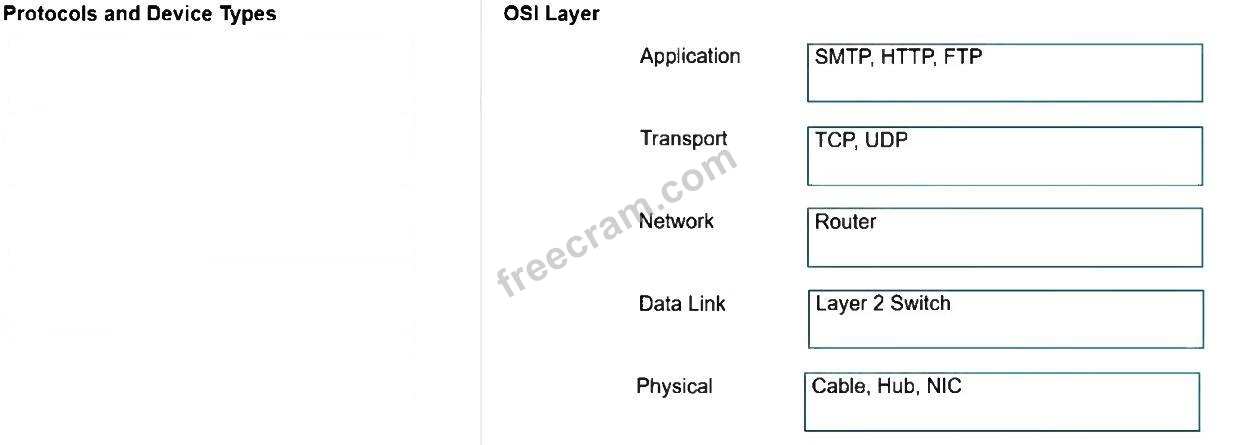
Physical gets the hardware, Data Link the switch, Network the router, Transport the segments, Application the services. One layer per function.
Key concepts in this question
- Physical (L1): cables, hubs, NICs — bits on the wire, no addressing decisions.
- Data Link (L2): switches forwarding by MAC within the LAN.
- Network (L3): routers forwarding by IP between networks.
- Transport (L4): TCP/UDP segmentation, ports, end-to-end recovery.
- Application (L7): user-facing services SMTP, HTTP, FTP.
Why this mapping is correct
Cables, hubs and NICs are pure physical-layer components moving bits. A Layer 2 switch forwards Ethernet frames inside one broadcast domain. A router forwards packets across networks at L3. TCP and UDP provide L4 end-to-end transport services. SMTP, HTTP and FTP are application-layer protocols users directly consume.
Why the others are wrong
- Switch at Network confuses MAC forwarding with IP routing.
- Router at Data Link drops inter-network routing down to frame switching.
- TCP/UDP at Application mistakes transport plumbing for user services.
- Cables at Data Link attributes framing to passive media.
100-150 exam tip
Hardware bottom, switch L2, router L3, TCP/UDP L4, acronym services on top.
- Identify host portion only
- Separate network and host portions
- Encrypt IP traffic
- Assign MAC addresses
The short version
B — The mask draws the line between network and host bits. A host ANDs its address with the mask to find its network.
Key concepts in this question
- Subnet mask: a 32-bit value of contiguous 1s (network) followed by 0s (host).
- Network versus host portion: determines the subnet address, broadcast address, and usable range.
- Longest match: routers use the mask/prefix to pick the best route.
Why B is correct
Every IPv4 configuration pairs an address with a mask precisely so the device can separate the network portion from the host portion. That split tells the host whether a destination is local or remote (send via gateway) and defines the subnet's size and boundaries, which is the mask's primary enterprise purpose.
Why the others are wrong
- A. The mask identifies both portions, not the host portion alone.
- C. A subnet mask performs no encryption of traffic.
- D. MAC addresses are burned into NICs and resolved by ARP; masks do not assign them.
100-150 exam tip
See mask, think split: ones mean network, zeros mean host.
- Network
- Transport
- Session
- Data Link
The short version
D — The Data Link layer builds frames with MAC headers and an FCS trailer. The header carries addressing; the trailer carries error checking.
Key concepts in this question
- Data Link layer (L2): hop-to-hop framing on Ethernet.
- MAC header: source and destination hardware addresses for local delivery.
- FCS trailer: frame check sequence used by receivers to detect corruption.
Why D is correct
During encapsulation the Data Link layer wraps the network-layer packet in a frame: it prepends a header containing source/destination MAC addresses (plus EtherType) and appends a trailer holding the frame check sequence. The receiver recomputes the FCS to detect transmission errors, which matches the stem exactly.
Why the others are wrong
- A. Network layer adds logical (IP) addressing in the packet, not MAC headers or FCS trailers.
- B. Transport layer adds port numbers and reliability fields in segments, not MAC framing.
- C. Session layer manages sessions and dialogs, adding no MAC header or trailer.
100-150 exam tip
Header plus trailer together always means the Data Link frame with its FCS.
- Show running system information
- Select an interface to configure
- Enable a routing process
- Enter interface IP configuration subcommands
The short version
A — Show commands run directly in privileged EXEC. The graphic shows router1#.
Key concepts in this question
- Privileged EXEC: prompt hostname plus hash with no config suffix, entered via enable from user EXEC.
- Show family: show running-config, show version, show ip interface brief all execute at this level.
- Config modes: global config needs configure terminal first; interface subcommands need interface selection inside it.
Why A is correct
The exhibit prompt router1# is the signature of privileged EXEC: a hash terminator without any parenthesized config qualifier. Show running system information is a privileged EXEC command, so it runs directly at exactly the mode shown with no mode change.
Why the others are wrong
- B. Selecting an interface with interface <id> is a global-configuration command under Router(config)#, not EXEC.
- C. Enabling a routing process with router <protocol> is entered from global configuration, one level deeper.
- D. Interface IP subcommands such as ip address run under Router(config-if)# after selecting the interface.
100-150 exam tip
Hash with no brackets means privileged EXEC — show runs here, configure terminal leaves here.
- 2001:db8:0:16::1b:2000:56
- 2001:db8::16::1b:2000:56
- 2001:db8:16::1b:2:56
- 2001:db8::16::1b:2:56
The short version
A — 2001:db8:0:16::1b:2000:56 is the most compressed valid form. Leading zeros are stripped and one double colon covers the single zero group.
Key concepts in this question
- Leading-zero suppression: 0db8 becomes db8, 0016 becomes 16, 0056 becomes 56.
- Double colon: :: may replace one contiguous run of all-zero groups, usable only once.
- Validity: two :: sequences in one address is illegal.
Why A is correct
Strip leading zeros in each hextet: 2001:db8:0:16:0:1b:2000:56. The only all-zero runs are two isolated single groups (the third and fifth), so :: can replace just one of them; the banked key keeps the first 0 and compresses the second (2001:db8:0:16::1b:2000:56). Groups 2000 and 0056 keep significant digits, so they stay 2000 and 56.
Why the others are wrong
- B. Uses :: twice, which is forbidden and ambiguous.
- C. Drops the real 0 group and corrupts 2000 into 2, changing the address value.
- D. Uses :: twice and also corrupts 2000 into 2.
100-150 exam tip
Compress zeros once only: strip leading zeros everywhere, then use a single ::.
- Coaxial
- Fiber optic
- Twisted pair
- Serial
The short version
C — Twisted pair is the twisted-pair Ethernet cable. The name answers the question.
Key concepts in this question
- Twisted pair: pairs of copper conductors twisted to cancel electromagnetic interference, terminated in RJ-45 for Ethernet.
- Common Ethernet media: Cat5e/Cat6 twisted pair dominates enterprise access-layer wiring.
Why C is correct
The stem describes twisted pairs reducing interference for Ethernet — that is the definition of twisted-pair cabling (Cat5e/6/6a). It is the standard enterprise Ethernet medium.
Why the others are wrong
- A. Coaxial uses a single shielded conductor (legacy bus/BNC, broadband drops), not twisted pairs.
- B. Fiber optic uses light in glass, immune to EMI but pair-less and connector-different (LC/SC).
- D. Serial covers WAN links (DB-60/smart-serial), not twisted-pair Ethernet.
100-150 exam tip
Twisted pairs in the stem means twisted pair in the answer.
Want the full bank of 44 questions for Cisco Certified Support Technician (CCST) Networking? See all practice exams.